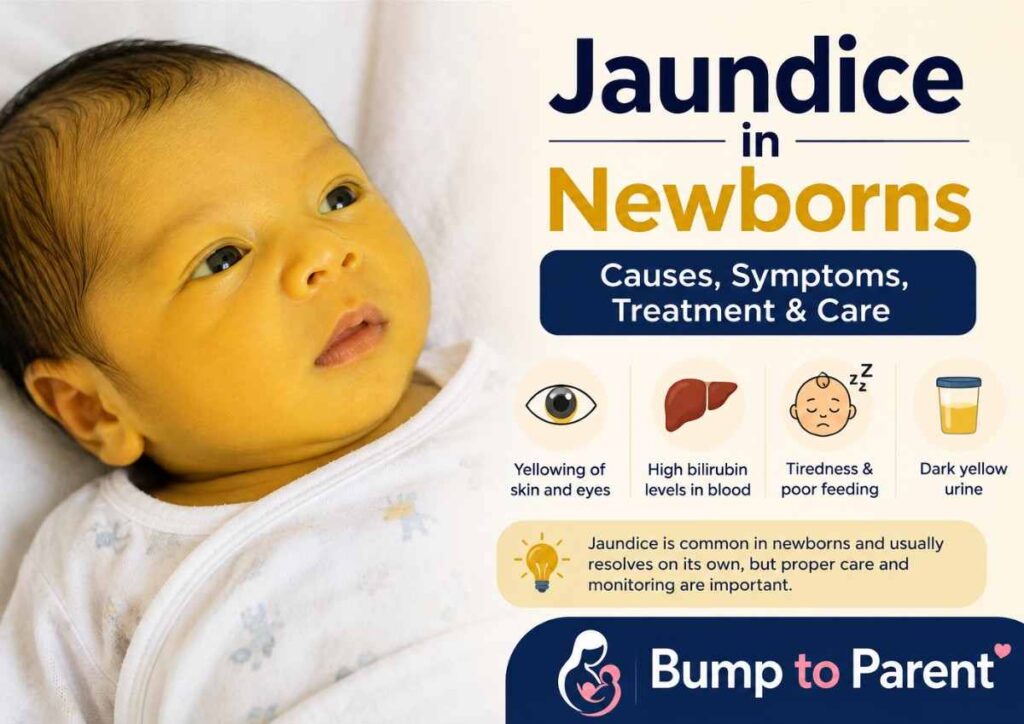

Seeing a newborn baby develop yellow-looking skin or yellow eyes can be frightening for new parents. The good news is that jaundice in newborns is very common and is usually temporary. It happens because a baby’s body has more bilirubin than the immature liver can process and remove efficiently.
In most healthy newborns, jaundice appears during the first few days after birth and gradually disappears as the baby’s liver becomes better at handling bilirubin. However, jaundice should never simply be ignored. In some babies, bilirubin can rise to levels that require medical treatment, and very severe untreated jaundice can cause serious neurological complications.
Understanding what newborn jaundice looks like, why it happens, how doctors check bilirubin levels, and when to seek medical help can make this common newborn condition much less stressful.
What Is Jaundice in Newborns?
Newborn jaundice, also called neonatal jaundice, is yellowing of a baby’s skin and the whites of the eyes caused by an increased level of bilirubin in the blood.
Bilirubin is produced naturally when old red blood cells are broken down. Normally, the liver processes bilirubin and helps the body eliminate it through stool. A newborn’s liver is still developing, so it may not remove bilirubin as efficiently during the first days of life.
Newborns also produce relatively large amounts of bilirubin because they have a higher number of red blood cells and those cells have a shorter lifespan than in adults.
For this reason, a mild yellow color during the first few days is often part of the normal transition after birth.
How Common Is Newborn Jaundice?
Newborn jaundice is extremely common. Around 60% of full-term babies and 80% of premature babies may develop neonatal jaundice.
Most cases are mild and resolve without specific treatment. However, healthcare professionals monitor jaundice because a small number of babies can develop unusually high bilirubin levels.
The important point for parents is that jaundice is common, but severe jaundice is not something to manage without medical guidance.
What Causes Jaundice in Newborns?
1. Immature Liver
The most common reason is that a newborn’s liver is not yet fully mature. It needs time to become efficient at processing and removing bilirubin.
2. Normal Breakdown of Red Blood Cells
Babies naturally break down red blood cells after birth. This produces bilirubin, and newborns can produce more bilirubin than their developing liver can quickly eliminate.
3. Feeding Difficulties
Babies who are not feeding effectively may receive less milk and may have fewer bowel movements. This can contribute to bilirubin remaining in the body for longer. Breastfeeding itself is not the problem; getting adequate milk and feeding frequently are important.
4. Blood Group Incompatibility
Sometimes the mother’s blood type and the baby’s blood type can contribute to increased breakdown of the baby’s red blood cells. Conditions involving Rh or ABO incompatibility can cause bilirubin to rise more quickly.
5. Premature Birth
Premature babies have less mature livers and are more likely to develop jaundice. They may also have additional feeding difficulties that can affect bilirubin elimination.
6. Certain Medical Conditions
Less commonly, jaundice may be associated with infection, red blood cell disorders, enzyme deficiencies such as G6PD deficiency, or problems involving the liver or bile ducts.
When Does Jaundice Usually Start?
Typical newborn jaundice often becomes noticeable around the second or third day after birth. It may become most noticeable over the following few days before gradually improving.
Jaundice that appears during the first 24 hours of life is different. It can indicate a condition causing bilirubin to rise rapidly and requires prompt medical assessment.
Signs and Symptoms of Newborn Jaundice
The main sign is yellow discoloration.
Parents may notice:
- Yellow skin, especially on the face and forehead
- Yellowing that spreads toward the chest, abdomen, arms, or legs
- Yellow-looking whites of the eyes
- Yellow color inside the mouth or under the tongue
- Increased sleepiness in more concerning cases
- Poor feeding in babies with significant jaundice
Yellowing can be harder to recognize on brown or black skin. Looking at the whites of the eyes and inside the mouth in good natural light may make changes easier to notice.
Parents should not rely only on how yellow their baby looks to determine whether jaundice is mild or severe. Bilirubin levels need to be assessed by a healthcare professional when indicated.
How Is Newborn Jaundice Diagnosed?
A healthcare professional may assess your baby’s skin and eyes and consider the baby’s age, gestational age, feeding, and other risk factors.
Bilirubin can be measured using:
1. Transcutaneous Bilirubin Test
A small handheld device can estimate bilirubin through the baby’s skin. It is painless and can provide a quick assessment.
2. Blood Bilirubin Test
A blood test provides a bilirubin measurement and may be required to confirm or further evaluate the level.
The bilirubin number is not interpreted in isolation. Doctors consider the baby’s age in hours, gestational age, bilirubin level, and other risk factors when deciding whether monitoring or treatment is needed. The American Academy of Pediatrics recommends appropriate bilirubin measurement and follow-up because identifying babies at risk of severe hyperbilirubinemia is important.
Types of Newborn Jaundice
1. Physiological Jaundice
This is the most common type. It occurs because the newborn’s liver needs time to mature and become more efficient at processing bilirubin.
2. Breastfeeding-Associated Jaundice
When a newborn is not taking enough milk, reduced feeding can contribute to increased bilirubin levels. This may happen because of difficulty latching, poor milk transfer, excessive sleepiness, or other feeding challenges.
The solution is usually feeding support rather than stopping breastfeeding. Healthcare professionals may help parents improve feeding and may recommend additional feeding when medically appropriate.
3. Breast Milk Jaundice
Some healthy breastfed babies continue to have mild jaundice for longer than the first couple of weeks. Breast milk jaundice is generally harmless, but prolonged jaundice still deserves medical assessment to make sure other causes have been excluded.
4. Pathological Jaundice
This refers to jaundice caused by an underlying medical problem, such as excessive red blood cell breakdown, infection, or liver or bile duct disease. It may appear unusually early, rise rapidly, become severe, or persist longer than expected.
How Long Does Newborn Jaundice Last?
For many babies, jaundice improves within about two weeks. Some breastfed babies may remain mildly jaundiced for longer.
If jaundice continues beyond the expected period, your baby’s pediatrician should evaluate it. Persistent jaundice can sometimes be associated with conditions involving the liver or bile flow.
Pay particular attention to the baby’s stool and urine color. Pale, chalky, or very light stools and dark urine can be warning signs that require medical evaluation.
Treatment for Jaundice in Newborns
Most newborns with mild jaundice do not need specific treatment. The baby’s bilirubin level and overall condition determine whether treatment is necessary.
1. Frequent Feeding
Adequate feeding helps babies maintain hydration and pass bilirubin through their stools. Breastfed newborns are commonly encouraged to feed frequently, often around 8 to 12 times a day, depending on individual circumstances and professional advice.
If your baby is difficult to wake for feeds or is not feeding effectively, contact your healthcare professional rather than simply waiting for the jaundice to disappear.
2. Phototherapy
Phototherapy is the most common treatment when bilirubin becomes high enough to require treatment.
The baby is placed under specially designed lights that help transform bilirubin into forms the body can eliminate more easily. The baby’s eyes are protected during treatment, and bilirubin levels are monitored.
Phototherapy is generally safe and highly effective when used appropriately.
3. Exchange Transfusion
In extremely severe cases, an exchange transfusion may be necessary. This treatment rapidly lowers bilirubin by replacing some of the baby’s blood with donor blood.
This is uncommon and is reserved for situations where bilirubin reaches very high levels or does not respond adequately to other treatment.
What Is the Normal Bilirubin Level in a Newborn?
There is no single bilirubin number that is considered “normal” or “safe” for every newborn.
Treatment decisions depend on factors such as:
- The baby’s age in hours
- Whether the baby was born prematurely
- The total bilirubin level
- How quickly bilirubin is increasing
- Whether there are additional medical risk factors
This is why parents should avoid comparing their baby’s bilirubin number with another baby’s number. Two babies with the same bilirubin result may receive different recommendations because their ages or medical circumstances are different.
Newborn Baby Jaundice Level Chart
There is no single bilirubin level that is considered safe or dangerous for every newborn. Doctors interpret bilirubin according to the baby’s age in hours, gestational age, and risk factors. The AAP recommends hour-specific treatment thresholds rather than one universal cutoff.
| Baby’s Age | Bilirubin Level | General Meaning |
|---|---|---|
| First 24 hours | Any visible jaundice | Needs prompt medical assessment |
| 24–48 hours | Below ~10 mg/dL | Often monitored depending on age and risk factors |
| 24–48 hours | ~10–15 mg/dL | May require closer monitoring/testing |
| 24–48 hours | ≥15 mg/dL | Needs medical assessment; treatment may be considered depending on age and gestation |
| 48–72 hours | Below ~12 mg/dL | Often monitored if baby is otherwise well |
| 48–72 hours | ~12–18 mg/dL | Requires interpretation against the baby’s treatment threshold |
| 48–72 hours | ≥18 mg/dL | Needs prompt medical assessment |
| After 72 hours | ~15–20 mg/dL | Requires assessment against the appropriate treatment chart |
| Any age | ≥20 mg/dL | Urgent medical evaluation is needed |
| Any age | ≥25 mg/dL | Medical emergency; intensive treatment may be required |
Important: The ranges above are not treatment thresholds and should not be used by parents to decide whether a baby needs phototherapy. Actual treatment thresholds vary with gestational age and neurotoxicity risk factors. The AAP guideline uses separate curves for gestational ages and risk categories.
General Bilirubin Conversion Chart
| Bilirubin | Approx. µmol/L |
|---|---|
| 5 mg/dL | 86 µmol/L |
| 10 mg/dL | 171 µmol/L |
| 12 mg/dL | 205 µmol/L |
| 15 mg/dL | 257 µmol/L |
| 18 mg/dL | 308 µmol/L |
| 20 mg/dL | 342 µmol/L |
| 25 mg/dL | 428 µmol/L |
When Should Parents Be Concerned?
- Jaundice appearing within the first 24 hours: This is not typical physiological jaundice and requires prompt evaluation.
- Very high bilirubin: A bilirubin level of 25 mg/dL (428 µmol/L) or higher is considered a medical emergency in the AAP guidance and requires immediate hospital management.
- Poor feeding or unusual sleepiness: A baby who is difficult to wake, feeding poorly, unusually floppy or stiff, or developing abnormal movements needs urgent medical attention.
Remember: A bilirubin number should always be interpreted using the baby’s exact age in hours, gestational age, and clinical risk factors. Even a level that looks “normal” on a general chart can require treatment in a particular newborn.
Can You Treat Newborn Jaundice at Home?
Mild jaundice may simply require observation, regular feeding, and scheduled follow-up. However, parents should not attempt to treat significant jaundice on their own.
Do not place a jaundiced newborn in direct sunlight as a substitute for medical phototherapy. Medical phototherapy uses controlled light at specific wavelengths and is administered according to bilirubin levels and the baby’s clinical condition.
If your baby’s healthcare provider has recommended follow-up bilirubin testing, do not skip it simply because your baby’s skin appears less yellow.
Feeding a Baby With Jaundice
Parents often wonder whether they should continue breastfeeding. In most situations, breastfeeding should continue.
Offer feeds regularly and watch for signs that your baby is feeding effectively. If your baby is very sleepy, a healthcare professional may advise waking the baby for feeds.
If feeding is difficult, seek help from your pediatrician, midwife, lactation professional, or other qualified healthcare provider. In some circumstances, temporary supplementation may be recommended, but this should be individualized rather than started automatically.
Signs of Recovery From Jaundice in Newborns
As a newborn’s bilirubin level decreases, parents may notice several reassuring changes. However, appearance alone cannot confirm that bilirubin has returned to a safe level; follow-up testing may still be needed.
- Yellow Skin Starts Fading: The yellow color gradually becomes less noticeable, often beginning around the face and moving toward the body.
- Whites of the Eyes Look Less Yellow: Yellowing of the eyes gradually returns toward its normal appearance.
- Baby Feeds Better: The baby becomes more interested in feeding and feeds more effectively.
- Baby Is More Alert: The newborn becomes easier to wake for feeds and has normal periods of alertness.
- Wet Diapers Increase: Regular wet diapers suggest that the baby is receiving adequate fluids and feeding well.
- Stools Become More Frequent: Regular bowel movements help the body eliminate bilirubin.
- Normal Weight Gain Resumes: Once feeding is well established, the baby should gradually regain and then gain weight as expected.
- Baby Becomes More Active: Normal movements and activity return as significant jaundice improves.
- Bilirubin Level Falls: A follow-up bilirubin measurement showing a decrease is the most reliable evidence that jaundice is improving.
- No New Symptoms Appear: The baby remains comfortable, feeds normally, and does not develop increasing sleepiness, abnormal movements, or other concerning symptoms.
How Long Does Jaundice Last in a Newborn?
Mild jaundice usually improves within about 1–2 weeks. Some breastfed babies may have mild jaundice for longer, but persistent jaundice should be evaluated by a doctor.
When Is Newborn Jaundice an Emergency?
Seek urgent medical attention if a newborn with jaundice:
- Develops yellowing during the first 24 hours of life
- Is extremely sleepy or difficult to wake
- Is not feeding
- Becomes unusually floppy or stiff
- Has jerking or twitching movements
- Has a fever or unusually low temperature
- Has very few or no wet diapers
- Has breathing difficulties
- Has jaundice that is rapidly worsening
- Has dark urine or very pale/chalky stools
These signs can indicate significant jaundice or another serious illness and should not be managed at home. (nhs.uk)
Can Severe Jaundice Harm a Baby?
Most newborn jaundice is harmless, but very high bilirubin levels can be dangerous.
In severe untreated cases, bilirubin can affect the brain and cause a rare but serious condition called kernicterus, which can result in permanent neurological problems. Fortunately, appropriate screening, monitoring, follow-up, and treatment make this complication uncommon.
This is why parents should take follow-up appointments and bilirubin testing seriously, even when their baby otherwise appears healthy.
What Parents Can Do at Home?
Parents can support their baby’s recovery by:
- Feed Regularly: Follow the feeding schedule recommended by your baby’s healthcare professional.
- Monitor Wet Diapers: Keep track of urine output because it provides useful information about feeding and hydration.
- Watch Stool Color: Ask a healthcare professional about pale or chalky stools.
- Check the Skin and Eyes: Look for increasing yellowing in good natural light.
- Attend Follow-Up Visits: Keep all recommended bilirubin and pediatric appointments.
- Watch Your Baby’s Behavior: Pay attention to alertness, feeding ability, movement, and breathing.
- Ask Questions: If you are unsure whether the jaundice is improving, contact your baby’s healthcare provider.
FAQ’s
How do I know if my baby has jaundice?
The most noticeable signs are yellow skin and yellowing of the whites of the eyes. On darker skin, check the eyes and inside the mouth in natural light.
Should I stop breastfeeding if my baby has jaundice?
Usually, no. Breastfeeding should generally continue, with frequent and effective feeds. If your baby is struggling to feed, seek professional feeding support.
Can newborn jaundice go away without treatment?
Yes, many mild cases disappear without treatment. However, higher bilirubin levels may require monitoring or phototherapy.
When is newborn jaundice dangerous?
Jaundice that appears within the first 24 hours, becomes rapidly worse, or occurs with poor feeding, extreme sleepiness, abnormal movements, fever, or breathing problems needs urgent medical assessment.
Can sunlight treat newborn jaundice?
Direct sunlight is not a safe substitute for medical phototherapy. If treatment is needed, follow your healthcare professional’s recommendation.
What bilirubin level is dangerous for a newborn?
There is no single dangerous level for every baby. Doctors interpret bilirubin according to the baby’s age in hours, gestational age, and other risk factors.
Does phototherapy cure newborn jaundice?
Phototherapy helps lower high bilirubin levels and is the standard treatment when bilirubin reaches the treatment threshold.
Can newborn jaundice cause brain damage?
Severe untreated hyperbilirubinemia can rarely cause brain injury, known as kernicterus. Early monitoring and appropriate treatment greatly reduce this risk.
Can newborns recover from jaundice?
Yes. Most newborns recover completely as bilirubin levels fall and the liver matures.
How can you prevent jaundice in newborns?
Feed your baby regularly and seek help if breastfeeding or feeding is difficult.
Why do C-section babies get jaundice?
C-sections do not directly cause jaundice, but feeding difficulties after birth may increase the risk.
What color is jaundice poop?
Normal newborn stool is usually yellow, green, or brown. White, pale, or chalky stool needs medical attention.
Does vitamin D help newborn jaundice?
No. Vitamin D is important for babies but does not treat jaundice.
Can a 2-week-old baby still have jaundice?
Yes. Mild jaundice can sometimes persist beyond two weeks, especially in breastfed babies, but it should be checked.
Can jaundice go away in 3 days?
It can start improving within a few days, but complete recovery often takes longer.
How much jaundice is normal in a newborn?
There is no single normal level. Doctors consider the baby’s bilirubin level, age, gestational age, and risk factors.
What is the last stage of jaundice?
There is no official “last stage.” Recovery means bilirubin falls and the baby’s yellowing gradually disappears.
Sources / References:
About the Author:
Written by: Kirti Solanki, Health Content Researcher
Kirti Solanki is a health content researcher who focuses on creating clear, reader-friendly health and wellness information based on reputable medical and public-health sources.
Disclaimer:
This article is for educational purposes only and does not replace medical advice, diagnosis, or treatment. Newborn jaundice can sometimes become serious. If you are concerned about your baby’s symptoms, bilirubin level, feeding, or behavior, contact a qualified pediatrician or healthcare professional promptly.
Also Read: