
One of the most common questions new parents ask is, “How much breast milk does my baby actually need?”
With formula feeding, parents can see exactly how many ounces their baby drinks. Breastfeeding is different. When your baby feeds directly from the breast, there is no bottle to measure, which can make it difficult to know whether your baby is getting enough milk.
The good news is that you usually do not need to measure every ounce. Babies are generally able to regulate how much they drink, and breastfeeding is designed to respond to their changing nutritional needs. Instead of focusing only on a number, parents should look at feeding frequency, swallowing, wet diapers, stools, satisfaction after feeds, and—most importantly—healthy growth.
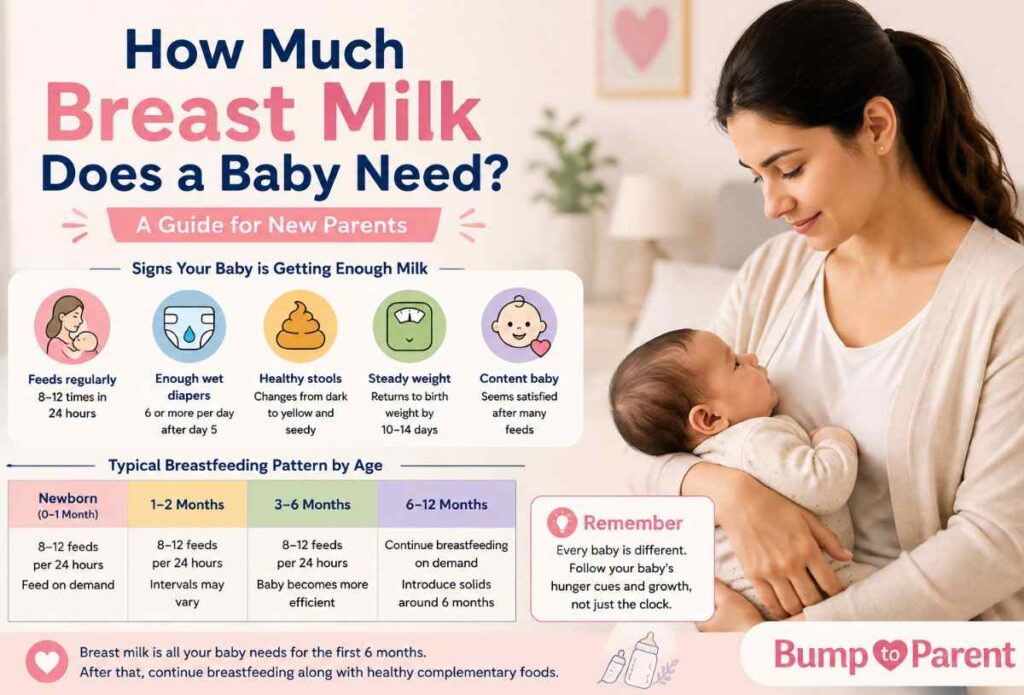
Most breastfed babies feed about 8 to 12 times in 24 hours during the early months, although some babies may feed more frequently, particularly during periods of cluster feeding.
So, how much breast milk does a baby need by age? Let’s break it down in a simple, practical way.
How Much Breast Milk Does a Baby Need Per Day?
There is no single amount that every breastfed baby needs at each feeding. Breast milk intake varies according to the baby’s age, size, growth pattern, appetite, and whether the baby is going through a growth spurt.
For babies breastfeeding directly, feeding on demand is generally more important than trying to reach a specific number of ounces.
During the first few days, a newborn’s stomach is very small, so frequent feeds of small amounts are normal. As the baby grows, the amount consumed at each feeding gradually increases, while the overall pattern may become somewhat more predictable.
Newborns may want to feed as often as every 1 to 3 hours during the first days. During the following weeks and months, most exclusively breastfed babies feed approximately every 2 to 4 hours, with some babies occasionally feeding as often as every hour.
Baby Breast Milk Feeding Chart by Age
| Baby’s Age | Approx. Breast Milk Per Feeding | Typical Feedings |
|---|---|---|
| First 24 hours | About 1 teaspoon (5 mL) | 8–12 times/day |
| Days 2–3 | About 0.5–1 oz (15–30 mL) | 8–12 times/day |
| Days 4–7 | About 1–2 oz (30–60 mL) | 8–12 times/day |
| 1 month | About 2–3 oz (60–90 mL) | 8–12 times/day |
| 2 months | About 3–4 oz (90–120 mL) | 7–9 times/day |
| 3–4 months | About 3–4 oz (90–120 mL) | 6–8 times/day |
| 5–6 months | About 4 oz (120 mL) | 5–7 times/day |
| 7–8 months | About 4 oz (120 mL) | Breast milk remains important alongside solids |
| 9–12 months | About 4–4.5 oz (120–135 mL) | Varies with solids and breastfeeding frequency |
Important: These are general estimates, especially useful when giving expressed breast milk in a bottle. A baby nursing directly at the breast may take a different amount at each feeding. The AAP recommends responsive feeding and using signs such as adequate wet diapers, satisfaction after feeds, and healthy weight gain to assess whether a breastfed baby is getting enough milk. By about 5–7 days, a well-fed newborn generally has at least 6 wet diapers per day and typically breastfeeds 8–12 times in 24 hours.
For babies 8–12 months, breast milk or formula still provides a substantial share of nutrition while complementary foods are introduced. The AAP gives roughly 24 oz (720 mL) per day as an approximate amount of breast milk or formula in a sample 8–12-month diet, although individual breastfed babies can vary considerably.
Breast Milk Intake by Baby’s Age
The following figures are useful as general guidance, but they should not be treated as strict targets.
| Baby’s Age | Typical Breastfeeding Pattern | What to Expect |
|---|---|---|
| First 24 hours | Frequent short feeds | Small amounts of colostrum are normal |
| Days 2–3 | About 8–12 feeds/day | Milk intake gradually increases |
| Days 4–7 | About 8–12 feeds/day | Mature milk production begins increasing |
| 1–4 weeks | About 8–12 feeds/day | Baby gradually takes more per feed |
| 1–3 months | Usually 8–12 feeds/day, sometimes fewer | Feeding intervals may gradually lengthen |
| 3–6 months | Feed according to hunger cues | Some babies become more efficient at breastfeeding |
| 6–12 months | Breast milk continues alongside complementary foods | Breastfeed according to baby’s cues |
These are broad patterns rather than rules. Some healthy babies feed more often, while others take longer, more efficient feeds.
Most breastfed infants take around 1 ounce per feeding during the first few weeks, with intake gradually increasing over time. However, direct breastfeeding makes precise measurement difficult and unnecessary in most situations.
How Much Milk Does a Newborn Need?
The first few days can be confusing because breast milk production does not immediately look like the larger volumes parents may expect.
In the beginning, the breasts produce colostrum, a thick, yellowish first milk. Colostrum is produced in relatively small quantities, but it is concentrated and provides important nutrients and immune-related components.
Newborns generally receive the nutrition they need from colostrum during the first days while milk production gradually increases.
Your newborn may want to breastfeed frequently, sometimes every 1 to 3 hours. Frequent feeding is not necessarily a sign that you do not have enough milk. It is also part of the process that stimulates milk production.
How Much Breast Milk Does a 1-Month-Old Need?
By around one month, babies generally take more milk per feeding than they did during the newborn period.
However, breastfed babies do not necessarily follow the same feeding schedule as formula-fed babies. A breastfed baby may nurse frequently throughout the day and have periods of cluster feeding.
The breastfed infants generally increase their intake gradually during the first months, rather than suddenly increasing to large bottle-sized amounts.
The most useful indicators are whether your baby is:
- Feeding regularly
- Swallowing during feeds
- Producing enough wet diapers
- Appearing satisfied after many feeds
- Gaining weight appropriately
How Much Breast Milk Does a 2-Month-Old Need?
At around two months, many babies continue breastfeeding approximately 8 to 12 times in 24 hours, although some may nurse less frequently as they become more efficient.
You may also notice that your baby’s feeding pattern changes from week to week. A baby who suddenly wants to nurse much more often may be experiencing a growth spurt or cluster feeding.
Rather than restricting feeds to a fixed schedule, respond to your baby’s hunger and fullness cues.
How Much Breast Milk Does a 3- to 6-Month-Old Need?
Between three and six months, breastfeeding patterns can become quite different from one baby to another.
Some babies feed quickly because they have become efficient at removing milk. Others continue to enjoy longer or more frequent nursing sessions.
The CDC recommends continuing to follow the baby’s hunger cues rather than relying on a rigid schedule.
It is also normal for feeding frequency to temporarily increase during growth spurts.
How Much Breast Milk Does a Baby Need After 6 Months?
At approximately six months, babies should begin receiving complementary foods while breastfeeding continues.
Breast milk remains an important source of nutrition, but breast milk alone is no longer intended to meet all of the baby’s evolving nutritional needs.
WHO recommends introducing appropriate, safe complementary foods at around six months while continuing breastfeeding up to two years or beyond.
Parents should still breastfeed according to the baby’s hunger cues. When starting solids, breastfeeding does not suddenly become unimportant.
The breast milk remains the most important source of nutrition even after complementary foods are introduced.
How Many Times Should a Breastfed Baby Eat?
Most breastfed babies feed approximately 8 to 12 times in 24 hours during the early months.
Some babies may feed every two to four hours, while others may want to nurse much more frequently at certain times.
Cluster feeding can be completely normal. During cluster feeding, a baby may want to breastfeed repeatedly over several hours.
Frequent breastfeeding does not automatically mean that your baby is not getting enough milk.
Instead, look at the complete picture, including your baby’s diaper output, swallowing, behavior, and weight gain.
How Can You Tell If Your Baby Is Getting Enough Breast Milk?
Because you cannot see how much milk your baby removes from the breast, other signs become especially important.
1. Your Baby Breastfeeds Regularly
A newborn typically breastfeeds around 8 to 12 times in 24 hours. Feeding patterns may change as the baby gets older.
2. You Can Hear or See Swallowing
Hearing or seeing your baby swallow during breastfeeding is a useful sign that milk is transferring.
3. Your Baby Has Enough Wet Diapers
By approximately 5 to 7 days of age, a well-fed breastfed newborn generally has six or more wet diapers per day.
At least six wet disposable diapers per day can be a reassuring sign that a baby is receiving enough breast milk.
4. Your Baby’s Stool Changes Normally
Newborn stools change during the first week from dark meconium to lighter greenish and then yellow stools.
These changes are useful clues that milk intake is increasing.
5. Your Baby Gains Weight
Weight gain is one of the most reliable indicators of adequate milk intake.
It is normal for newborns to lose some weight during the first days after birth. Breastfed babies should generally return to their birth weight by approximately 10 to 14 days.
6. Your Baby Appears Satisfied After Many Feeds
A baby who relaxes, releases the breast, and appears content after feeding is generally showing a sign of satiety.
However, wanting to breastfeed again soon does not necessarily mean the previous feeding was inadequate.
What Does a Hungry Baby Look Like?
Learning your baby’s early hunger cues can make breastfeeding easier.
Common hunger cues include:
- Turning the head toward the breast
- Opening the mouth
- Bringing hands toward the mouth
- Sucking on fingers or hands
- Making sucking sounds
- Becoming increasingly alert
- Moving the arms and legs
- Rooting toward the breast
Crying is usually a late hunger cue. Responding to earlier cues may make it easier to latch your baby before they become very upset.
What Are Signs That a Baby May Not Be Getting Enough Milk?
Parents should contact their baby’s healthcare professional if they are concerned about milk intake.
Potential warning signs include:
- Fewer wet diapers than expected
- Poor or inadequate weight gain
- Difficulty staying awake for feeds
- Weak or ineffective sucking
- Little or no audible swallowing
- Persistent difficulty latching
- Increasing jaundice
- Baby consistently appearing unsatisfied after feeds
- Very long or extremely frequent feeds without evidence of effective milk transfer
Seeking help from a healthcare professional or lactation support provider if you are concerned about your baby’s milk intake or your milk supply.
Does Frequent Breastfeeding Mean Low Milk Supply?
Not necessarily.
Newborns naturally feed frequently, and some babies cluster feed for several hours. Frequent breastfeeding can actually help establish and maintain milk production.
Breastfeeding or pumping sends a signal to the breasts to continue producing milk.
Other things can also affect how frequently a baby feeds, including growth spurts, developmental changes, comfort nursing, and the baby’s individual temperament.
Can You Measure How Much Breast Milk Your Baby Drinks?
If your baby breastfeeds directly, you generally cannot know the exact amount consumed during each feeding without specialized weighing methods.
This is one reason parents should not compare a breastfeeding session with a bottle measurement.
For example, a baby may breastfeed for 10 minutes during one session and 25 minutes during another. Both can potentially be normal.
If your baby is gaining weight appropriately and showing other signs of adequate intake, the exact number of ounces consumed at each feed is usually less important.
How Much Breast Milk Should You Pump?
Pumping output is not the same thing as your baby’s total milk intake or your body’s ability to produce enough milk.
A breast pump may remove milk differently from a baby, and the amount pumped can vary based on the time of day, pump settings, how recently you breastfed, and other factors.
If you are exclusively pumping or are separated from your baby, the CDC recommends pumping approximately as often as your baby normally drinks breast milk. This helps signal your body to maintain milk production.
If pumping produces less milk than expected, do not automatically assume that your baby is not receiving enough when breastfeeding directly.
What If the Baby Wants to Breastfeed Again Soon?
This is extremely common.
Babies do not always follow a predictable feeding timetable. One feeding may be followed by another relatively soon afterward.
Reasons a baby may want to nurse again include:
- Normal hunger
- Cluster feeding
- Growth spurts
- Comfort
- Sleepiness
- Increased need for closeness
- Changes in routine
If your baby is gaining weight and producing an appropriate number of wet diapers, frequent breastfeeding alone is usually not evidence of insufficient milk.
Should You Wake a Newborn to Feed?
Newborns generally need frequent feeding, including during the night.
Newborns may need to eat every 2 to 4 hours, and some sleepy babies may need to be awakened to feed.
Whether you should wake your baby depends on factors such as age, birth weight, weight gain, health, and your pediatrician’s recommendations.
Once a baby is consistently gaining weight and your healthcare professional confirms that nighttime waking is no longer necessary, feeding patterns may become more flexible.
Does Breast Milk Supply Increase as the Baby Grows?
Yes. Breast milk production changes as your baby grows. During the first days, the body produces colostrum. Milk volume then increases, and the breasts continue responding to the baby’s feeding pattern.
Frequent and effective milk removal—through breastfeeding or pumping—helps signal the body to continue making milk.
This is why feeding on demand is generally encouraged rather than strictly limiting breastfeeding sessions.
Does a Baby Need Water Before 6 Months?
For a healthy infant who is exclusively breastfed, additional water is generally not needed during the first six months, including in hot weather.
Breast milk provides the water a baby needs during this period and recommends exclusive breastfeeding without additional food or drink, including water.
If you are worried that your baby is thirsty, breastfeeding more frequently is generally preferable to giving water.
Always follow your healthcare professional’s advice if your baby has a medical condition requiring a different feeding plan.
When Should Solid Foods Be Introduced?
WHO and the CDC recommend exclusive breastfeeding for approximately the first six months, followed by the introduction of appropriate complementary foods while breastfeeding continues.
Starting solids does not mean you need to stop breastfeeding.
Instead, breast milk and complementary foods gradually work together to meet your growing baby’s nutritional needs.
Breastfeeding and Vitamin D
Breastfed babies may need vitamin D supplementation.
Babies who are exclusively breastfed or receive less than 32 ounces of infant formula per day need additional vitamin D beginning shortly after birth.
Because supplementation recommendations can vary depending on the baby and local guidance, parents should ask their pediatrician or healthcare professional about the appropriate vitamin D supplement and dose.
Tips for Making Breastfeeding Easier
1. Follow Your Baby’s Hunger Cues
Rather than watching the clock constantly, learn your baby’s early signs of hunger and offer the breast when those cues appear.
2. Focus on Effective Latching
A comfortable, effective latch helps the baby transfer milk and can reduce nipple pain.
3. Allow Frequent Feeding
Newborns often need frequent feeds. Avoid assuming that frequent nursing automatically means something is wrong.
4. Monitor Diapers
Wet diapers and stool patterns provide useful clues about milk intake, particularly during the first week.
5. Keep Track of Weight Gain
Regular pediatric visits help determine whether your baby is growing appropriately.
6. Ask for Help Early
If breastfeeding hurts, your baby repeatedly struggles to latch, or you are concerned about milk supply, seek assistance from a lactation consultant, pediatrician, nurse, or other qualified breastfeeding professional.
Breast Milk Intake: The Most Important Takeaway
There is no perfect number of ounces that every breastfed baby should drink each day.
A newborn may feed frequently and take very small amounts at each session. As the baby grows, milk intake per feeding generally increases, while feeding intervals may gradually become longer.
For most young breastfed babies, 8 to 12 breastfeeding sessions in 24 hours is a useful general benchmark.
However, your baby’s individual needs matter more than a rigid chart.
The best indicators of adequate intake include:
- Regular breastfeeding
- Effective sucking and swallowing
- Adequate wet diapers
- Appropriate stool changes
- A baby who generally appears satisfied after feeding
- Healthy weight gain
When these signs are present, there is usually less reason to worry about the exact number of ounces your baby consumes.
FAQ’s
Is it normal for my baby to breastfeed every hour?
Yes. Babies may breastfeed very frequently during cluster feeding, growth spurts, or periods when they need extra comfort.
How many wet diapers should a breastfed baby have?
After about day 5, a breastfed baby generally has at least 6 wet diapers per day when feeding adequately.
How much breast milk should I pump for my baby?
There is no single required pumping amount. Pumping output varies, and the amount you pump does not necessarily represent how much milk your baby can get directly from the breast.
Does frequent breastfeeding mean I have low milk supply?
Not necessarily. Frequent breastfeeding is common in newborns and can help stimulate milk production.
Can I give my breastfed baby water?
Healthy exclusively breastfed babies generally do not need additional water during the first six months because breast milk provides their fluid needs.
When should I introduce solid foods?
Complementary foods are generally introduced at around 6 months, while breastfeeding continues.
How long should I breastfeed my baby?
WHO recommends exclusive breastfeeding for about the first six months, followed by complementary foods while continuing breastfeeding up to two years or beyond, according to the needs of the parent and child.
How often should a newborn breastfeed?
Most newborns breastfeed around 8 to 12 times in 24 hours, although some may feed more frequently.
Does breast milk provide enough water for a newborn?
Yes, for healthy exclusively breastfed babies, breast milk provides the necessary fluids during the first six months. WHO recommends not giving additional water during this period.
When should I worry that my baby is not getting enough milk?
Speak with your baby’s healthcare professional if your baby has unusually few wet diapers, poor weight gain, difficulty feeding, weak sucking, persistent latch problems, increasing jaundice, or other concerning symptoms.
What is the 3-3-3 rule for breast milk?
The 3-3-3 rule is an informal storage guideline, not a universal official recommendation. Always follow current safe-storage guidance.
Does cold breast milk upset a baby’s stomach?
No. Cold breast milk is generally safe and does not usually upset a baby’s stomach.
What happens to breast milk after 4 hours?
Freshly expressed milk can generally stay at room temperature for up to 4 hours. After that, it should be refrigerated or discarded.
At what age is breast milk most beneficial?
Breast milk is beneficial from birth, with exclusive breastfeeding generally recommended for about the first 6 months.
How fast do breasts refill with milk?
Milk is produced continuously. Regular breastfeeding or pumping helps maintain and increase supply.
Does drinking more water increase milk supply?
Adequate hydration is important, but drinking extra water does not usually increase milk supply.
Can breast milk suddenly dry up?
Milk supply can decrease suddenly due to factors such as reduced feeding, illness, hormonal changes, or certain medications.
How much milk does a newborn need at night?
Newborns typically feed 8–12 times in 24 hours, including during the night, although needs vary.
How much milk does a newborn need per feed?
Newborns take small amounts per feed initially, gradually increasing as they grow.
Final Thoughts
Knowing how much breast milk a baby needs can feel stressful, especially when there is no bottle to measure.
But breastfeeding is not meant to be a numbers-only process. Your baby’s behavior, feeding pattern, diapers, and growth provide much more useful information than trying to calculate every ounce.
During the early months, frequent breastfeeding is normal. As your baby grows, feeding patterns change. Some days your baby may seem constantly hungry, while on other days feeds may be shorter and less frequent.
If you are unsure whether your baby is getting enough breast milk, don’t rely solely on a feeding chart or pumping output. A healthcare professional can assess your baby’s weight, feeding technique, latch, and overall health and give you individualized guidance.
Most importantly, you do not have to figure it all out alone. Breastfeeding support from a pediatrician or qualified lactation professional can make a significant difference when questions or concerns arise.
Sources / References:
About the Author:
Kirti Solanki is a Health Content Researcher who creates reader-friendly health, pregnancy, newborn, parenting, and nutrition content. Her approach focuses on simplifying health information while referring to reliable medical and public-health sources.
Disclaimer:
This article is for educational purposes only and should not replace personalized medical advice. If you are concerned about your baby’s feeding, milk intake, weight gain, hydration, or health, consult your pediatrician or a qualified lactation professional.
Also Read: