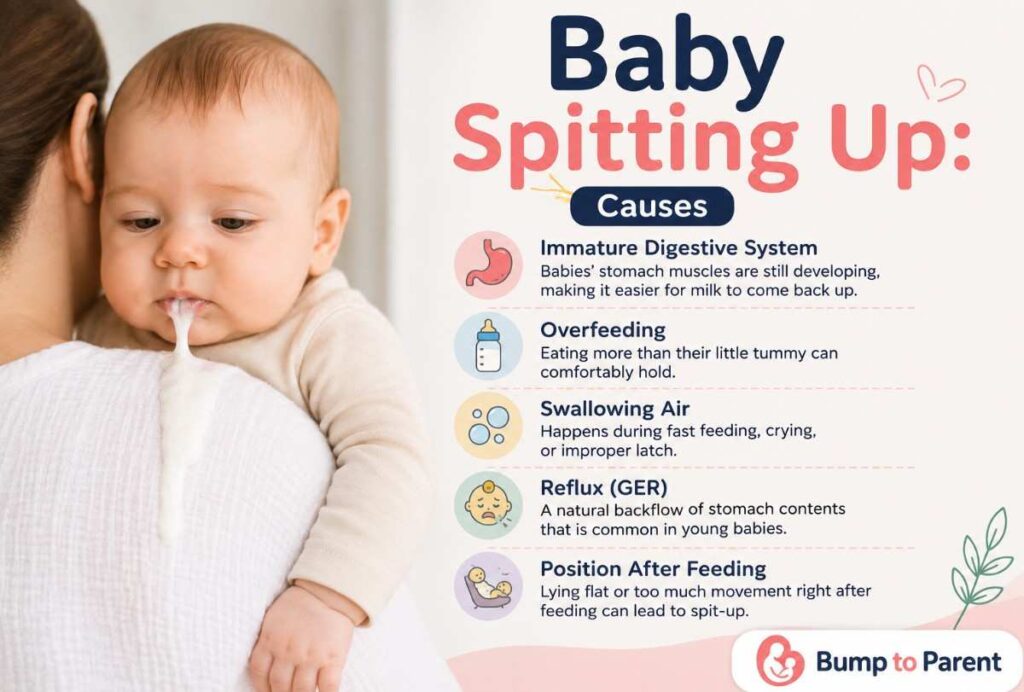

Seeing your baby spit up after a feeding can be unsettling, especially when it looks like they have brought up a large portion of their milk. The good news is that spitting up is extremely common in babies and is usually a normal part of early infancy.
Babies have small stomachs, developing digestive systems, and a valve between the stomach and esophagus that is still maturing. Because of this, milk can sometimes flow back up after feeding. Most babies who spit up are otherwise comfortable, feed normally, gain weight, and gradually outgrow the problem.
However, there is an important difference between ordinary spit-up and vomiting. Certain symptoms, such as forceful projectile vomiting, green or yellow vomit, blood, breathing difficulties, feeding refusal, or poor weight gain, require prompt medical attention.
This guide explains why babies spit up, how to reduce it, what normal spit-up looks like, and when you should contact your baby’s healthcare professional.
What Is Baby Spitting Up?
Baby spitting up is the effortless flow of milk or stomach contents back through the esophagus and out of the mouth. Doctors commonly call this gastroesophageal reflux (GER).
Unlike vomiting, spit-up usually happens without strong abdominal contractions or significant distress. A baby may simply dribble or gently bring up a small amount of milk, sometimes accompanied by a burp.
Spitting up can happen shortly after feeding or sometimes later when the baby’s position changes. It is particularly common during the first several months of life.
Is It Normal for a Baby to Spit Up?
Yes. Occasional or frequent small amounts of spit-up are generally normal in young babies, particularly when the baby is otherwise healthy and gaining weight.
The National Institute of Diabetes and Digestive and Kidney Diseases reports that about 70% to 85% of infants have daily regurgitation by around 2 months of age. Most infants improve naturally as their digestive system matures.
Normal reflux may become more noticeable around the first few months and usually becomes less frequent as babies develop better muscle control, spend more time upright, and mature physically. The American Academy of Pediatrics notes that reflux commonly peaks around 4 to 5 months and generally improves during infancy.
Why Do Babies Spit Up?
Several factors can contribute to baby spit-up.
1. Immature Digestive System
The muscle between the esophagus and stomach, called the lower esophageal sphincter, is still developing in young babies. When it relaxes while the stomach is full, milk can move back toward the mouth.
2. Small Stomach Size
A baby’s stomach can hold only a limited amount of milk. If the stomach becomes too full, some milk may naturally come back up.
3. Swallowing Air
Babies can swallow air while breastfeeding or bottle-feeding. Extra air can make the stomach feel full and may bring some milk back up during burping.
4. Feeding Too Quickly
A baby who feeds very quickly may take in more milk or air than their stomach can comfortably handle.
5. Overfeeding
Offering more milk than the baby needs at one feeding can increase the likelihood of spit-up. Smaller, appropriately sized feeds may help some babies.
6. Movement After Feeding
Bouncing, vigorous play, tummy pressure, or quickly changing the baby’s position immediately after feeding may make spit-up more likely.
Baby Spit-Up vs. Vomiting: What’s the Difference?
Knowing the difference between spit-up and vomiting is important.
| Baby Spitting Up | Vomiting |
|---|---|
| Usually gentle or effortless | Usually forceful |
| Often small amounts | May involve a larger amount |
| Often happens around feeding | Can occur independently of feeding |
| Baby usually remains comfortable | Baby may appear uncomfortable or distressed |
| Milk may simply dribble from the mouth | Contents may be expelled forcefully |
| Usually does not affect normal growth | Repeated vomiting can lead to dehydration or poor weight gain |
The American Academy of Pediatrics describes spit-up as an easy flow of stomach contents, while vomiting involves stronger contractions and forceful expulsion. If your baby repeatedly has forceful or projectile vomiting, especially after feeds, contact a healthcare professional promptly.
What Does Normal Baby Spit-Up Look Like?
Normal spit-up may look different depending on how long it has been since the baby fed.
It may appear:
- White or milky
- Slightly curdled
- Thin and watery
- Mixed with saliva
- A small amount of recently consumed breast milk or formula
Milk can look curdled because it has mixed with stomach contents. The appearance alone does not necessarily mean something is wrong.
More important than the appearance is how your baby behaves, feeds, breathes, urinates, and grows.
A baby who spits up but remains alert, feeds well, has regular wet diapers, and gains weight is generally less concerning than a baby who is repeatedly vomiting and becoming lethargic or refusing feeds.
How Much Spit-Up Is Too Much?
It can be difficult for parents to judge the amount of spit-up because a small quantity of milk can spread across clothing, blankets, or burp cloths and look much larger than it actually is.
Babies often spit up only one or two mouthfuls, even when the stain makes it appear like much more.
Rather than focusing only on the amount, pay attention to your baby’s overall health.
Signs that are reassuring include:
- Normal feeding
- Regular wet diapers
- Good alertness
- Normal activity
- Steady weight gain
- No breathing problems
- No persistent distress
If you are unsure whether your baby’s spit-up is excessive, your pediatrician can assess feeding patterns and growth.
15 Ways to Help Reduce Baby Spitting Up
1. Avoid Overfeeding
Giving your baby more milk than their stomach can comfortably hold may increase spit-up. Follow age-appropriate feeding guidance from your baby’s healthcare professional.
2. Offer Smaller, More Frequent Feeds When Appropriate
For some babies with frequent reflux, smaller feeds given more often may reduce the amount coming back up. Discuss feeding changes with your baby’s healthcare professional, particularly for newborns.
3. Burp During and After Feeding
Regular burping can help release swallowed air and may reduce discomfort associated with a full, gas-filled stomach.
4. Keep Feeding Calm
Try to feed your baby in a calm environment and avoid rushing feeds.
5. Check Bottle Feeding Technique
If bottle-feeding, make sure the nipple flow is appropriate and that your baby is not struggling to keep up with milk flow.
6. Check Breastfeeding Position
A comfortable, well-supported breastfeeding position can help your baby latch effectively and may reduce excessive air swallowing.
7. Keep Your Baby Upright After Feeding
Holding your baby upright for around 20 to 30 minutes after feeding may help reduce reflux symptoms.
8. Avoid Vigorous Activity After Feeding
Try to avoid bouncing, active play, or unnecessary movement immediately after your baby eats.
9. Avoid Tight Pressure Around the Stomach
Very tight clothing, diapers, or positions that compress the abdomen may make reflux more noticeable.
10. Feed Before Your Baby Becomes Extremely Hungry
A very hungry baby may gulp milk quickly and swallow more air. Feeding at appropriate intervals can sometimes help.
11. Watch for Feeding Cues
Rather than automatically encouraging a baby to finish a bottle, pay attention to signs that they are full.
12. Keep the Baby Supervised While Upright
If you hold your baby upright after feeding, remain awake and attentive. Do not use an inclined sleep position as a substitute for supervised upright holding.
13. Always Follow Safe Sleep Guidance
Even babies who spit up or have reflux should be placed flat on their backs for sleep. Do not put a baby to sleep on their stomach or side to prevent spit-up.
14. Avoid Raising the Crib Mattress
Raising the head of a crib or bassinet is not recommended as a reflux treatment because it can create an unsafe sleeping position.
15. Discuss Persistent Problems With a Pediatrician
If simple feeding adjustments do not help or your baby appears uncomfortable, a healthcare professional can determine whether reflux, an allergy, feeding difficulty, or another condition could be involved.
Baby Spitting Up After Breastfeeding
Breastfed babies can spit up just like formula-fed babies.
Possible contributors include:
- Fast milk flow
- Swallowing excess air
- Feeding too quickly
- Taking a large volume during a feeding
- Normal infant reflux
If you notice frequent spit-up during breastfeeding, a lactation professional or pediatrician can assess your baby’s latch, feeding position, and feeding pattern.
Do not automatically eliminate foods from your diet because of ordinary spit-up. Dietary changes may sometimes be recommended when a healthcare professional suspects cow’s milk protein allergy or another specific problem.
Baby Spitting Up After Formula Feeding
Formula-fed babies can also experience normal reflux.
Check that:
- The formula is prepared exactly according to instructions.
- Your baby is not being encouraged to finish more than they need.
- The bottle nipple flow is appropriate.
- Your baby is positioned comfortably during feeding.
- Your baby is burped during and after feeding.
Do not dilute formula, thicken formula, or switch to a specialized formula without discussing it with your baby’s healthcare professional.
Silent Reflux in Babies
Some babies may have reflux without obvious milk coming out of their mouths. This is sometimes called silent reflux.
Possible signs can include swallowing or gulping after feeds, coughing, unsettled feeding, or apparent discomfort. However, these symptoms can have several causes and do not automatically mean that a baby has GERD.
A pediatrician should assess persistent symptoms rather than relying on the label “silent reflux.”
When Is Baby Spitting Up a Sign of GERD?
Normal gastroesophageal reflux and gastroesophageal reflux disease are not the same thing.
GER is common in infants and often improves naturally.
GERD occurs when reflux causes troublesome symptoms or complications. Possible concerns include feeding refusal, persistent irritability associated with feeding or regurgitation, poor weight gain, coughing, wheezing, or other complications.
Not every fussy baby has GERD, and symptoms can overlap with other infant conditions. A healthcare professional should make the diagnosis.
When Should You Call a Doctor?
Contact your baby’s healthcare professional if:
- Your baby is not gaining weight as expected.
- Your baby repeatedly refuses feeds.
- Spitting up is becoming significantly worse.
- Your baby appears persistently uncomfortable during or after feeds.
- Your baby has ongoing coughing or breathing problems.
- Your baby has fewer wet diapers than usual.
- Reflux begins for the first time after about 6 months of age.
- Spitting up continues beyond the expected period of improvement.
These signs do not necessarily mean something serious is wrong, but they deserve medical assessment.
When Is Baby Vomiting an Emergency?
Seek urgent medical care if your baby:
- Has repeated projectile or forceful vomiting.
- Vomits green or yellow fluid.
- Has blood in the vomit or material resembling coffee grounds.
- Has blood in the stool.
- Has significant breathing difficulty.
- Becomes unusually sleepy, weak, or difficult to wake.
- Shows signs of dehydration.
- Cannot keep feeds down.
Forceful vomiting in a young infant can sometimes indicate conditions that require prompt diagnosis and treatment.
Can You Prevent Baby Spitting Up Completely?
Usually, No. Spitting up is often related to normal development, so it may not be possible to stop it completely. The goal is generally to reduce unnecessary triggers while making sure the baby continues to feed and grow normally.
As the digestive system matures, most babies naturally spit up less frequently.
Does Spitting Up Mean My Baby Is Overfed?
Not necessarily. A baby may spit up because of normal reflux even when they are being fed appropriately. However, overfeeding can increase the amount of milk in the stomach and may make spit-up more frequent.
Look at the baby’s overall feeding pattern and growth rather than assuming that every episode means the baby has eaten too much.
Can Babies Choke on Spit-Up While Sleeping?
Parents often worry about this, but safe sleep remains important even for babies who have reflux.
Babies should be placed on their backs on a firm, flat sleep surface. Do not place them on their stomach, side, or on an inclined surface to prevent reflux.
If your baby has unusual choking episodes, breathing difficulties, blue or gray discoloration, or repeated pauses in breathing, seek immediate medical attention.
Do Babies Outgrow Spitting Up?
Most babies do.
Infant reflux generally becomes less frequent as the digestive system matures. NIDDK reports that symptoms commonly improve by 12 to 14 months, while the American Academy of Pediatrics notes that normal reflux generally improves during infancy.
The exact timeline differs from baby to baby.
Baby Spitting Up: Quick Parent Checklist
| Question | What to Look For |
|---|---|
| Is it gentle? | Small amounts flowing out without force are more consistent with spit-up. |
| Is baby comfortable? | A content baby is generally reassuring. |
| Is baby feeding normally? | Normal feeding is a positive sign. |
| Is baby gaining weight? | Appropriate growth is reassuring. |
| Is the vomit green or bloody? | Seek urgent medical advice. |
| Is vomiting projectile? | Contact a healthcare professional promptly. |
| Is baby having breathing problems? | Seek medical attention. |
| Are wet diapers normal? | Fewer wet diapers can indicate dehydration. |
FAQ’s
Is it normal for a baby to spit up after every feeding?
Small amounts of spit-up after many feeds can be normal, especially in young babies. If your baby is comfortable, feeding well, and gaining weight, it is usually not a concern.
Why does my baby spit up curdled milk?
Milk can look curdled after mixing with stomach acid. This is usually normal and does not necessarily mean your baby is sick.
When do babies stop spitting up?
Most babies gradually spit up less as their digestive system matures. Reflux often improves significantly during the first year.
Is baby spit-up the same as vomiting?
No. Spit-up usually flows gently from the mouth, while vomiting is more forceful and may cause visible discomfort.
Is projectile vomiting normal in babies?
Repeated projectile vomiting is not typical spit-up and should be discussed with a pediatrician promptly, particularly in young infants.
Should I stop breastfeeding if my baby spits up?
Usually not. Spitting up is common in breastfed babies and does not by itself mean breastfeeding should be stopped.
Should babies with reflux sleep on their stomach?
No. Babies should always be placed on their backs on a firm, flat sleep surface, even when they have reflux.
When should I worry about baby spit-up?
Seek medical advice if spit-up is accompanied by poor feeding, poor weight gain, dehydration, breathing problems, persistent distress, or repeated forceful vomiting.
Is green or bloody spit-up dangerous?
Green or bloody vomit is a warning sign and requires prompt medical evaluation.
Is spit-up the same as acid reflux?
Spitting up is commonly caused by gastroesophageal reflux, in which stomach contents move back into the esophagus. In infants, uncomplicated GER is usually considered a normal developmental process.
Should I put my baby on their stomach to prevent spit-up?
No. Babies should be placed on their backs for sleep, even when they have reflux.
Should you feed your baby again if they spit up a lot?
Usually, you don’t need to feed your baby again immediately. If your baby still shows hunger cues after settling, you can offer another feed. Avoid forcing extra milk.
Does spit-up count as a burp?
No. Spit-up means milk has come back up, while a burp is swallowed air being released from the stomach. A baby can spit up without actually burping.
Do I still need to burp my baby if she spit up?
Yes, gently. Spitting up doesn’t necessarily mean all the trapped air has been released. Hold your baby upright and gently burp her without vigorous patting.
Final Thought
Baby spitting up can look dramatic, but in most healthy infants it is a normal part of early development. A developing digestive system, small stomach, swallowed air, feeding patterns, and a still-maturing stomach valve can all contribute.
The most reassuring signs are a baby who feeds well, remains generally comfortable, has normal wet diapers, and gains weight appropriately.
At the same time, parents should not ignore warning signs. Forceful vomiting, green or bloody vomit, breathing difficulties, dehydration, feeding refusal, or poor weight gain warrant medical evaluation.
When in doubt, it is always appropriate to discuss your baby’s feeding and spit-up pattern with their pediatrician.
Sources / References:
- American Academy of Pediatrics
- National Institute of Diabetes and Digestive and Kidney Diseases – GER & GERD in Infants
- Mayo Clinic
- NHS – Reflux in Babies
- NIDDK
About the Author:
Written by: Kirti Solanki is a health content researcher who creates clear, reader-friendly articles on pregnancy, newborn care, parenting, nutrition, and general health. Her content is developed using information from reputable medical organizations and evidence-based health sources, with a focus on making complex health topics easier for parents and families to understand.
Disclaimer:
This article is for general education and does not replace professional medical advice. For concerning symptoms or questions about your baby’s health, feeding, or growth, consult a qualified pediatric healthcare professional.
Also Read: