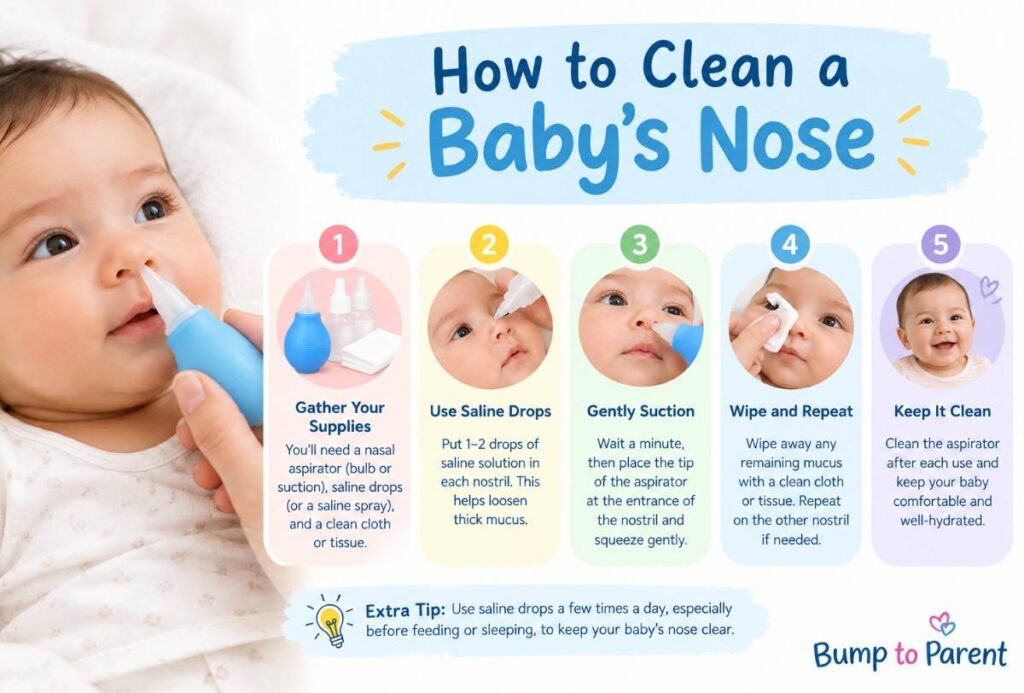

A baby’s tiny nose can become congested very easily. Even a small amount of dried mucus can make breathing, breastfeeding, bottle-feeding, and sleeping more difficult. Because babies cannot blow their own noses, parents and caregivers often need to help clear the nasal passages gently.
The good news is that cleaning a baby’s nose does not have to be complicated. In most situations, plain saline drops and gentle suction are enough to loosen and remove mucus. The key is to avoid inserting anything deeply into the nostrils or using unnecessary medicated products.
This guide explains how to clean a baby’s nose safely, what supplies you need, how to use saline drops and a bulb syringe, how often you can do it, common mistakes to avoid, and when nasal congestion requires medical attention.
Why Do Babies Get a Stuffy Nose?
Babies have very small nasal passages, so even a little mucus can make their nose sound blocked. Nasal congestion can occur with a common cold, viral infection, dry air, exposure to irritants, or normal mucus production.
A congested nose can be especially troublesome for young babies because they often breathe through their nose while feeding. Clearing excessive mucus may therefore make breastfeeding or bottle-feeding easier. The American Academy of Pediatrics recommends plain saline drops followed by gentle suction when a baby’s nose is blocked.
When Should You Clean Your Baby’s Nose?
You do not need to clean your baby’s nose simply because you notice a small amount of mucus. Nasal mucus is normal and helps protect the nasal passages.
Consider gently cleaning the nose when:
- Your baby’s nose is visibly blocked with mucus.
- Dried mucus is interfering with comfortable breathing.
- Your baby is having difficulty feeding because of nasal congestion.
- Congestion is making it difficult for your baby to settle or sleep.
- There is thick mucus around the nostril openings.
Cleaning the nose before a feeding can be particularly helpful when congestion is interfering with nursing or bottle-feeding.
What You Need to Clean a Baby’s Nose
You generally need only a few simple supplies:
- Plain saline nasal drops: Saline helps loosen thick or dried mucus so it can be removed more easily.
- Bulb syringe: A soft rubber suction bulb can gently remove loosened mucus from the nostril.
- Nasal aspirator: Some parents prefer a manual or electric nasal aspirator instead of a bulb syringe.
- Clean tissues or soft cloth: These can be used to wipe mucus from around the baby’s nose.
- Clean water and soap: These are useful for washing the suction device according to its manufacturer’s instructions.
The saline product should be plain saline without added medication unless your baby’s healthcare professional specifically recommends something else. The American Academy of Pediatrics advises against using nonprescription medicated nasal drops for infants.
How to Clean a Baby’s Nose Safely?
Step 1: Wash Your Hands
Before touching your baby’s nose, wash your hands thoroughly with soap and water.
This simple step helps reduce the transfer of germs to your baby’s face and nasal passages.
Step 2: Choose a Comfortable Position
Place your baby on their back on a secure, flat surface while you prepare to clean the nose.
Keep your movements calm and gentle. Babies often become uncomfortable when something comes near their face, so speaking softly and taking your time can make the process easier.
Never leave your baby unattended on a changing table, bed, or other elevated surface.
Step 3: Use Plain Saline Drops
If mucus is dry or sticky, saline can help loosen it.
Place the recommended amount of plain saline into the opening of one nostril at a time, following the product instructions or your pediatrician’s advice.
Use saline drops to loosen congestion before gentle suction.
Allow a short moment for the saline to soften the mucus.
You do not need to force the liquid deep into the nose.
Step 4: Prepare the Bulb Syringe
If you are using a bulb syringe, squeeze the bulb before placing the tip near the nostril.
This is important because releasing the bulb after it is gently positioned allows it to create suction and draw mucus outward. The AAP specifically recommends squeezing the bulb before placing it in the baby’s nostril.
Step 5: Gently Suction the Nostril
Place the soft tip gently at the opening of the nostril. Do not push it deeply into the nose.
Slowly release the bulb to create gentle suction.
Remove the bulb and empty the mucus.
Repeat on the other nostril if necessary.
The goal is to remove mucus, not to completely dry out the nasal passages.
Step 6: Wipe Around the Nose
Use a clean, soft cloth or tissue to gently wipe mucus from the skin around your baby’s nostrils.
If repeated wiping causes redness, be extra gentle and avoid rubbing the skin.
For stubborn mucus around the outside of the nose, a damp cotton swab can be used carefully around the nostril opening, but it should not be pushed inside the nasal passage.
Step 7: Clean the Suction Device
After use, clean the bulb syringe or nasal aspirator according to the manufacturer’s cleaning instructions.
Allow reusable equipment to dry completely before storing it.
Keeping the device clean is important because mucus and moisture can support the growth of germs.
How Often Can You Clean a Baby’s Nose?
There is no need to suction your baby’s nose repeatedly throughout the day when the nose is already clear.
Use saline and suction when congestion is interfering with breathing or feeding.
For infants, some pediatric guidance recommends limiting saline nose cleaning to around four times per day, with cleaning before feeding being a practical time when congestion is affecting feeding.
Frequent or forceful suction can irritate the delicate lining of the nose, so gentle and occasional cleaning is preferable to repeatedly trying to achieve a completely clear nose.
What Is the Best Time to Clean a Baby’s Nose?
A useful time to clean your baby’s nose is before breastfeeding or bottle-feeding if congestion is making feeding difficult.
Another practical time is before sleep if nasal congestion is preventing your baby from settling comfortably.
Saline may loosen mucus, while gentle suction can remove the loosened secretions.
However, cleaning the nose does not mean that a congested baby should be placed in an inclined sleeping position.
Should You Clean a Baby’s Nose Before Sleep?
You can gently clear significant congestion before sleep if it is bothering your baby.
However, after cleaning the nose, your baby should still sleep according to safe-sleep recommendations.
The American Academy of Pediatrics recommends that infants sleep flat on their backs on a firm, level sleep surface without pillows, loose blankets, positioners, or other soft objects. Raising or propping up the mattress to help a congested baby breathe is not considered safe.
Can You Use Saline Water to Clean a Baby’s Nose?
Yes. Plain saline is commonly used to loosen mucus in babies.
Commercial infant saline drops are a convenient option. If a homemade saline solution is being considered, safe water preparation is important. Pediatric guidance recommends sterile, distilled, or previously boiled water for homemade nasal solutions.
For very young babies, especially newborns, parents should consider asking their pediatrician about the appropriate saline product and technique before using a homemade preparation.
Can You Use a Bulb Syringe on a Newborn?
A bulb syringe can be used to gently remove mucus from a newborn’s nose when needed.
However, newborns have particularly delicate nasal passages, so the bulb should be used gently and the tip should remain near the nostril opening rather than being pushed deeply inside.
The saline drops followed by suction with a bulb syringe can help clear blocked nasal passages in newborns.
If your newborn appears to have difficulty breathing, is feeding poorly, or seems unusually sleepy or unwell, do not rely only on home nasal cleaning. Contact a healthcare professional promptly.
Bulb Syringe vs. Nasal Aspirator
Both bulb syringes and nasal aspirators are designed to remove mucus, but they work somewhat differently.
| Feature | Bulb Syringe | Nasal Aspirator |
|---|---|---|
| How it works | Creates suction when the bulb is released | Uses manual or mechanical suction |
| Easy to carry | Yes | Usually yes |
| Suitable for infants | Generally used gently | Some models are designed for infants |
| Cleaning | Must be cleaned thoroughly | Follow manufacturer’s cleaning instructions |
| Main purpose | Remove mucus | Remove mucus |
| Important safety point | Avoid deep insertion or forceful suction | Use gentle suction and follow product instructions |
The device matters less than the technique. Whichever device you use, the baby’s nasal tissue should be treated gently.
What Not to Do When Cleaning a Baby’s Nose
1. Do Not Insert Cotton Swabs Deep Into the Nose
Cotton swabs should not be pushed into a baby’s nostrils. They can irritate delicate tissue or push mucus farther inside.
If mucus is visible around the outside of the nostril, gently wipe the area instead.
2. Do Not Use Medicated Nasal Drops Without Medical Advice
Plain saline is different from medicated nasal drops.
Avoid giving a baby decongestant or medicated nasal products unless specifically recommended by a healthcare professional. The AAP advises using plain saline rather than nonprescription medicated nasal drops for infants.
3. Do Not Use Forceful Suction
More suction is not necessarily better.
Strong or repeated suction can irritate the nasal lining and make the experience uncomfortable for your baby.
Use gentle suction only when needed.
4. Do Not Try to Remove Every Bit of Mucus
A small amount of mucus inside the nose is normal.
The purpose of cleaning is to relieve significant blockage and remove excess or dried mucus, not to make the nose completely mucus-free.
5. Do Not Prop Up Your Baby to Treat Congestion
A common mistake is placing a pillow or rolled towel under a baby’s head or mattress.
Although this may seem like it would make breathing easier, inclined sleep surfaces can create an unsafe position. Babies should continue to sleep flat on their backs on a firm, level surface.
How to Help a Baby With a Stuffy Nose?
Nasal cleaning is only one part of caring for a congested baby.
- Use plain saline: Saline can loosen dried or sticky mucus and make gentle suction easier.
- Keep the baby hydrated: Regular breast milk or formula feeding helps maintain hydration, which is important during illness.
- Consider a cool-mist humidifier: A cool-mist humidifier may help moisten dry air, but it should be cleaned regularly according to the manufacturer’s instructions to reduce mold and bacterial growth.
- Avoid smoke exposure: Cigarette smoke and other irritants can worsen respiratory symptoms, so babies should not be exposed to tobacco smoke.
- Keep feeding in mind: If nasal congestion makes breastfeeding or bottle-feeding difficult, gently clearing the nose before feeding may help.
Can Steam Help a Baby’s Stuffy Nose?
Moist air may temporarily help loosen mucus. The AAP notes that sitting with a baby in a bathroom while a hot shower runs can provide moisture-rich air.
However, babies should never be placed directly under hot water or near a source of boiling water because of the risk of burns.
A cool-mist humidifier is another option when the air is dry.
When Should You Call a Doctor About a Baby’s Stuffy Nose?
Most mild nasal congestion can be managed with supportive care, but some symptoms require medical attention.
Contact your baby’s healthcare professional if:
- Your baby is having difficulty breathing.
- Breathing is much faster than usual.
- You can see the ribs pulling inward with each breath.
- Your baby is having significant difficulty feeding.
- Your baby is unusually sleepy, weak, or difficult to wake.
- Your baby’s symptoms are getting worse rather than better.
- Your baby has a fever, particularly if the baby is younger than 12 weeks.
- Your baby has persistent wheezing.
- You are worried that your baby is not getting enough fluids.
For severe breathing difficulty, bluish lips or face, or a baby who appears to be struggling for every breath, emergency medical care is needed.
Is a Stuffy Nose in a Newborn Always a Cold?
No. A newborn may have nasal congestion for several reasons, and congestion alone does not automatically mean the baby has a cold.
Because newborns have small nasal passages, relatively small amounts of mucus can sound noisy. Environmental irritants and viral infections can also cause congestion.
If a newborn has significant breathing or feeding problems, it is important to have the baby evaluated rather than assuming the problem is simply mucus.
How to Keep Your Baby Comfortable During Nose Cleaning
Nose cleaning can be stressful for both parents and babies. Your baby may cry, turn their head, or resist the suction device.
A few simple habits can make the process easier:
- Stay calm: Babies often respond to the caregiver’s tone and movements.
- Prepare everything first: Have saline, the suction device, and a clean cloth ready before starting.
- Work gently: Avoid rushing or forcing the device into the nose.
- Clean one nostril at a time: This makes the process easier to control.
- Stop if your baby becomes extremely distressed: Give your baby a short break and try again later if appropriate.
- Use suction only when needed: Saline alone may sometimes be enough to loosen mucus.
A Simple Baby Nose-Cleaning Routine
For parents who want a quick routine, the process can be remembered as:
- Wash: Wash your hands before touching your baby’s face.
- Soften: Use plain saline to loosen thick or dried mucus.
- Suction: Gently suction the nostril with a clean bulb syringe or appropriate nasal aspirator.
- Wipe: Clean mucus around the outside of the nose with a soft cloth.
- Clean: Wash the suction device according to the manufacturer’s instructions.
- Observe: Pay attention to your baby’s breathing, feeding, hydration, and overall behavior.
This simple approach is generally more appropriate than repeatedly trying to clear every trace of mucus.
FAQ’s
Should I clean my baby’s nose before feeding?
If nasal congestion makes feeding difficult, gently clearing the nose before breastfeeding or bottle-feeding may help your baby feed more comfortably.
Can I use a cotton bud to clean my baby’s nose?
Avoid inserting a cotton bud inside your baby’s nostril because it can irritate delicate nasal tissue or push mucus farther inside.
Is nasal suction safe for babies?
Gentle nasal suction can be useful for removing excess mucus, but excessive or forceful suction may irritate the inside of the nose.
Can I use an adult nasal spray for my baby?
No. Do not use adult or medicated nasal sprays for a baby unless specifically recommended by a healthcare professional.
How do I remove dried mucus from my baby’s nose?
Use plain saline to soften the dried mucus, then gently wipe the visible mucus around the nostril with a soft, clean cloth.
Can I clean my baby’s nose every day?
You can gently wipe the outside of your baby’s nose daily, but internal suction should generally be limited to times when congestion is causing discomfort or feeding problems.
What is the best way to clean a baby’s nose without a bulb syringe?
Plain saline drops followed by gently wiping loosened mucus around the nostril opening can help. A suitable baby nasal aspirator is another option.
Can I use a nasal aspirator for a newborn?
Some nasal aspirators are designed for newborns, but they should be used gently and according to the manufacturer’s instructions.
Why does my baby’s nose sound congested but there is no mucus?
Babies have very small nasal passages, so normal mucus or mild swelling can sometimes make their breathing sound congested even when visible mucus is absent.
Can nasal congestion make a baby stop feeding?
Severe nasal congestion can make breastfeeding or bottle-feeding more difficult because babies may struggle to breathe comfortably while feeding.
Should I put oil inside my baby’s nose?
Avoid putting oils or other home remedies inside a baby’s nostrils unless specifically recommended by a healthcare professional.
When is a baby’s stuffy nose an emergency?
Severe difficulty breathing, bluish lips or face, significant pauses in breathing, or a baby who appears to be struggling for every breath requires immediate medical attention.
Should my baby sleep with their head elevated when congested?
No. Congestion does not change safe-sleep recommendations. Babies should sleep on their backs on a firm, flat, level surface without pillows or other positioning devices.
What if my baby cannot breathe well because of a blocked nose?
Use plain saline and gentle suction if appropriate, but seek medical advice if breathing difficulty is significant or does not improve after clearing the nose. Severe breathing difficulty requires emergency medical attention.
Can nasal congestion make breastfeeding difficult?
Yes. Babies with blocked noses may have difficulty coordinating breathing and feeding. Gently clearing the nose before feeding can sometimes make feeding easier.
What is the safest way to clean a baby’s nose?
The safest approach is to use plain saline drops to loosen mucus and gently wipe or suction it with a clean baby bulb syringe or nasal aspirator without inserting anything deeply into the nostril.
How to remove hard boogers from a baby’s nose?
Soften hard boogers with a few drops of plain saline, wait briefly, and gently wipe away the loosened mucus from the nostril opening with a soft, clean cloth; do not pick or scrape inside the nose.
How to make a baby sneeze to clear the nose?
You should not deliberately trigger a baby’s sneeze by inserting anything into the nose. If mucus is irritating the nasal passages, the baby may naturally sneeze, while saline drops can help loosen congestion safely.
How to unblock a baby’s nose without an aspirator?
Use plain saline drops to loosen mucus, keep your baby well hydrated, and gently wipe away mucus around the nostrils with a soft cloth. A cool-mist humidifier may also help when the air is dry.
Can I use saline drops every day?
Plain saline is commonly used to loosen nasal mucus, but if your baby needs frequent nasal cleaning every day for an extended period, discuss the situation with your pediatrician.
Final Takeaway
Learning how to clean a baby’s nose is a useful skill for new parents. In most cases, the process is simple: wash your hands, loosen thick mucus with plain saline, use gentle suction when needed, and wipe away mucus around the outside of the nose.
The most important part is knowing when to stop home care and seek medical help. A baby who is struggling to breathe, feeding poorly, becoming unusually sleepy, or showing other concerning symptoms should be evaluated by a healthcare professional.
Nasal congestion can be uncomfortable, but gentle care and safe-sleep practices can help keep your baby more comfortable while you monitor their symptoms.
Sources / References:
Disclaimer:
This guide is for general educational purposes only and does not replace advice, diagnosis, or treatment from a qualified pediatrician or other healthcare professional.
Also Read:


Pingback: How to Clean a Baby’s Ears Safely: A Step-by-Step Guide
Pingback: How to Clean a Baby’s Eyes Safely: A Step-by-Step Guide
Pingback: How to Clean a Baby’s Tongue Safely: A Step-by-Step Guide