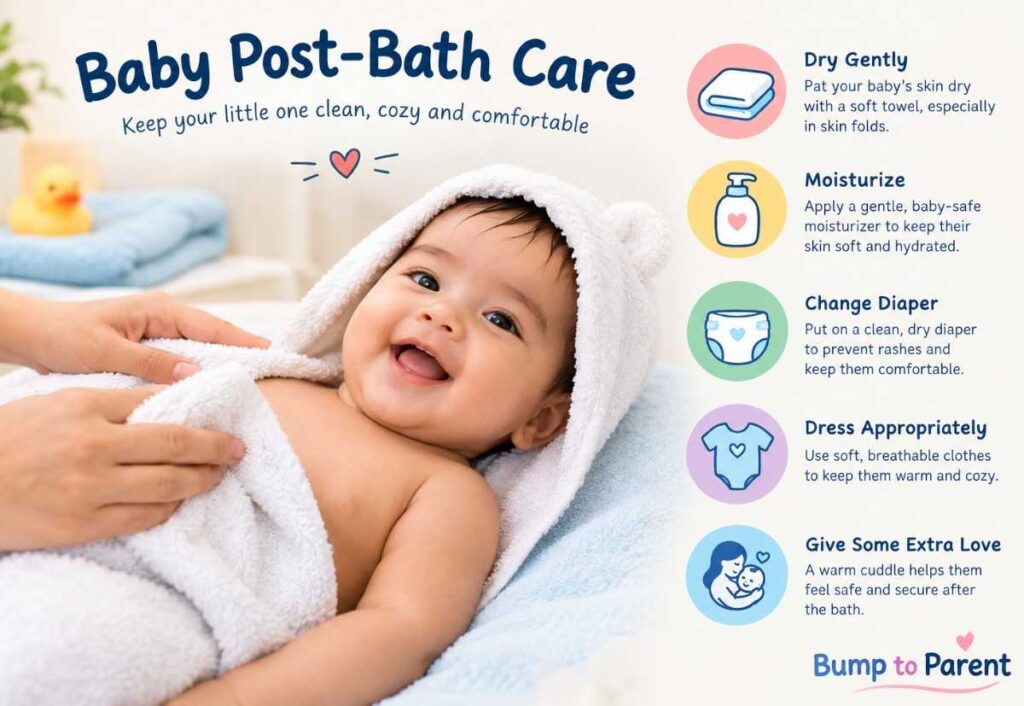

Bath time can be a relaxing part of your baby’s routine, but what you do immediately after the bath is just as important. A baby’s skin is delicate, and newborns can lose body heat quickly when they are wet. Gentle drying, moisturizing, dressing, and checking the skin can help keep your little one comfortable.
For new parents, post-bath care may initially feel complicated. Should you use baby lotion? How should you dry the skin folds? What should you do with the umbilical cord? Is baby oil necessary?
The good news is that baby post-bath care does not have to involve a long list of products. In most cases, a simple and gentle routine is enough.
What Is Baby Post-Bath Care?
Baby post-bath care refers to the steps taken immediately after bathing a baby to keep the baby’s skin clean, dry, warm, and comfortable.
A basic routine usually includes:
- Wrapping the baby in a soft towel.
- Gently patting the skin dry.
- Drying skin folds carefully.
- Checking the baby’s skin for redness or irritation.
- Applying a suitable fragrance-free moisturizer if needed.
- Taking special care of the umbilical cord if it has not fallen off.
- Putting on a clean diaper and comfortable clothes.
- Keeping the baby warm after the bath.
The American Academy of Pediatrics recommends gently patting babies dry and applying a small amount of fragrance-free, hypoallergenic moisturizer after bathing when needed to help prevent dry skin.
Why Is Post-Bath Care Important for Babies?
Newborn and infant skin is more delicate than adult skin. Frequent bathing, hot water, harsh cleansers, and rubbing with a towel can contribute to dryness and irritation.
Post-bath care helps:
- Maintain the skin’s moisture.
- Reduce dryness and flaking.
- Keep skin folds clean and dry.
- Help prevent irritation caused by trapped moisture.
- Keep the baby warm after leaving the bath.
- Give parents an opportunity to notice unusual rashes, swelling, or skin changes.
Babies generally do not need a daily full bath. Three baths per week may be enough during the first year, although the diaper area should be cleaned regularly. Bathing too frequently can contribute to dry skin.
Baby Post-Bath Care: Step-by-Step Routine
1. Take the Baby Out of the Bath Carefully
Before lifting your baby out, make sure the towel, diaper, clothes, and other supplies are within easy reach.
Support your baby’s head and neck securely while removing them from the bath.
Never leave a baby unattended in or near bath water, even for a few seconds. Young babies can drown in very small amounts of water, and bath seats or rings should not be considered substitutes for active supervision.
2. Wrap Your Baby in a Soft Towel
As soon as bath time is finished, gently wrap your baby in a clean, soft towel.
Cover the baby’s head and body to help reduce heat loss. A hooded baby towel can be convenient, but it is not essential.
Avoid leaving a wet baby exposed for longer than necessary, particularly in a cool room.
3. Pat the Skin Dry Instead of Rubbing
This is one of the simplest but most important post-bath habits.
Use the towel to gently pat your baby’s skin dry rather than rubbing vigorously.
Pay particular attention to:
- Neck folds
- Underarms
- Behind the ears
- Groin
- Buttocks
- Behind the knees
- Between the toes
- Other deep skin folds
Moisture trapped inside folds can contribute to irritation, so these areas should be dried gently but thoroughly.
The AAP specifically recommends gently patting babies dry after bathing rather than rubbing the skin.
4. Check Your Baby’s Skin
Post-bath time is a convenient opportunity to look at your baby’s skin.
Look for:
- Unusual redness
- Dry patches
- Peeling
- Small bumps
- Rash
- Swelling
- Cracked skin
- Areas that appear unusually irritated
A little temporary redness can occur from warmth or friction, but persistent, spreading, painful, or oozing skin changes should be discussed with your baby’s healthcare professional.
5. Apply Moisturizer if Your Baby Needs It
Not every baby needs moisturizer after every bath.
If your baby’s skin is dry, a simple fragrance-free, hypoallergenic moisturizer may help retain moisture. Applying moisturizer shortly after bathing can be particularly useful because some moisture remains on the skin.
Choose products designed for sensitive baby skin and avoid heavily fragranced products when possible.
A small amount of fragrance-free, hypoallergenic moisturizer after bathing to help prevent dry skin.
How to Apply Baby Moisturizer:
Apply a thin layer to areas that are dry. Avoid getting moisturizer into the eyes, mouth, or other areas where it is not intended to be used.
If your baby develops a rash or irritation after using a particular product, stop using it and ask a healthcare professional for advice.
6. What About Baby Oil?
Baby oil is not an essential part of post-bath care.
Some parents use baby oil for massage or to help reduce the feeling of dry skin, but choosing a simple moisturizer may be more practical for everyday skin care.
If you use any oil or skincare product, avoid applying it to irritated or broken skin unless your baby’s healthcare professional recommends it.
Also, keep oils and skincare products away from your baby’s face and mouth.
7. Take Special Care of the Umbilical Cord
If your newborn’s umbilical cord stump is still attached, post-bath care requires extra attention.
The umbilical cord stump should generally be kept clean and dry. The AAP recommends dry cord care and advises keeping the diaper folded below the stump so urine does not soak the area.
For newborns whose cord has not yet fallen off, sponge baths are generally recommended rather than immersing the baby in a tub.
Do not pull on the cord stump, even if it looks like it is almost ready to fall off.
Signs of Possible Umbilical Cord Infection:
Contact your baby’s healthcare professional if you notice:
- Redness spreading around the belly button.
- Swelling around the cord.
- Pus or cloudy discharge.
- A foul-smelling discharge.
- Significant or persistent bleeding.
- Your baby appearing unwell.
The AAP identifies spreading redness, swelling, tenderness, and foul-smelling discharge as signs that may indicate an umbilical cord infection.
8. Put on a Clean Diaper
Once your baby is dry, put on a clean diaper.
For a newborn with an umbilical cord stump, fold the upper edge of the diaper down so that it does not cover or rub against the cord.
This helps keep the stump exposed to air and reduces contact with urine.
9. Dress Your Baby in Comfortable Clothing
Choose clean, soft, breathable clothing appropriate for the room temperature.
Avoid overdressing your baby simply because they have just had a bath. The goal is to keep them comfortably warm rather than excessively hot.
Soft cotton clothing can be a practical choice for many babies because it is comfortable and breathable.
10. Give Your Baby Some Cuddling Time
Post-bath care does not have to be purely practical.
Once your baby is clean, dry, and dressed, cuddling or holding them can make the transition from bath time to the rest of the evening more comfortable.
Skin-to-skin contact can also be a calming experience for babies. The AAP notes that skin-to-skin contact can provide warmth and comfort and can be continued at home, including after a bath.
Baby Post-Bath Care for Different Ages
Newborn Baby
Newborns require particularly gentle care.
Focus on:
- Keeping the baby warm.
- Patting rather than rubbing the skin.
- Keeping the umbilical cord dry.
- Using minimal skincare products.
- Drying skin folds carefully.
- Using sponge baths while the cord stump remains attached, according to healthcare guidance.
1 to 3-Month-Old Baby
At this stage, continue using gentle products and avoid unnecessary fragrances.
Check the neck, armpits, and diaper area carefully because milk, sweat, and moisture can collect in skin folds.
Older Infants
As babies become more active, they may sweat more and get food or other substances on their skin.
Continue to keep bath products simple, dry skin thoroughly, and use moisturizer when necessary.
Common Baby Post-Bath Mistakes to Avoid
1. Rubbing the Skin Too Hard
A baby’s skin can become irritated from vigorous towel drying. Pat the skin gently instead.
2. Using Too Much Soap
Babies generally do not need large amounts of cleanser. Excessive soap can contribute to dryness.
The AAP recommends using soap sparingly and choosing a mild cleanser when one is needed.
3. Using Strongly Fragranced Products
Strong fragrances can irritate sensitive skin. Fragrance-free products are often a simpler choice for babies with sensitive or dry skin.
4. Leaving Skin Folds Damp
Moisture trapped in skin folds can lead to irritation. Carefully pat these areas dry.
5. Applying Too Many Products
A baby’s post-bath routine does not need to include multiple oils, lotions, powders, creams, and fragrances.
A simple routine is often easier and less likely to irritate sensitive skin.
6. Using Hot Water
Hot water can dry the skin and increase the risk of burns. Baby bath water should be comfortably warm rather than hot.
7. Leaving the Baby Alone After the Bath
Even after the bath is finished, keep your baby within your immediate supervision while drying and dressing them.
Is Baby Powder Necessary After a Bath?
Baby powder is generally not necessary for routine post-bath care.
Instead of relying on powder to absorb moisture, gently dry your baby’s skin folds and keep the diaper area clean.
Powder should also be used carefully because loose powder can become airborne and may be inhaled by a baby.
Should You Massage Your Baby After a Bath?
A gentle baby massage can become part of a relaxing routine if your baby enjoys it.
Use gentle movements and stop if your baby becomes uncomfortable.
Avoid massaging areas with broken, inflamed, or infected-looking skin unless your healthcare professional has advised you to do so.
What Should You Do If Your Baby Has Dry Skin After a Bath?
If your baby’s skin looks dry after bathing:
- Make sure the bath water is not hot.
- Keep bath time relatively short.
- Use cleanser sparingly.
- Pat the skin dry instead of rubbing.
- Apply a fragrance-free moisturizer if appropriate.
- Avoid unnecessary fragranced products.
- Speak with your baby’s healthcare professional if dryness is persistent or severe.
The AAP notes that long or frequent baths can contribute to dry skin and recommends limiting bath time and using gentle skincare practices.
Baby Post-Bath Care Checklist
| Post-Bath Step | What to Do |
|---|---|
| Wrap baby | Use a clean, soft towel |
| Dry skin | Gently pat instead of rubbing |
| Skin folds | Dry neck, armpits, groin, and other folds |
| Skin check | Look for unusual redness, rash, or irritation |
| Moisturizer | Use a fragrance-free product if needed |
| Umbilical cord | Keep it clean and dry until healed |
| Diaper | Use a clean diaper and keep the cord uncovered |
| Clothing | Choose comfortable, breathable clothes |
| Comfort | Cuddle or use gentle skin-to-skin contact |
How Long Should You Wait to Dress a Baby After a Bath?
You do not need to wait long.
Once your baby has been gently dried and any needed moisturizer has been applied, dress the baby in clean, comfortable clothing.
The important thing is to avoid leaving the baby wet or exposed for an unnecessarily long time.
When Should You Contact a Doctor?
Most minor changes in a baby’s skin are not emergencies, but some symptoms deserve medical attention.
Contact your baby’s healthcare professional if you notice:
- A spreading rash.
- Significant swelling.
- Pus or foul-smelling discharge.
- Increasing redness around the umbilical cord.
- Persistent bleeding from the cord.
- Skin that appears infected.
- A baby who seems unusually unwell.
- Fever in a young infant.
For newborns, particularly those in the first few weeks of life, it is appropriate to seek medical advice when you are concerned rather than trying multiple home treatments.
FAQ’s
What should I do immediately after bathing my baby?
Immediately wrap your baby in a soft towel, gently pat the skin dry, dry all skin folds, apply moisturizer if needed, and dress the baby in clean, comfortable clothes.
Should I dry my baby completely after a bath?
Yes, gently dry your baby, especially the neck, armpits, groin, behind the ears, and other skin folds where moisture can remain.
Can I apply lotion immediately after bathing my baby?
Yes, if your baby’s skin is dry, applying a small amount of fragrance-free, hypoallergenic moisturizer shortly after the bath can help retain moisture.
Should I use baby oil after every bath?
No, baby oil is not necessary after every bath; if your baby has dry skin, a simple fragrance-free moisturizer may be sufficient.
Can I use coconut oil after bathing my baby?
Coconut oil is sometimes used for baby massage, but it is not necessary for routine post-bath care, and parents should stop using it if it causes irritation.
How can I prevent dry skin after a baby bath?
Use lukewarm water, keep baths reasonably short, use mild cleanser sparingly, pat the skin dry, and apply a fragrance-free moisturizer when needed.
What should I put on my baby’s skin after a bath?
For most babies, nothing is required if the skin is healthy; if the skin is dry, a gentle fragrance-free moisturizer can be used.
How do I care for my baby’s skin folds after a bath?
Gently pat the folds dry without rubbing and make sure no moisture remains in areas such as the neck, armpits, groin, and behind the ears.
Can I breastfeed my baby after a bath?
Yes, you can breastfeed your baby after a bath, and feeding can be a comforting part of the post-bath routine.
Why does my baby cry after a bath?
Babies may cry after a bath because they are hungry, tired, cold, overstimulated, or simply adjusting to being removed from the warm water.
How can I keep my baby warm after a bath?
Keep the room comfortably warm, wrap your baby promptly in a dry towel, gently dry the skin, and dress them in suitable clothing.
Can I use scented lotion on my baby after a bath?
It is generally preferable to choose fragrance-free products, particularly for newborns or babies with sensitive skin.
Should I apply moisturizer to my baby’s face after a bath?
Moisturizer is not routinely required on a baby’s face, but a suitable fragrance-free product may be considered if the skin is dry.
What should I do if my baby’s skin becomes red after a bath?
If redness is mild and temporary, monitor it, but persistent, spreading, swollen, painful, or oozing redness should be discussed with a healthcare professional.
How should I care for the umbilical cord after bathing?
If the cord stump is still attached, keep it clean and dry, avoid pulling it, and follow your healthcare professional’s instructions for newborn cord care.
When can I give my newborn a regular tub bath?
Newborns with an attached umbilical cord stump are generally given sponge baths until the stump falls off and the area heals.
How often should I moisturize my baby’s skin?
Moisturizing frequency depends on your baby’s skin; healthy skin may not need moisturizer every day, while dry skin may benefit from regular application of a gentle product.
What are the signs of a skin problem after a baby bath?
Persistent redness, swelling, cracking, oozing, significant rash, or worsening irritation can indicate a skin problem that may require medical evaluation.
Can I use adult skincare products on my baby?
It is better to use products specifically formulated for babies or sensitive skin because adult products may contain ingredients or fragrances that can irritate delicate baby skin.
What clothes should my baby wear after a bath?
Choose clean, soft, breathable clothing appropriate for the room temperature and avoid dressing your baby too warmly.
Is it okay to let my baby sleep immediately after a bath?
Yes, a bath can be part of a bedtime routine, provided your baby is fully dry, comfortably dressed, and placed in a safe sleep environment.
Can I use a hair dryer to dry my baby after a bath?
A hair dryer is generally unnecessary and can expose your baby to excessive heat or burns; gently patting the hair and skin with a soft towel is safer.
Final Thoughts
Baby post-bath care does not need to be complicated. A warm towel, gentle drying, careful attention to skin folds, appropriate moisturizing when needed, and clean clothing can provide a simple and effective routine.
For newborns, the umbilical cord deserves special attention until it falls off and the area heals. Keeping it clean and dry and watching for signs of infection can help support normal healing.
Most importantly, focus on gentle care rather than using a large number of products. Your baby’s skin will change as they grow, so the best routine may also change over time.
Sources / References:
Short Disclaimer:
This guide is for general educational purposes only and does not replace advice, diagnosis, or treatment from your baby’s pediatrician or other qualified healthcare professional. Always seek medical advice for concerning symptoms or if your newborn appears unwell.
Also Read:


Pingback: How to Clean a Baby’s Nose Safely: A Step-by-Step Guide