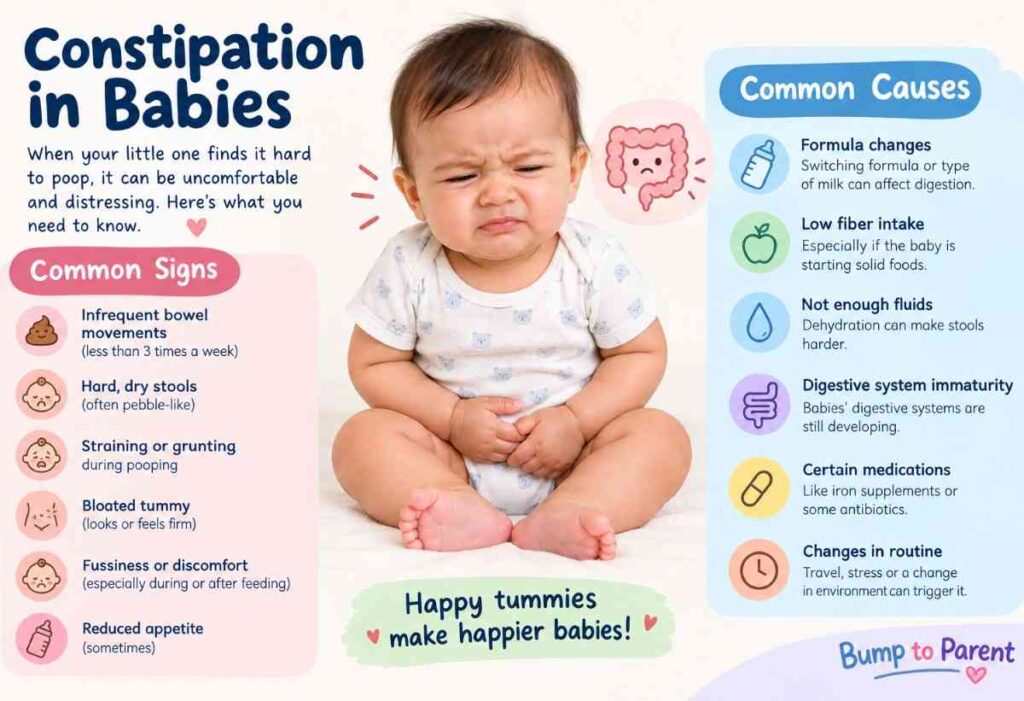

Constipation in babies can be stressful for parents, especially when a baby strains, cries, turns red, or goes several days without pooping. However, not every baby who strains or has infrequent bowel movements is actually constipated. Babies can have very different stooling patterns depending on their age, whether they are breastfed or formula-fed, and whether they have started solid foods.
The most important clue is usually what the stool looks and feels like, rather than simply how often your baby poops. Hard, dry, pellet-like stools or painful bowel movements are more concerning for constipation than a soft stool passed after several days.
This guide explains how to recognize constipation in babies, common causes, safe ways to help, treatments doctors may recommend, and warning signs that need medical attention.
What Is Constipation in Babies?
Constipation occurs when a baby has difficulty passing stool, especially when the stool is hard, dry, or painful to pass.
A baby may strain, grunt, cry, or turn red while pooping even when their stool is soft. This can be normal because young babies are still learning how to coordinate the abdominal muscles and pelvic muscles needed for a bowel movement.
Therefore, straining alone does not necessarily mean your baby is constipated.
A baby is more likely to be constipated when there are signs such as:
- Hard or dry stools
- Small, pellet-like stools
- Pain or significant distress while passing stool
- Blood associated with a hard stool
- Persistent difficulty passing stool
- A noticeable change from the baby’s usual bowel pattern
How Often Should a Baby Poop?
There is no single number of bowel movements that is normal for every baby.
Breastfed Babies
Breastfed newborns may poop frequently during the first few weeks. After about 3–6 weeks, some breastfed babies may go several days or even around a week without a bowel movement and still be normal if the stool remains soft and the baby is feeding and growing well.
Formula-Fed Babies
Formula-fed babies commonly have more regular bowel movements. The American Academy of Pediatrics notes that formula-fed babies generally have at least one bowel movement a day, although individual patterns can vary.
The key point is that poop consistency and whether the baby is comfortable matter more than counting every bowel movement.
Signs and Symptoms of Constipation in Babies
Parents may notice several symptoms when a baby is genuinely constipated.
1. Hard, Dry Poop
Hard or dry stool is one of the clearest signs of constipation.
2. Small Pellet-Like Stools
Stools that resemble small, dry pellets can indicate that stool is staying in the intestine longer than usual.
3. Painful Pooping
A baby may cry or appear very uncomfortable when trying to pass a hard stool.
4. Excessive Straining
Some straining is normal in infants, but prolonged straining without successfully passing stool can indicate a problem.
5. Blood on the Stool
A small amount of bright-red blood may occur when a hard stool causes a tiny tear around the anus. However, blood in a baby’s stool should be discussed with a pediatrician, particularly if it recurs or the cause is unclear.
6. Increased Fussiness
A constipated baby may become unusually irritable or difficult to settle.
7. Reduced Appetite
Some babies may feed less when they are uncomfortable or have significant constipation.
8. More Spitting Up
Increased spitting up can sometimes accompany digestive discomfort, although it has many other possible causes.
What Causes Constipation in Babies?
Several factors can contribute to constipation.
1. Change in Feeding
Changes in feeding patterns, including transitioning between breast milk, formula, and solid foods, may temporarily alter bowel movements.
2. Formula Feeding
Formula-fed babies may have firmer stools than breastfed babies. This does not automatically mean constipation, but a significant change in stool consistency deserves attention.
3. Starting Solid Foods
Constipation can occur around the time babies begin eating solid foods, particularly if their diet does not contain enough fiber-rich fruits and vegetables.
4. Not Enough Fluid
Dehydration can contribute to harder stools. Babies, however, have specific fluid requirements based on age and feeding, so parents should not routinely give extra water without appropriate medical guidance.
5. Low-Fiber Solid Foods
Once a baby is eating solids, a diet heavily focused on low-fiber foods may contribute to constipation.
6. Illness or Changes in Routine
Changes in feeding, illness, or routine can sometimes temporarily affect bowel movements.
7. Certain Medical Conditions
Less commonly, constipation can be related to an underlying medical condition. Persistent constipation in a young infant should therefore be evaluated by a healthcare professional when appropriate.
Baby Constipation vs. Normal Infant Straining
This is one of the most important distinctions for parents.
A baby may grunt, cry, turn red, pull up their legs, and strain for several minutes before passing a soft stool. This can be a normal part of learning to coordinate bowel movements.
Normal Infant Straining
- Stool is soft
- Baby eventually passes stool
- Baby feeds normally
- Baby is otherwise comfortable and developing normally
More Suggestive of Constipation
- Stool is hard or dry
- Passing stool appears painful
- Baby repeatedly struggles without success
- Stools become noticeably different from usual
- Blood appears after passing a hard stool
So, a baby who strains but produces soft poop may not be constipated.
Safe Home Remedies for Constipation in Babies
Home care for baby constipation should depend on the baby’s age and whether they are breastfed, formula-fed, or eating solid foods. Not every baby who strains is constipated; soft stools can be normal even when a baby grunts or turns red.
1. Gentle Bicycle Legs
Lay your baby on their back and gently move their legs in a bicycle-like motion. This may encourage bowel movement and relieve discomfort.
2. Gentle Tummy Massage
Using very light pressure, gently massage your baby’s abdomen in circular motions. Stop if your baby becomes uncomfortable.
3. Knees Toward the Chest
While your baby is lying on their back, gently bring their knees toward their chest for a few seconds and release. This can sometimes make passing stool easier.
4. Continue Breast Milk or Formula
Continue normal breastfeeding or properly prepared infant formula. Do not dilute formula or replace feeds with water.
5. Offer Fiber-Rich Foods After Starting Solids
For babies who are developmentally ready for solid foods, foods such as pears, prunes, peaches, plums, peas, beans, and suitable whole grains can provide fiber.
6. Try Pear or Prune Options for Older Babies
For babies already eating solids, appropriately prepared pear or prune puree may help soften stools. Follow age-appropriate feeding guidance.
7. Ask About Juice for Young Infants
The American Academy of Pediatrics notes that small amounts of apple or pear juice may sometimes be used for constipation in babies over 1 month, but parents should discuss this with their pediatrician rather than using juice routinely.
8. Give a Warm Bath
A comfortably warm bath may help your baby relax, which can make passing stool easier.
When Home Remedies Aren’t Enough?
Contact your pediatrician if your baby has persistent constipation, hard painful stools, blood in the stool, vomiting, poor feeding, a swollen abdomen, unusual sleepiness, or poor weight gain. A newborn with significant difficulty passing stool should be evaluated promptly.
Can Babies Have Apple or Pear Juice for Constipation?
For babies over 1 month old, the American Academy of Pediatrics’ parent guidance discusses small amounts of apple or pear juice as an option for constipation. Its guidance gives an age-based amount and recommends discussing the issue with the child’s pediatrician, particularly if symptoms do not improve.
However, fruit juice is not generally recommended as a routine drink for babies under 1 year old. Using it specifically for constipation is different from offering juice as a regular beverage.
Because recommendations can vary according to a baby’s age, feeding method, medical history, and symptoms, speak with your pediatrician before using juice to treat constipation in a young infant.
Can You Give Water to a Constipated Baby?
Do not routinely give extra water to a young baby simply because they have not pooped.
Babies under about 6 months generally receive their fluid through breast milk or infant formula, and unnecessary additional water can interfere with appropriate nutrition and, in excessive amounts, cause dangerous electrolyte problems.
If your baby appears dehydrated or is feeding poorly, contact a healthcare professional rather than trying to correct the problem with extra water.
What About Constipation in Babies Starting Solids?
Constipation can become more noticeable when babies transition to solid foods.
Parents can focus on offering a varied diet appropriate for the baby’s developmental stage. Fiber-containing foods such as fruits, vegetables, beans, and suitable whole grains can be incorporated gradually.
Good options may include:
| Food | How it may help |
|---|---|
| Pears | Provide fiber and fluid |
| Prunes | Traditionally used to help soften stool |
| Peaches | Provide fiber and water |
| Plums | Provide fiber |
| Peas | Provide dietary fiber |
| Beans | Fiber-rich when appropriately prepared |
| Vegetables | Add fiber to the diet |
| Whole-grain infant cereals | Can provide dietary fiber |
Foods should always be prepared according to the baby’s developmental stage to reduce choking risk.
What Should You Avoid Giving a Constipated Baby?
Parents often find home remedies online, but not all are safe for infants.
Avoid giving a baby:
- Laxatives without medical advice
- Enemas unless specifically instructed by a healthcare professional
- Mineral oil
- Herbal remedies without pediatric guidance
- Large amounts of water
- Honey to treat constipation, particularly in babies younger than 12 months
- Adult constipation medicines
- Unapproved supplements
The American Academy of Pediatrics specifically emphasizes discussing treatment with a pediatrician rather than assuming every constipation remedy is appropriate for a baby.
Treatment for Baby Constipation
If dietary and supportive measures are not enough, a pediatrician may recommend treatment based on the baby’s age, symptoms, and underlying cause.
Treatment can sometimes involve a stool-softening or osmotic medication, but the product and dose should be determined by the child’s healthcare professional.
Do not use an adult laxative or calculate a baby’s dose from an internet recommendation.
For older children, several constipation medicines are used medically, but treatment for infants requires particular care.
When Should You Call a Pediatrician?
Contact your baby’s healthcare professional if:
- Constipation keeps returning
- Your baby repeatedly has hard stools
- Your baby appears to be in significant pain
- Your baby has blood in the stool
- Your baby is feeding poorly
- Your baby is vomiting
- Your baby’s abdomen appears swollen or unusually firm
- Your baby is not gaining weight as expected
- Your baby has persistent difficulty passing stool
- You are unsure whether your baby’s bowel movements are normal
For very young newborns, particularly during the first weeks of life, changes in feeding, stooling, or overall behavior deserve prompt discussion with a pediatrician.
When Is Baby Constipation an Emergency?
Seek urgent medical attention if your baby has severe or worsening abdominal swelling, repeated vomiting, marked lethargy, difficulty breathing, significant dehydration, severe pain, or appears seriously unwell.
A newborn who has never passed their first stool within the expected period after birth also needs medical evaluation because certain intestinal conditions can interfere with the passage of stool.
Do not attempt to treat a potentially serious bowel problem at home.
How to Prevent Constipation in Babies?
Constipation cannot always be prevented, but several healthy habits may help.
1. Continue Appropriate Milk Feeding
Breast milk or properly prepared infant formula remains the primary source of nutrition during early infancy.
2. Introduce Solids Gradually
When your baby is developmentally ready, introduce complementary foods gradually and offer a variety of age-appropriate foods.
3. Include Fiber-Rich Foods
Once solids are established, regularly offering suitable fruits, vegetables, legumes, and whole grains can support healthy bowel habits.
4. Pay Attention to Stool Changes
Parents who know their baby’s usual stool pattern are more likely to recognize meaningful changes.
5. Avoid Unnecessary Remedies
Giving medications or supplements without medical advice can create additional problems rather than solving constipation.
FAQ’s
How do I know if my baby is constipated?
Hard, dry stools, painful pooping, and pellet-like stools are common signs.
Is it normal for babies to strain while pooping?
Yes. Babies may strain, grunt, or turn red while passing soft stools.
How long can a breastfed baby go without pooping?
Some breastfed babies may go several days or even about a week if their stools remain soft and they are feeding well.
What can I give my baby for constipation?
Treatment depends on age. Ask your pediatrician before giving juice, water, or medication.
Can formula cause constipation in babies?
Formula-fed babies may have firmer stools, but hard or painful stools are more concerning.
Can starting solids cause constipation?
Yes. Changes in diet when starting solids can sometimes make stools harder.
What foods help baby constipation?
For babies eating solids, pears, prunes, peaches, plums, peas, and other fiber-rich foods may help.
Is baby constipation dangerous?
Most cases are manageable, but severe or persistent constipation can sometimes indicate an underlying problem and should be evaluated.
How to relieve constipation in babies quickly?
Gentle bicycle-leg movements, tummy massage, and age-appropriate fiber-rich foods may help. Ask your pediatrician before using juice or medication.
How to help a constipated baby?
Continue normal breast milk or formula feeds and try gentle leg movements or tummy massage. Babies eating solids may benefit from foods such as pears and prunes.
Is it normal for my baby’s poop to be hard?
Occasionally firmer stool can happen, but consistently hard, dry, or pellet-like poop may indicate constipation.
My baby hasn’t pooped in 5 days. Should I be worried?
Not necessarily. Some breastfed babies can go several days without pooping if their stool is soft and they are feeding and growing normally. Hard stools, pain, vomiting, poor feeding, or a swollen abdomen require medical advice.
Why is my baby passing gas but not pooping?
Gas can pass even when stool is temporarily delayed. If your baby is comfortable and eventually passes soft stool, this may be normal.
Can a baby fart if they are constipated?
Yes. A constipated baby can still pass gas because gas and stool move through the intestines differently.
Can overfeeding cause constipation?
Overfeeding is not a typical direct cause of constipation, but feeding problems or incorrectly prepared formula can affect digestion. Prepare formula exactly as directed.
Do breastfed babies get constipated easily?
True constipation is relatively uncommon in exclusively breastfed babies. Some breastfed babies may go several days without pooping while still having soft stools.
Final Thoughts
Constipation in babies is not always about how frequently they poop. The consistency of the stool, difficulty passing it, and your baby’s overall health are much more useful clues.
A baby who strains and turns red but eventually passes soft stool may simply be learning how to coordinate a bowel movement. In contrast, hard, dry, painful stools are more consistent with true constipation. When in doubt, especially with a newborn or young infant, it is better to ask a pediatrician before trying home remedies or medicines.
Sources / References:
Disclaimer:
This guide is for educational purposes only and does not replace professional medical advice. Always consult your pediatrician for concerns about your baby’s health, feeding, bowel movements, or treatment.
Also Read: