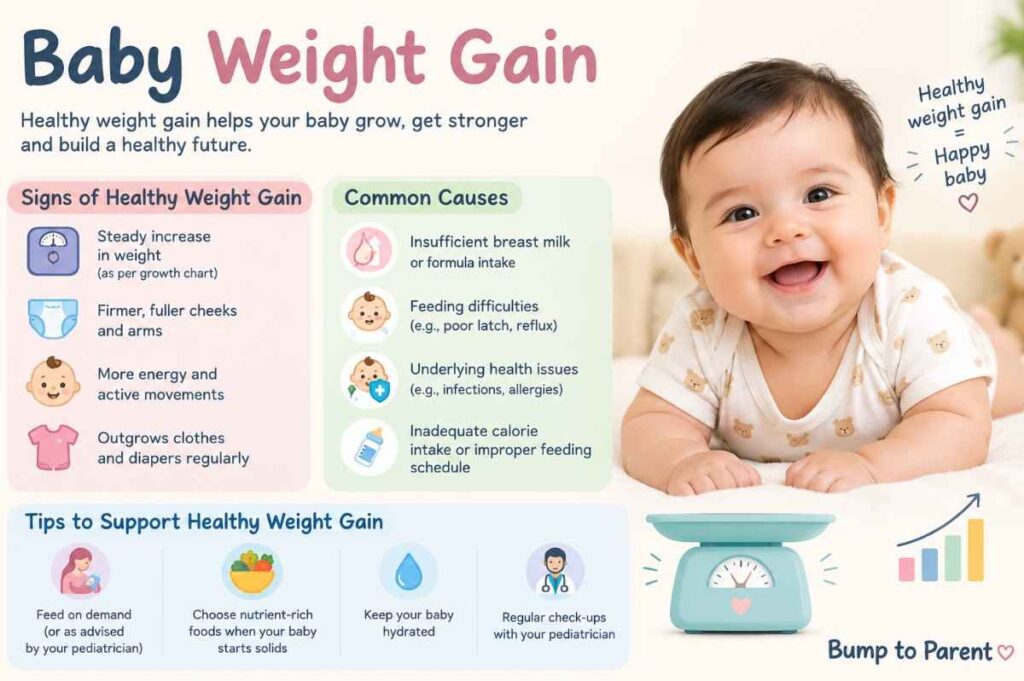

A baby’s weight is one of the simplest ways healthcare professionals monitor growth and nutrition. It is also one of the things parents tend to worry about most. Some babies gain weight quickly, while others gain more gradually. A baby may even lose some weight during the first few days after birth before beginning to gain steadily.
The important point is that healthy baby weight gain is not about reaching one specific number. Pediatricians look at a baby’s weight, length, head circumference, feeding pattern, and growth trend over time. Growth charts are useful for monitoring this pattern, but they are not meant to be used as a diagnosis by themselves.
What Is Baby Weight Gain?
Baby weight gain refers to the gradual increase in a baby’s body weight as they grow and receive enough calories and nutrients from breast milk, formula, and, later, complementary foods.
Weight gain can vary from baby to baby because of factors such as:
- Birth weight
- Genetics
- Gestational age at birth
- Feeding method
- Feeding frequency and effectiveness
- Illness or medical conditions
- Growth spurts
- Overall nutrition
A baby’s growth should therefore be considered individually rather than compared with another baby.
Is It Normal for Newborns to Lose Weight?
Yes. Some weight loss during the first days after birth is expected.
Newborns are born with extra fluid, which they gradually lose after delivery. According to the American Academy of Pediatrics, a breastfed newborn may lose around 8–10% of birth weight during the first few days before beginning to gain again.
Most healthy newborns begin gaining weight after the first several days and are generally back to their birth weight by around 2 weeks. Almost all babies have regained their birth weight by about 3 weeks, although individual circumstances can vary.
A baby who loses more weight than expected or continues losing weight should be evaluated by a healthcare professional.
Baby Weight Gain by Age
There is no single weight-gain target that applies to every baby. However, some general patterns can help parents understand what to expect.
| Age | General Growth Pattern |
|---|---|
| First few days | Some weight loss is normal |
| Around 5–7 days | Weight should generally begin increasing |
| Around 2 weeks | Many babies have regained birth weight |
| First month | Weight usually increases steadily |
| Around 6 months | Many babies have approximately doubled their birth weight |
| Around 12 months | Many babies have approximately tripled their birth weight |
These are general patterns rather than strict rules. Your baby’s pediatrician should interpret growth using measurements taken over time.
How Much Weight Should a Baby Gain Each Month?
Healthy babies do not all gain weight at the same rate.
For example, an average newborn may gain close to 28 grams, or about 1 ounce, per day during the first month. Growth spurts can temporarily change how quickly a baby gains weight.
Rather than focusing on a daily number, doctors generally look at the overall pattern.
A baby who remains on a consistent growth curve may be growing well even if they are smaller than other babies.
A baby’s monthly weight gain varies by age, but a general guide is:
| Baby’s Age | Average Weight Gain |
|---|---|
| 0–3 months | About 150–200 g (5–7 oz) per week |
| 3–6 months | About 100–150 g (3.5–5 oz) per week |
| 6–12 months | About 70–90 g (2.5–3 oz) per week |
So, roughly, babies may gain 600–800 g per month in the first 3 months, with the rate gradually slowing as they get older.
However, there is no single ideal monthly weight gain. Pediatricians look at the baby’s growth pattern over time, including weight, length, feeding, and growth-chart percentile. Some healthy babies naturally gain more or less than these averages.
Understanding Baby Growth Charts
Growth charts are an important tool for monitoring infant growth.
For babies younger than 2 years, the WHO Child Growth Standards are recommended in U.S. clinical settings. They include measurements such as:
- Weight-for-age
- Length-for-age
- Weight-for-length
- Head circumference-for-age
Growth percentiles are sometimes misunderstood. A baby at the 20th percentile is not necessarily less healthy than a baby at the 80th percentile.
What matters more is the growth pattern over time.
For example, if a baby has consistently tracked around the 20th percentile and continues growing along a similar pattern, that may be completely normal. A sudden and persistent change in the growth pattern deserves closer attention.
Signs Your Baby May Be Getting Enough Nutrition
Weight gain is only one way to assess whether a baby is getting enough nutrition. Other helpful signs include:
1. Regular Wet Diapers
After the first several days, babies generally have several wet diapers each day. After about day 4–5, newborns should have at least 5–6 wet diapers daily.
2. Regular Feeding
A newborn generally needs frequent feeding. Breastfed newborns commonly feed at least 8 times in 24 hours, although feeding patterns vary.
3. Audible Swallowing
During breastfeeding, hearing or seeing regular swallowing can be a reassuring sign that milk is being transferred.
4. Satisfied After Feeding
A baby who appears relaxed and satisfied after many feeds may be taking in an adequate amount, although this should be considered alongside weight and diaper patterns.
5. Steady Growth
Consistent weight gain over multiple measurements is one of the most useful indicators of healthy growth.
Baby Weight Gain and Breastfeeding
Breastfed babies can have different growth patterns from formula-fed babies.
Healthy breastfed infants generally gain weight more slowly than formula-fed infants during the later part of the first year, particularly after around 3 months. WHO growth standards account for breastfeeding when assessing infant growth.
This does not mean that slower weight gain automatically indicates a problem.
If breastfeeding is going well, parents may notice:
- Frequent feeding
- Audible swallowing
- Increasing wet diapers
- Regular stools
- Baby appearing satisfied after feeding
- Gradual weight gain
If you are concerned about milk supply, latch, feeding frequency, or your baby’s weight, speak with your pediatrician or a qualified lactation professional.
Baby Weight Gain and Formula Feeding
Formula-fed babies can also grow normally when they receive appropriate infant formula in appropriate amounts.
Parents should prepare formula according to the manufacturer’s instructions and their healthcare professional’s advice. Adding extra powder or diluting formula can be dangerous because it can alter the balance of nutrients and fluids.
If a formula-fed baby is consistently refusing feeds, vomiting frequently, having fewer wet diapers, or not gaining weight appropriately, contact the baby’s healthcare provider.
How to Support Healthy Baby Weight Gain?
Healthy weight gain starts with adequate nutrition, but it is not simply a matter of trying to make a baby gain weight faster.
1. Feed Responsively
Pay attention to hunger and fullness cues rather than trying to force a specific amount of food.
2. Feed Frequently
Young babies generally need frequent feeds because their stomachs are small and their nutritional requirements are high.
3. Check Breastfeeding Technique
If breastfeeding, proper positioning and latch can help the baby transfer milk effectively.
4. Monitor Diapers
Wet and dirty diapers can provide useful clues about feeding and hydration, particularly during the newborn period.
5. Attend Routine Pediatric Visits
Regular appointments allow healthcare professionals to monitor weight, length, head circumference, feeding, and development.
6. Follow the Growth Trend
One isolated weight measurement is less informative than a series of measurements taken over time.
7. Introduce Complementary Foods at the Appropriate Time
When a baby is developmentally ready, complementary foods can gradually be introduced while breast milk or infant formula continues to provide important nutrition.
8. Avoid Comparing Babies
Two healthy babies can have very different body sizes and growth patterns.
Why Might a Baby Not Gain Enough Weight?
Slow weight gain can have many possible causes.
Some babies may simply be naturally smaller. In other cases, slow growth can be related to feeding difficulties, inadequate milk transfer, difficulty taking formula, frequent vomiting, swallowing problems, infections, gastrointestinal conditions, or other medical issues.
The AAP’s 2026 guidance uses the term faltering weight when a child’s growth is not progressing as expected. Evaluation considers the child’s growth over time, feeding history, physical examination, and individual circumstances.
Importantly, slow weight gain does not automatically mean that parents have done something wrong.
Signs of Possible Poor Weight Gain
Talk with your baby’s pediatrician if you notice:
- Continued weight loss after the early newborn period
- Failure to regain birth weight as expected
- Poor feeding
- Difficulty latching or sucking
- Very long or unusually difficult feeds
- Frequent vomiting
- Significantly fewer wet diapers
- Baby is unusually sleepy or difficult to wake for feeds
- Baby appears weak or lethargic
- Weight repeatedly drops across growth percentiles
- Your healthcare provider is concerned about the growth pattern
A baby with significant feeding difficulties, dehydration, breathing problems, extreme sleepiness, or other concerning symptoms should receive prompt medical evaluation.
What If My Baby Is Gaining Weight Too Quickly?
Parents sometimes worry when their baby gains weight rapidly.
Rapid growth does not automatically mean that something is wrong. Infant growth can occur in spurts, and weight should always be interpreted alongside length and other measurements.
Your pediatrician can determine whether the baby’s weight is appropriate for their length and age rather than judging weight alone.
Avoid putting an infant on a diet or restricting feeds without medical advice.
Baby Weight Gain: Breastfed vs. Formula-Fed Babies
| Factor | Breastfed Baby | Formula-Fed Baby |
|---|---|---|
| Early feeding | Frequent feeding is common | Frequent feeding is common |
| Weight pattern | May gain more slowly after early infancy | May gain more rapidly after about 3 months |
| Monitoring | Weight, diapers and feeding behavior | Weight, diapers and feeding behavior |
| Growth assessment | WHO growth standards can be used | WHO growth standards can be used |
| Main concern | Adequate milk transfer and feeding | Appropriate preparation and intake |
Feeding method can influence growth patterns, which is one reason growth charts should be interpreted in context.
When Should You Contact a Pediatrician?
Contact your baby’s healthcare professional if you are concerned about weight gain, feeding, or hydration.
You should not wait for the next routine appointment if your baby:
- Is difficult to wake for feeds
- Is feeding poorly
- Has significantly fewer wet diapers
- Continues losing weight
- Is repeatedly vomiting
- Appears dehydrated
- Has breathing difficulties
- Seems unusually weak or lethargic
For newborns, early assessment can be especially important because feeding problems can develop quickly.
Healthy Baby Weight Gain: What Parents Should Remember
Baby growth is not a competition. Some babies are naturally small, some are naturally larger, and growth can happen in spurts.
The most useful question is not, “How much does my baby weigh compared with another baby?”
Instead, ask:
“Is my baby growing steadily, feeding well, staying hydrated, and following an appropriate growth pattern?”
Regular pediatric visits provide the best opportunity to answer that question. Growth charts are designed to help healthcare professionals identify patterns rather than judge a baby based on a single number.
FAQ’s
When should a newborn regain birth weight?
Most newborns regain their birth weight by about 2 weeks, although some may take up to 3 weeks.
Why is my baby not gaining weight?
Possible reasons include feeding difficulties, inadequate milk intake, illness, reflux, or other medical conditions.
Do breastfed babies gain weight slower?
Yes. After about 3 months, breastfed babies may gain weight more slowly than formula-fed babies.
How can I help my baby gain weight?
Ensure regular feeding, monitor feeding and diaper patterns, and follow your pediatrician’s recommendations.
Is slow weight gain always a problem?
No. Some babies naturally grow more slowly, but persistent or unexpected changes should be evaluated.
How do I know if my baby is getting enough milk?
Regular feeding, adequate wet diapers, swallowing during feeds, and steady growth are reassuring signs.
When should I worry about my baby’s weight?
Seek medical advice if your baby continues losing weight, feeds poorly, has fewer wet diapers, or is unusually sleepy or weak.
Can a baby gain weight too quickly?
Rapid weight gain is not necessarily a problem, but your pediatrician can assess whether growth is appropriate for your baby’s length and age.
What growth chart is used for babies?
WHO growth standards are commonly used for children under 2 years to assess growth patterns.
How much weight should a baby gain each week?
Weight gain varies by age and individual baby. During the first month, an average newborn may gain around 28 grams per day, but growth spurts and individual differences are common.
How can I tell if my baby is gaining enough weight?
Regular weight measurements, growth-chart trends, feeding behavior, and diaper output can all provide useful information. Your pediatrician can interpret these together.
Can a baby’s weight fluctuate?
Yes. Weight can change because of normal fluid shifts, feeding, illness, and growth spurts. Doctors look at repeated measurements and the overall growth trend.
Is a low percentile always unhealthy?
No. A low percentile does not automatically mean a baby is unhealthy. Consistency and the overall growth pattern are generally more informative than a single percentile.
Should I wake my baby to feed?
Some newborns, particularly those having difficulty gaining weight or who were born early, may need scheduled or more frequent feeds. Ask your pediatrician about your baby’s individual feeding needs.
How do I increase my baby’s weight?
Offer age-appropriate breast milk, formula, or complementary foods and follow your pediatrician’s advice rather than trying to increase weight quickly.
Is 7 kg normal for a 1-year-old?
7 kg can be normal for some 1-year-olds, but it is on the lower side. A pediatrician should assess the baby’s weight along with length and growth-chart pattern.
At what age do babies gain the most weight?
Babies generally gain weight fastest during the first few months of life, with growth gradually slowing as they approach their first birthday.
What causes slow weight gain in babies?
Slow weight gain can result from feeding difficulties, inadequate milk intake, frequent vomiting, illness, or underlying medical conditions.
How can I know if my baby is gaining weight?
Regular weight checks and tracking your baby’s growth on an appropriate growth chart are the best ways to monitor weight gain.
What is the average weight of a baby?
A healthy baby’s weight varies considerably. Birth weight is often around 3–3.5 kg, but genetics, gestational age, and other factors affect individual weight.
Can a baby gain 2 kg in a month?
Gaining 2 kg in one month is much faster than typical infant growth and should be discussed with a pediatrician.
How can I speed up my baby’s weight gain?
Do not try to speed up weight gain without medical guidance. Focus on adequate feeding and have your pediatrician evaluate any concerns about growth.
Sources / References:
Disclaimer:
This guide is for general educational purposes only and does not replace advice from a pediatrician or other qualified healthcare professional. If you are concerned about your baby’s feeding, weight gain, hydration, or health, seek professional medical advice.
Also Read: