
Baby eczema can be stressful for parents. One day a baby’s skin may look soft and healthy, and the next day it may become dry, red, rough, or intensely itchy. Because babies cannot explain what hurts or itches, eczema can also show up as fussiness, rubbing, scratching, or difficulty sleeping.
Baby eczema is common, especially during the first year of life. The most common type is atopic dermatitis, a chronic inflammatory skin condition that can come and go in flares. Although there is currently no permanent cure, appropriate skin care, trigger management, and medical treatment can usually keep symptoms under control.
This guide explains what baby eczema looks like, what may trigger it, how to care for affected skin, which treatments doctors may recommend, and which warning signs should not be ignored.
What Is Baby Eczema?
Baby eczema usually refers to atopic dermatitis, a condition that causes dry, itchy, inflamed skin. It can appear anywhere on a baby’s body, although the face and scalp are common areas in infants.
Eczema is not contagious, so a baby cannot catch it from another person.
The condition is associated with a weakened skin barrier. When the skin barrier does not work properly, the skin can lose moisture more easily and become more vulnerable to irritation from substances in the environment.
Baby eczema can have periods when the skin is relatively clear and periods called flares, when symptoms become more noticeable.
Eczema affects up to 25% of children, and approximately 60% of people with eczema develop it during their first year of life.
What Does Baby Eczema Look Like?
Baby eczema does not look exactly the same in every child, and its appearance can vary with skin tone.
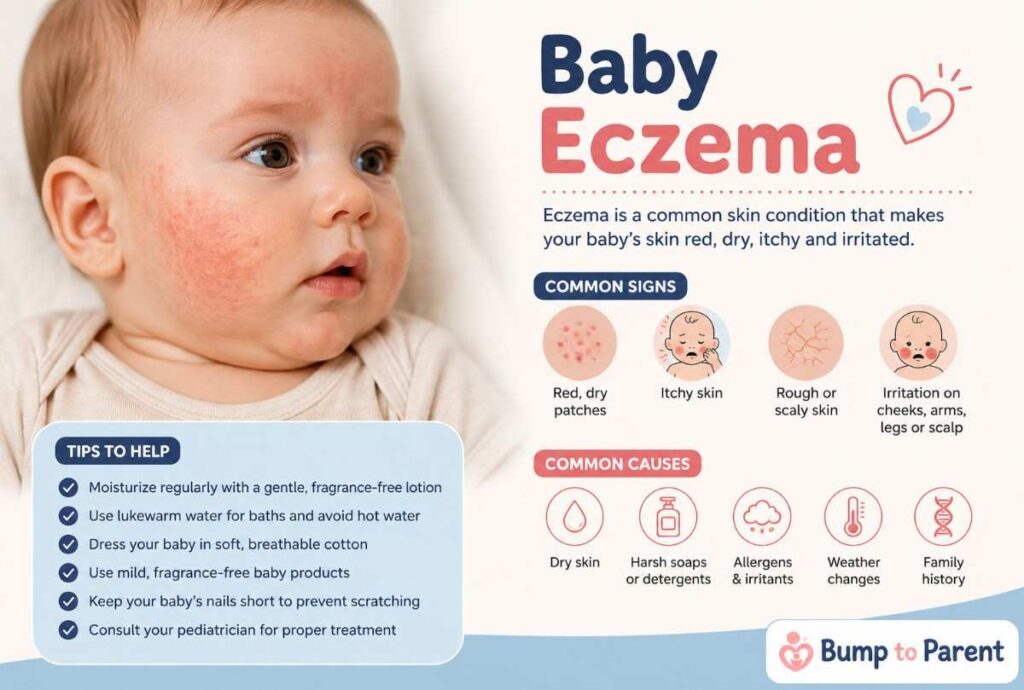
Common symptoms of baby eczema include:
- Dry skin: The affected area may feel rough, dry, or unusually tight.
- Itchy patches: Babies may rub their face, head, arms, or legs against bedding or clothing.
- Red or darker patches: Inflamed areas may appear red, brown, purple, gray, or darker or lighter than surrounding skin depending on the baby’s skin tone.
- Small bumps: Tiny rough bumps may develop, particularly after scratching or rubbing.
- Scaly skin: The affected skin may become flaky or scaly.
- Cracked skin: Severe dryness can cause small cracks or fissures.
- Oozing or crusting: Scratched areas may ooze and later develop crusts.
- Thickened skin: Repeated scratching over time can make the skin thicker.
The American Academy of Dermatology describes atopic dermatitis as an “itch that rashes” because itching can begin before the rash becomes obvious.
Where Does Baby Eczema Usually Appear?
In infants, eczema commonly affects the:
- Cheeks
- Forehead
- Scalp
- Around the mouth
- Neck
- Arms
- Legs
- Torso
The exact location can change as a baby grows. Some babies primarily develop eczema on the face, while others have patches on several parts of the body.
Eczema around the mouth can sometimes become worse because of saliva, especially during teething or feeding.
Baby Eczema vs. Cradle Cap
Parents sometimes confuse eczema with cradle cap because both can affect a baby’s scalp.
Cradle cap is usually characterized by greasy or flaky scales on the scalp and is generally not intensely itchy.
Eczema tends to cause dry, irritated, itchy skin and may involve areas beyond the scalp.
However, babies can have more than one skin condition at the same time. If you are unsure what a rash is, a pediatrician or dermatologist can help identify it.
What Causes Baby Eczema?
There is not one single cause of baby eczema. It usually develops from a combination of genetic, immune-system, and environmental factors.
1. A Weakened Skin Barrier
A baby’s skin is delicate, and babies with eczema may have a skin barrier that does not retain moisture as effectively.
This can contribute to dryness and make the skin more susceptible to irritants.
2. Immune-System Activity
Atopic dermatitis involves inflammation and an abnormal immune response in the skin.
This inflammation contributes to itching, redness, and irritation.
3. Family History
Children with a family history of eczema, asthma, or hay fever may have a higher likelihood of developing atopic dermatitis.
However, a baby can develop eczema even when neither parent has it.
4. Environmental Triggers
Certain environmental factors can aggravate eczema, including:
- Dry air
- Heat
- Sweat
- Tobacco smoke
- Dust
- Pollen
- Pet dander
These factors do not necessarily cause eczema by themselves, but they may contribute to flare-ups in susceptible babies.
Common Baby Eczema Triggers
Identifying triggers can help reduce repeated flare-ups.
1. Fragrances
Perfumes and fragrances in soaps, lotions, shampoos, detergents, and wipes can irritate sensitive skin.
2. Heat and Sweat
Overheating can make itching worse. Dressing a baby in breathable clothing and avoiding excessive layers may help.
3. Saliva
Drooling can irritate the skin around the mouth and chin.
4. Rough Fabrics
Wool and rough-textured clothing can rub against sensitive skin.
5. Laundry Products
Some detergents and fabric softeners may irritate eczema-prone skin.
6. Dry Weather
Low humidity can contribute to dry skin and may worsen eczema.
7. Scratching
Scratching can damage the skin barrier and make inflammation worse, creating a cycle of itching and scratching.
Treatment for Baby Eczema
Treatment depends on how severe the eczema is and where it occurs. For many babies, a consistent skin-care routine is an important part of management.
1. Moisturize Regularly
Moisturizing is one of the most important parts of baby eczema care.
Use a fragrance-free cream or ointment rather than relying only on thin lotions. Thick creams and ointments are generally more effective at reducing dryness than lotions.
Apply moisturizer:
- After bathing
- At least twice daily
- Whenever the skin becomes noticeably dry
- According to your child’s healthcare professional’s recommendations
Consistent moisturizing helps support the skin barrier and reduce dryness.
2. Keep Baths Short and Gentle
Bathing can help clean away sweat and potential irritants, but long, hot baths can worsen dryness.
The American Academy of Dermatology recommends:
- Lukewarm rather than hot water
- Baths of about 5–10 minutes
- A mild, fragrance-free cleanser
- Avoiding scrubbing
- Applying moisturizer immediately afterward
You do not necessarily need to use cleanser over the baby’s entire body during every bath.
3. Use Fragrance-Free Products
Choose products labeled fragrance-free rather than simply “unscented.”
Consider fragrance-free:
- Baby wash
- Moisturizer
- Laundry detergent
- Shampoo
- Wipes
- Creams and ointments
Introduce new skin-care products carefully because even products marketed for babies can irritate particularly sensitive skin.
4. Keep the Baby Cool
Heat and sweating can intensify itching.
Dress the baby in lightweight, breathable clothing and avoid unnecessary layers.
Keep the sleeping environment comfortable rather than excessively warm.
5. Keep Fingernails Short
Short, smooth fingernails can reduce skin damage caused by scratching.
For young babies, parents may also use appropriately sized clothing or sleepwear that makes accidental scratching less damaging.
6. Protect Irritated Areas Around the Mouth
If drooling contributes to facial irritation, gently pat the skin dry rather than rubbing it.
A healthcare professional may also recommend a protective barrier product appropriate for the baby’s age and location of the rash.
7. Use Prescription Treatment When Needed
Some babies require medication when moisturizers and trigger avoidance are not enough.
Doctors may prescribe topical corticosteroids to reduce inflammation and itching. These medicines come in different strengths, and babies are more sensitive to corticosteroids than adults, so parents should follow the healthcare professional’s instructions regarding strength, amount, frequency, and duration.
Other prescription treatments may be considered depending on the baby’s age, severity, location of eczema, and response to treatment.
Do not automatically use an adult eczema medication on a baby.
Can You Use Hydrocortisone for Baby Eczema?
Hydrocortisone is a topical corticosteroid that may be recommended for some children with eczema.
However, parents should speak with the baby’s pediatrician or another qualified healthcare professional before using an over-the-counter hydrocortisone product, particularly on a young infant, the face, or other sensitive areas.
The appropriate product and duration depend on the baby’s age and the location and severity of the eczema. The AAD specifically advises parents to discuss over-the-counter eczema medicine with their child’s pediatrician before use.
What About Natural Remedies for Baby Eczema?
Parents often look for natural oils, herbal products, or homemade remedies.
Natural does not automatically mean safe for an infant’s skin. Essential oils, fragrances, herbal preparations, and some plant-based ingredients can irritate sensitive skin or cause allergic reactions.
It is better to use a simple skin-care routine with products appropriate for babies and recommended by a healthcare professional when necessary.
Avoid applying kitchen ingredients, essential oils, or homemade preparations to inflamed baby skin without professional advice.
Can Food Cause Baby Eczema?
Food allergies and eczema can sometimes occur together, but eczema should not automatically be assumed to be caused by a food allergy.
Parents should not eliminate major foods from a baby’s or breastfeeding parent’s diet simply because the baby has eczema unless a healthcare professional recommends it.
Unnecessary food restriction can create nutritional problems.
If eczema repeatedly appears alongside symptoms such as vomiting, swelling, hives, breathing difficulty, or other concerning reactions after eating a particular food, seek medical advice promptly.
Is Baby Eczema Contagious?
No. Baby eczema is not contagious.
A baby cannot develop eczema because another child has it, and normal contact does not spread atopic dermatitis.
However, eczema can increase the risk of skin infection because damaged skin makes it easier for bacteria, viruses, and other germs to enter.
Signs That Baby Eczema May Be Infected
Parents should watch for changes that may indicate infection.
Contact your baby’s healthcare professional if the affected skin develops:
- Pus-filled blisters
- Increasing pain or tenderness
- Open sores
- Yellowish or orange crusting
- Rapidly worsening redness
- Significant swelling
- Fever or unusual lethargy
The AAD specifically identifies pus-filled blisters, sores, and yellowish-orange crusts as signs that an eczema-affected area may be infected and should be evaluated.
When Should You Take a Baby With Eczema to a Doctor?
Make an appointment with a pediatrician or dermatologist if:
- The rash is spreading.
- Your baby appears very uncomfortable.
- The baby is scratching frequently.
- Eczema is interfering with sleep.
- Moisturizing does not improve the symptoms.
- The rash repeatedly returns.
- The skin becomes cracked or starts bleeding.
- You suspect a skin infection.
- You are unsure whether the rash is actually eczema.
- You are considering medication for your baby.
Moderate or severe eczema may require a more structured treatment plan from a dermatologist.
Baby Eczema and Sleep
Itching can make it difficult for babies to settle or sleep comfortably.
A baby with an eczema flare may:
- Rub against bedding
- Scratch their skin
- Wake frequently
- Become unusually fussy
- Have difficulty settling after waking
Controlling dryness and inflammation can help reduce discomfort. If itching is repeatedly disturbing sleep, discuss the situation with your baby’s pediatrician.
How to Prevent Baby Eczema Flares?
You may not be able to prevent every flare, but consistent skin care can help.
1. Maintain a Moisturizing Routine
Apply a suitable moisturizer regularly rather than waiting until the skin becomes extremely dry.
2. Avoid Known Triggers
If you notice that a particular detergent, fabric, product, or environmental condition consistently worsens symptoms, discuss practical ways to avoid it.
3. Avoid Overheating
Keep the baby comfortable and avoid excessive sweating.
4. Choose Gentle Clothing
Soft, breathable fabrics are generally preferable for eczema-prone skin.
5. Keep Baths Gentle
Avoid hot water, harsh cleansers, scrubbing, and prolonged bathing.
6. Treat Flares Early
Starting the recommended treatment plan when symptoms begin may prevent the flare from becoming more difficult to control. Early treatment and consistent skin care as part of eczema management.
Baby Eczema Skin-Care Routine
A practical routine may look like this:
- Step 1: Bath gently. Use lukewarm water and keep the bath relatively short.
- Step 2: Clean carefully. Use a mild, fragrance-free cleanser only where needed.
- Step 3: Pat dry. Avoid rubbing the skin with the towel.
- Step 4: Apply treatment if prescribed. Follow your healthcare professional’s directions.
- Step 5: Moisturize. Apply a fragrance-free cream or ointment while the skin is still slightly damp.
- Step 6: Repeat regularly. Moisturize at least twice a day or as recommended.
This type of routine focuses on protecting the skin barrier while reducing irritation.
Baby Eczema: What Parents Should Avoid
Avoid:
- Hot baths
- Scrubbing the rash
- Strongly fragranced products
- Perfumed lotions
- Fabric softeners if they appear to irritate the skin
- Essential oils without professional guidance
- Unprescribed prescription-strength medications
- Adult eczema products without checking their suitability
- Frequent switching between multiple products
- Restrictive diets without medical advice
Keeping the routine simple can make it easier to identify potential triggers.
Does Baby Eczema Go Away?
Many children experience improvement as they get older, although the course varies from child to child.
Eczema can come and go, with periods of flares followed by periods when the skin is much clearer. There is currently no cure for atopic dermatitis, but treatment can help control symptoms and reduce flares.
Having eczema as a baby does not necessarily mean a child will have severe eczema throughout life.
Baby Eczema vs. Other Baby Rashes
Not every rash on a baby’s skin is eczema.
Other conditions can cause redness, bumps, scaling, or irritation, including:
- Cradle cap
- Contact dermatitis
- Heat rash
- Diaper dermatitis
- Viral rashes
- Bacterial skin infections
- Fungal infections
- Other inflammatory skin conditions
Because different rashes require different treatments, persistent or unusual skin changes should be evaluated rather than automatically treated as eczema.
FAQ’s
How can I treat baby eczema at home?
Use fragrance-free moisturizers, lukewarm baths, gentle cleansers, soft clothing, and avoid known triggers.
What is the best moisturizer for baby eczema?
Fragrance-free creams or ointments are generally preferred because they help reduce moisture loss from the skin.
Can teething cause baby eczema?
Teething does not directly cause eczema, but drooling and saliva can irritate the skin around the mouth.
Can food allergies cause baby eczema?
Food allergies and eczema can occur together, but eczema should not automatically be attributed to a food allergy.
Should I bathe my baby every day with eczema?
Bathing can be part of eczema care when done gently with lukewarm water and followed by immediate moisturizing.
What makes baby eczema worse?
Heat, sweat, dry air, fragrances, harsh soaps, rough fabrics, saliva, and scratching can worsen symptoms.
How do I stop my baby from scratching eczema?
Keep the baby’s nails short, use soft clothing, moisturize regularly, and follow the recommended treatment plan.
What are signs of infected baby eczema?
Pus, open sores, yellowish crusts, increasing redness, swelling, pain, or fever may indicate infection and require medical attention.
What is the fastest way to calm baby eczema?
Regular moisturizing, gentle bathing, avoiding known triggers, and using prescribed treatment when necessary can help calm a flare. Moderate or severe eczema may require medical treatment.
Can breast milk cure baby eczema?
There is not enough evidence to recommend breast milk as a treatment for eczema. Avoid applying it to inflamed skin as a substitute for appropriate eczema care.
Is eczema painful for babies?
Eczema is primarily itchy, but severely dry, cracked, inflamed, or infected skin can also become uncomfortable or painful.
Can baby eczema be caused by detergent?
Laundry detergents and fabric products can irritate sensitive skin in some babies. Fragrance-free products may be preferable, especially when a particular product appears to trigger flares.
Can eczema spread from one baby to another?
No. Eczema is not contagious.
Should I stop foods because my baby has eczema?
Not automatically. Food elimination should generally be discussed with a pediatrician or allergy specialist, particularly for infants, because unnecessary dietary restrictions can create nutritional problems.
Can I use steroid cream on my baby’s eczema?
Some topical corticosteroids are used in children and infants, but the appropriate product, strength, amount, and duration should be determined by a healthcare professional.
What foods should I avoid with baby eczema?
Do not eliminate foods automatically. If a specific food repeatedly causes eczema along with hives, vomiting, swelling, or breathing problems, consult a pediatrician or allergy specialist.
What oils worsen baby eczema?
Fragranced oils and essential oils may irritate sensitive baby skin. Avoid using them on eczema unless recommended by a healthcare professional.
Can coconut oil make baby eczema worse?
Yes, coconut oil may irritate some babies or cause a reaction. If you notice increased redness, itching, or irritation after using it, stop and ask your pediatrician about alternatives.
What not to put on baby eczema?
Avoid perfumes, essential oils, fragranced lotions, harsh soaps, alcohol-based products, and unapproved homemade remedies on eczema-prone skin.
Can babies grow out of eczema?
Yes. Many children experience significant improvement as they grow, although eczema can continue or return periodically.
Sources / References:
About the Author:
Written by: Kirti Solanki, Health Content Researcher
Kirti Solanki creates research-based health content focused on making medical and wellness information easier for general readers to understand. Health articles are developed using reputable medical and public-health sources.
Disclaimer:
This article is for educational purposes only and does not replace professional medical advice. Babies with persistent, severe, infected, or unusual skin rashes should be evaluated by a pediatrician or qualified healthcare professional.
Also Read: