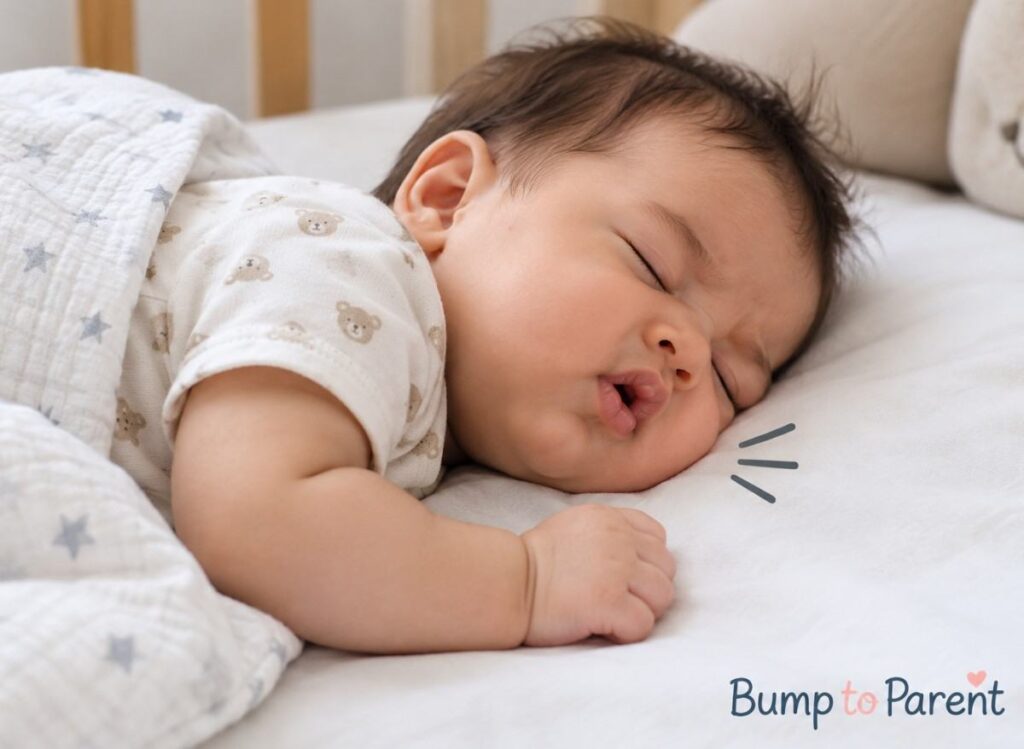

Hearing your baby grunt, groan, squeak, or make other unusual noises while sleeping can be surprising, especially during the first few weeks of life. Many parents immediately wonder whether their baby is having trouble breathing or is in pain.
The good news is that baby grunting while sleeping is often normal, particularly in newborns. Babies have immature nervous and digestive systems, relatively narrow nasal passages, and different sleep patterns from older children and adults. As a result, they can be surprisingly noisy sleepers.
However, not every type of grunting should be ignored. A repeated grunting sound that happens with every breath, especially when accompanied by fast breathing, chest retractions, nostril flaring, bluish skin, poor feeding, or unusual sleepiness, can indicate breathing difficulty and requires prompt medical attention.
This guide explains why babies grunt in their sleep, what normal newborn noises sound like, and which warning signs parents should know.
What Does Baby Grunting While Sleeping Mean?
Baby grunting while sleeping refers to a short, low-pitched sound your baby makes during sleep. It may sound like a little groan, moan, or straining noise.
Newborns commonly make many sounds while sleeping, including:
- Grunting
- Groaning
- Squeaking
- Whimpering
- Snorting
- Gurgling
- Hiccups
- Sighing
- Brief cries
- Nasal noises
Newborns can make a wide variety of grunts, squeaks, sighs, sneezes, and hiccups. Normal newborn sleep can also include movements, irregular breathing, and other noises.
So, a noisy baby does not automatically mean a sick baby.
The important question is whether the grunting is simply a sleep sound or whether it is actually part of difficult breathing.
Why Does My Baby Grunt While Sleeping?
There are several possible reasons for baby grunting while sleeping. Some are completely normal and usually improve as your baby grows.
1. Immature Sleep Patterns
Newborn sleep is very different from adult sleep. Babies spend a significant amount of time in active sleep, during which they may move their arms and legs, twitch, make facial expressions, and produce various sounds.
Their breathing may also become irregular for short periods during normal sleep.
This can make a sleeping newborn seem much more active and noisy than an older child.
2. Developing Digestive System
Gas and intestinal movement can cause babies to grunt, squirm, or strain, particularly during sleep.
Newborns are still learning how to coordinate their abdominal muscles and pelvic floor muscles when passing gas or stool. Normal gastrointestinal noises and grunting associated with pushing out stools among common newborn behaviors.
3. Nasal Congestion
Babies naturally have small nasal passages. Even a small amount of dried mucus can make their breathing sound noisy.
Your baby may therefore grunt, snort, or sound congested while sleeping even when they do not have a cold.
4. Saliva or Milk Secretions
Secretions in the throat can create gurgling or rattling sounds during sleep. Babies are still developing their ability to swallow these secretions efficiently.
This can sometimes make parents think their baby is struggling to breathe when the baby is actually breathing comfortably.
5. Active Sleep
During active sleep, babies can make noises without fully waking up.
You may notice your baby:
- Grunting
- Smiling
- Frowning
- Sucking
- Moving their arms
- Stretching
- Making brief cries
- Breathing irregularly
These behaviors can occur as babies transition between sleep stages.
6. Reflux or Spitting Up
Some babies experience reflux, in which milk moves back toward the esophagus after feeding. This can contribute to gurgling, swallowing, coughing, or noisy sleep.
Occasional spit-up is common in infants, but frequent choking, coughing during feeds, poor weight gain, or breathing problems should be discussed with a pediatrician.
7. Normal Newborn Breathing
Newborns do not always breathe in a perfectly steady rhythm.
Some babies experience periodic breathing, where breathing briefly pauses and then resumes with several faster breaths. The American Academy of Pediatrics describes short pauses of around 5 to 10 seconds as potentially normal during newborn active sleep when the baby’s color and overall condition remain normal.
Is It Normal for a Baby to Grunt While Sleeping?
Yes, occasional grunting can be normal in newborns.
If your baby is sleeping comfortably, has normal skin color, feeds well, wakes normally, and does not appear to be working hard to breathe, occasional sleep grunting is generally less concerning.
Normal newborn sleep can be surprisingly noisy. Grunting, groaning, whimpering, gurgling, and other unusual sounds as possible normal sleep behaviors.
What matters most is how your baby looks and breathes while making the sound.
A baby who makes a few grunting noises and then continues sleeping comfortably is very different from a baby who grunts with every breath and appears to be struggling.
Signs to Watch for When a Baby Is Grunting While Sleeping
Occasional grunting can be normal, but grunting with signs of breathing difficulty needs medical attention.
Signs that may need urgent medical attention:
- Grunting with every breath: The sound occurs repeatedly as your baby breathes in and out.
- Fast breathing: Your baby is breathing noticeably faster than usual.
- Chest retractions: The skin between or below the ribs pulls inward with each breath.
- Nostril flaring: The nostrils widen with each breath.
- Color changes: Lips, tongue, or face appear blue, gray, or unusually pale.
- Feeding difficulty: Your baby cannot feed normally because of breathing problems.
- Breathing pauses: Repeated or prolonged pauses in breathing occur.
- Unusual sleepiness: Your baby is difficult to wake, unusually weak, or less responsive.
- Persistent noisy breathing: The grunting or other breathing sounds continue even when your baby is awake.
If your baby has severe difficulty breathing, blue or gray coloring, or is difficult to wake, seek emergency medical care immediately.
What to Do When Your Baby Is Grunting While Sleeping?
If your baby is grunting occasionally but appears comfortable and is breathing normally, it is often part of normal newborn sleep. You can:
- Observe your baby’s breathing rather than focusing only on the sound.
- Check for nasal congestion and use saline drops or gentle suction if recommended by your pediatrician.
- Burp your baby after feeding if gas seems to be causing discomfort.
- Keep your baby on their back on a firm, flat sleep surface for every sleep.
- Avoid pillows, wedges, positioners, or inclined sleep products to try to stop the grunting.
- Do not wake your baby unnecessarily if they are sleeping comfortably, breathing normally, and have normal skin color.
- Record the sound if you are unsure whether it is normal; showing it to your pediatrician can be helpful.
Baby Grunting While Sleeping but Breathing Normally
If your baby grunts occasionally but:
- Has a normal skin color
- Is breathing comfortably
- Is feeding normally
- Has regular wet diapers
- Wakes appropriately
- Is gaining weight as expected
- Does not have persistent coughing or choking
- Does not have chest or rib retractions
the noise may simply be part of normal newborn sleep.
Parents often become more concerned at night because a quiet room makes every little sound seem louder. Listening to the baby’s breathing pattern and observing their overall appearance is more useful than focusing on the noise alone.
When Is Baby Grunting a Sign of Breathing Trouble?
Grunting becomes more concerning when it occurs with breathing rather than simply during sleep.
A baby who grunts with every breath may be trying to keep the small airways open. Respiratory distress can also cause other visible changes.
Seek urgent medical attention if your baby has grunting along with:
- Fast or difficult breathing
- Ribs pulling inward with each breath
- The skin below the ribs or around the neck sucking inward
- Flaring nostrils
- Persistent pauses in breathing
- Bluish, gray, or unusually pale lips or face
- Difficulty feeding because of breathing problems
- Weakness or unusual sleepiness
- Difficulty waking
- A sudden change in normal behavior
Grunting while breathing, very fast breathing, chest or abdominal sucking-in, and changes in skin color among signs that a baby may be seriously unwell.
The American Academy of Pediatrics similarly advises immediate evaluation when a newborn has grunting while breathing, fast breathing, nasal flaring, retractions, or persistent blue coloring.
What Does Grunting With Every Breath Mean?
Grunting with every breath is different from an occasional sleep grunt.
When a baby makes a repeated grunting sound at the end of almost every breath, it may indicate that the baby is working harder to breathe.
Possible causes can include:
- Respiratory infection
- Bronchiolitis
- Pneumonia
- Respiratory distress
- Problems related to prematurity
- Other airway or lung conditions
Newborn respiratory distress can include rapid breathing, nasal flaring, blue discoloration, and grunting during breathing.
Because babies can become seriously ill quickly, persistent breathing difficulty should not be managed at home without medical advice.
Baby Grunting While Sleeping and Congestion
A stuffy nose is another common reason a baby may sound noisy during sleep.
Babies primarily breathe through their noses, and their nasal passages are very small. Dried mucus can therefore make normal breathing sound much louder.
If your baby’s nose appears blocked, pediatric guidance may include saline nose drops and gentle removal of loosened mucus. Avoid inserting cotton swabs or other objects into the baby’s nose.
If your baby is struggling to breathe, however, do not rely on home measures. Seek medical care.
Baby Grunting While Sleeping After Feeding
Some babies become particularly noisy after feeding.
You may hear:
- Grunting
- Gurgling
- Swallowing
- Hiccups
- Small burps
- Snorting
This can happen because babies swallow air during feeding and have immature digestive systems.
Keeping the baby upright for a short period after feeding may help with swallowed air and spit-up, but babies should still be placed flat on their backs for sleep on a firm, safe sleep surface.
Do not place pillows, wedges, positioners, or other soft objects under a sleeping baby to try to reduce grunting or reflux.
Should I Wake My Baby if They Are Grunting?
If your baby makes an occasional grunt but otherwise looks comfortable and is breathing normally, you generally do not need to wake them simply because of the noise.
Instead, observe:
- Is the baby’s chest moving normally?
- Is the baby breathing comfortably?
- Is the skin color normal?
- Is the baby sleeping peacefully?
- Does the baby feed normally when awake?
- Are there any signs of breathing difficulty?
If everything appears normal, the sound may simply be part of active sleep.
If you are unsure whether the sound is coming from normal sleep or difficult breathing, contact your pediatrician.
How Can I Help a Baby Who Grunts While Sleeping?
You cannot always stop normal newborn grunting, and you do not need to.
However, you can support comfortable sleep by:
1. Keep the Nose Clear
If your baby has dried mucus or mild nasal congestion, ask your pediatrician about appropriate saline drops and gentle suctioning.
2. Follow Safe Sleep Practices
Place your baby on their back for every sleep on a firm, flat sleep surface. Avoid pillows, loose blankets, sleep positioners, and inclined sleeping products.
3. Avoid Smoke and Strong Irritants
Tobacco smoke and strong odors can contribute to nasal irritation and congestion.
4. Observe Rather Than Immediately Intervene
If the baby is breathing comfortably, an occasional grunt does not necessarily require picking them up or waking them.
5. Keep Track of Concerning Changes
If the grunting becomes much louder, more frequent, or starts happening with every breath, contact your baby’s healthcare provider.
Baby Grunting While Sleeping: Normal vs. Concerning
| Normal Sleep Grunting | Concerning Grunting |
|---|---|
| Occasional sound | Grunting with every breath |
| Baby looks comfortable | Baby appears to struggle to breathe |
| Normal skin color | Blue, gray, or unusually pale color |
| Normal feeding | Difficulty feeding because of breathing |
| No chest pulling | Ribs or chest pulling inward |
| Baby wakes normally | Baby is difficult to wake |
| No persistent breathing difficulty | Fast or labored breathing |
| Often occurs during active sleep | Continues while awake and breathing |
This distinction is important because the sound itself is not enough to determine whether a baby is sick. The baby’s breathing effort, color, feeding, alertness, and overall behavior matter.
When Should You Call a Pediatrician?
Contact your baby’s healthcare provider if you notice a new or persistent change in your baby’s breathing or behavior.
It is particularly important to seek medical advice if:
- The grunting is becoming more frequent.
- Your baby is feeding less than usual.
- Your baby tires during feeding.
- Your baby has repeated coughing or choking.
- Your baby appears unusually sleepy.
- Your baby has persistent noisy breathing.
- You notice pauses in breathing.
- Your baby has a fever, especially if they are very young.
- You are simply worried that something is not right.
For babies younger than one month, the threshold for contacting a healthcare professional should be low when the baby looks or acts abnormal.
When Is Baby Grunting an Emergency?
Call emergency medical services immediately if your baby:
- Is struggling to breathe
- Is grunting with each breath and appears distressed
- Has blue or gray lips, tongue, or face
- Has severe chest retractions
- Cannot feed because of breathing difficulty
- Is extremely difficult to wake
- Becomes limp or unusually weak
The NHS and American Academy of Pediatrics both emphasize that significant breathing difficulty, grunting with breathing, and blue or gray discoloration can require emergency care.
FAQ’s
Why does my baby grunt but seem comfortable?
Your baby may be making normal sleep or digestive sounds. Newborns often make noises while transitioning between sleep stages.
Can gas cause my baby to grunt while sleeping?
Yes. Gas and immature digestion can cause babies to strain, squirm, and grunt during sleep.
Can congestion make a baby grunt while sleeping?
Yes. Newborns have small nasal passages, so mucus or mild congestion can make their breathing sound noisy.
Why does my baby grunt after feeding while sleeping?
Swallowed air, digestion, spit-up, or reflux may contribute to grunting and other noises after feeding.
Can a baby stop breathing from grunting?
Grunting itself does not usually cause a baby to stop breathing. However, grunting accompanied by breathing pauses, blue or gray skin, or severe breathing difficulty requires urgent medical attention.
Do babies outgrow grunting during sleep?
Many newborn sleep noises become less noticeable as their nervous, respiratory, and digestive systems mature.
Should I worry if my baby grunts at night?
Not necessarily. Pay attention to breathing effort, skin color, feeding, alertness, and whether the sound occurs occasionally or with every breath.
Does grunting mean my baby has reflux?
Not necessarily. Reflux can cause gurgling, swallowing, spit-up, or discomfort, but grunting alone does not prove that a baby has reflux.
At what age do babies stop grunting in their sleep?
Most babies gradually stop grunting in their sleep by around 3–6 months of age as their breathing and digestive systems mature.
Final Thoughts
Baby grunting while sleeping is often a normal part of newborn life. Babies are naturally noisy sleepers, and their immature nervous, respiratory, and digestive systems can produce many sounds that may seem unusual to new parents.
The key is to look at the whole picture. An occasional grunt from a comfortable, normally feeding baby is very different from persistent grunting accompanied by labored breathing or color changes.
When in doubt, trust your instincts and contact your baby’s pediatrician. It is always appropriate to ask about a breathing sound that seems new, persistent, or different from your baby’s usual pattern.
Sources / References:
About the Author:
Written by: Kirti Solanki (Health Content Researcher)
Kirti Solanki creates research-based, reader-friendly health content focused on making medical and wellness information easier to understand.
Disclaimer:
This guide is for general education and does not replace professional medical advice. If a baby has breathing difficulty, blue or gray skin, severe lethargy, or other emergency symptoms, seek immediate medical care.
Also Read: