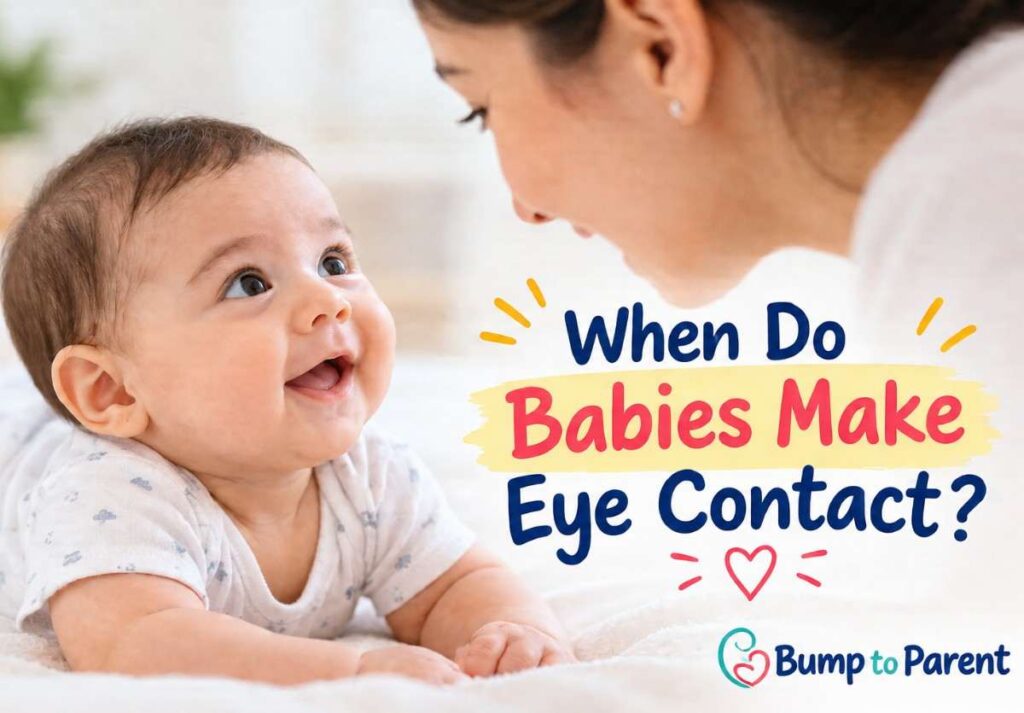

One of the sweetest moments for new parents is when their baby looks directly into their eyes. During feeding, cuddling, or quiet playtime, those little glances can feel like the beginning of a special connection. But when do babies actually start making eye contact, and what if your newborn rarely looks at your face?
Most babies begin making more intentional eye contact between 6 and 10 weeks of age, with looking at a parent’s face becoming a typical developmental milestone by around 2 months. Some babies briefly look at faces earlier, while others take more time to develop steady, consistent eye contact.
Eye contact develops alongside vision, attention, and social communication. Understanding what is typical at different ages can help you support your baby’s development without worrying about every missed glance.
When Do Babies Start Making Eye Contact?
Babies can look at faces from birth, although their vision is still developing and their attention span is short. In the first few weeks, a newborn may briefly look toward your face without consistently focusing on your eyes.
As your baby grows, these brief glances often become more deliberate. By around 2 months, most babies can look at your face, show interest when you approach, and begin smiling in response to your voice or smile.
Here is a general timeline of how eye contact and related visual skills develop.
| Baby’s age | What you may notice |
|---|---|
| Birth to 1 month | Briefly looks at faces or high-contrast shapes, especially at close range. |
| 1–2 months | Begins looking at caregivers more intentionally and may hold a gaze for a short time. |
| Around 2 months | Looks at your face, watches you move, and may smile when you talk or smile. |
| 3–4 months | Often focuses more steadily on faces and follows moving people or objects with the eyes. |
| 4–6 months | Becomes more visually engaged, recognizes familiar people, and uses eye contact during playful interactions. |
| 6–9 months | Increasingly combines looking, facial expressions, sounds, and gestures to interact with caregivers. |
These are general developmental ranges, not strict deadlines. Babies develop at different rates, and eye contact is only one part of development.
Why Is Eye Contact Important for Babies?
Eye contact is more than simply looking into someone’s eyes. It is one way babies begin to engage with people and learn about the world around them.
- Supports bonding: Looking at your face during calm moments helps create opportunities for connection between you and your baby.
- Encourages social learning: Babies gradually learn to notice facial expressions, voices, and reactions.
- Supports communication: Eye contact can become part of the back-and-forth interaction that later includes smiles, cooing, babbling, and gestures.
- Helps develop visual attention: Looking at faces and following movement gives babies opportunities to practice focusing their eyes.
- Encourages interaction: As babies grow, they may look at you to get your attention or share an enjoyable moment.
These skills develop together over time. A baby does not need to maintain prolonged eye contact to bond with a parent or learn to communicate.
Why Does My Baby Not Make Eye Contact Yet?
If your baby does not make much eye contact, it does not automatically mean something is wrong. Several everyday factors can affect how often your baby looks at you.
1. Their vision is still developing: Newborns see most clearly at close distances, approximately 8–12 inches (20–30 cm). Objects farther away may appear blurry.
2. Your baby is sleepy: Babies who are tired or drifting off to sleep may show little interest in faces.
3. Your baby is hungry or uncomfortable: Hunger, a wet diaper, gas, or general discomfort can make it harder for your baby to focus on social interaction.
4. The surroundings are distracting: Bright lights, movement, loud sounds, or several people talking may draw your baby’s attention away from your face.
5. Your baby needs a break: Babies can look away when they have had enough stimulation. Briefly looking away can be a normal way of regulating their attention.
6. Your baby is developing at their own pace: Eye contact does not become consistent overnight. Some babies need more time to develop visual attention and social engagement.
How to Encourage Eye Contact With Your Baby
You do not need special toys or complicated exercises to encourage eye contact. Simple, loving interactions throughout the day provide plenty of opportunities.
1. Hold Your Baby Close to Your Face
During calm, awake moments, hold your baby approximately 8–12 inches from your face. This is a comfortable distance for a young infant to see you clearly.
2. Talk to Your Baby Gently
Speak in a soft, natural voice while your baby is awake. Your voice may encourage your baby to look toward your face and become interested in your expressions.
3. Smile and Use Facial Expressions
Smile gently, raise your eyebrows, and make simple facial expressions. Give your baby time to notice and respond rather than expecting an immediate reaction.
4. Make Feeding Time an Opportunity
During breastfeeding or bottle-feeding, your baby may naturally look toward your face. Enjoy these moments when they happen, but do not worry if your baby is focused on feeding instead.
5. Choose the Right Time
Try interacting when your baby is calm, alert, and comfortable. The quiet-alert state is often a good time for babies to look at faces and respond to voices.
6. Follow Your Baby’s Lead
If your baby looks away, pauses, or becomes fussy, give them a break. You can try again later when they are relaxed.
Remember that eye contact should develop naturally. Avoid forcing your baby’s face toward yours or repeatedly trying to capture their attention when they are tired.
When Should You Worry About Your Baby Not Making Eye Contact?
It is reasonable to discuss your baby’s eye contact with a pediatrician if you notice that they rarely look at faces or seem unable to focus on people.
The American Academy of Pediatrics advises parents to seek medical guidance if a baby cannot make steady eye contact by around 3 months or appears unable to see. Babies should also begin following moving objects with their eyes at approximately this age.
Consider contacting your pediatrician if your baby:
- Rarely looks at your face during calm, awake moments.
- Does not seem to focus on nearby faces or objects.
- Does not follow a moving object with their eyes by around 3 months.
- Has eyes that frequently cross or drift outward after 4 months.
- Has unusual eye movements, a white or grayish-white pupil, or another noticeable eye abnormality.
- Stops doing a visual or social skill they previously demonstrated.
A lack of eye contact can have different explanations, including vision difficulties or differences in development. It does not, by itself, diagnose autism or any other condition.
If you are concerned, do not wait for a particular age or assume your baby will necessarily grow out of it. A healthcare professional can assess your baby’s vision and overall development and recommend further evaluation if needed.
Is Lack of Eye Contact a Sign of Autism?
Parents sometimes worry that limited eye contact could be an early sign of autism. Although differences in eye contact and social interaction can occur in autistic children, lack of eye contact alone is not enough to diagnose autism.
Eye contact varies among babies, especially in the early months when vision, attention, and social communication are developing. A healthcare professional considers a child’s overall pattern of social communication, behavior, developmental milestones, and medical history.
If your baby consistently avoids looking at faces, does not respond as expected during interactions, or shows other developmental concerns, discuss these observations with your pediatrician. Early evaluation can help identify any support your child may need.
FAQ’s
Should a newborn make eye contact?
Newborns may briefly look at faces, but their vision and attention are still developing, so consistent eye contact is not expected.
When do babies make consistent eye contact?
Many babies develop steadier visual attention by around 3 months, although individual development varies.
Is it normal for a 2-month-old baby to avoid eye contact?
Occasional looking away is normal, but if your baby rarely looks at faces, discuss your concerns with a pediatrician.
When do babies make eye contact and smile?
Babies often begin smiling in response to people around 2 months of age, along with becoming more attentive to faces.
Can babies recognize their parents through eye contact?
Babies become familiar with their caregivers through a combination of sight, voice, smell, and touch rather than eye contact alone.
Do premature babies make eye contact later?
Premature babies may reach developmental milestones later than full-term babies. Healthcare professionals often consider corrected age when assessing their development.
Should a 1-month-old baby make eye contact?
A 1-month-old may briefly look at your face, especially when held close. Eye contact may still be inconsistent because the baby’s vision and attention are developing.
Is it normal for a baby to avoid eye contact?
Yes, occasional eye contact avoidance is normal in babies, especially when they are tired, hungry, or overstimulated. However, consult a pediatrician if your baby consistently avoids looking at faces or shows other developmental concerns.
How much eye contact is normal for babies?
There is no fixed amount of eye contact that is normal for every baby. Newborns may look at faces briefly, while babies around 2–3 months often show more intentional eye contact. What matters is their overall visual and social development.
When do babies make eye contact while breastfeeding?
Babies may briefly look at their mother’s face during breastfeeding from the early weeks, but more intentional eye contact often develops around 6–10 weeks. Not every baby looks up during feeding, and this is not necessarily a concern.
When will a premature baby make eye contact?
Premature babies may develop eye contact later than full-term babies. Doctors often use corrected age, calculated from the baby’s due date, when assessing developmental milestones. If your premature baby rarely looks at faces or you have concerns about their vision, consult your pediatrician.
Conclusion
Babies usually begin making more intentional eye contact during the first two months of life, with visual attention becoming steadier as they grow. These early glances help babies explore faces, interact with caregivers, and develop social communication skills.
Every baby develops at an individual pace, so occasional missed glances are not necessarily a cause for concern. Offer plenty of calm opportunities to talk, smile, cuddle, and connect with your baby. If eye contact remains limited or you notice other developmental concerns, consult your pediatrician for personalized guidance.
Sources / References:
Disclaimer:
This guide is for educational purposes only and does not replace professional medical advice, diagnosis, or treatment. Consult your pediatrician if you have concerns about your baby’s vision or development.
Also Read:



Pingback: When Do Babies Start Understanding Words?