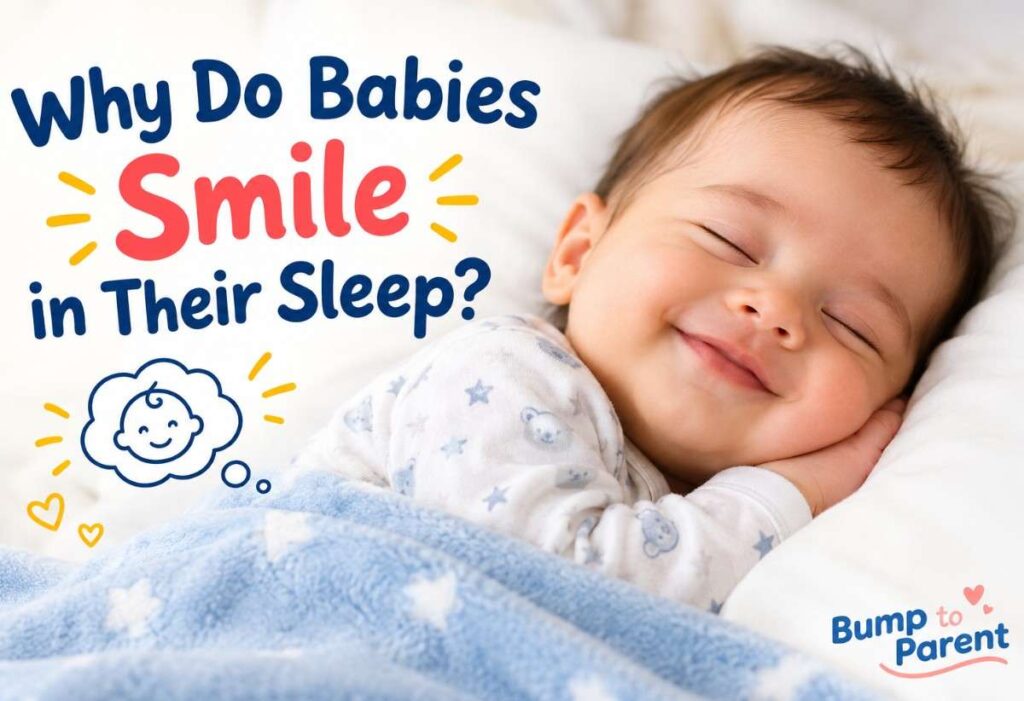

Watching your baby sleep peacefully and suddenly break into a little smile is one of the sweetest moments of parenthood. You might wonder whether your little one is having a happy dream, remembering your face, or simply reacting to something happening inside their tiny body.
The good news is that babies smiling in their sleep is usually a normal part of early development. These little smiles are particularly common in newborns and are often associated with active sleep, when the brain is busy and small movements can occur.
However, a baby’s sleeping smile does not necessarily mean they are happy or dreaming about something pleasant. Researchers are still learning about why infants make different facial expressions during sleep.
In this guide, we will explore the reasons babies smile in their sleep, what these expressions mean at different ages, how sleep smiles differ from social smiles, and when parents should seek medical advice.
Why Do Babies Smile in Their Sleep?
Babies commonly smile during sleep because of involuntary facial movements and activity in the developing nervous system. These smiles often occur during active sleep, a stage similar to rapid eye movement (REM) sleep in adults.
During active sleep, babies may move their eyes beneath closed eyelids, twitch their arms and legs, make sucking movements, frown, or briefly smile. These behaviors are generally normal when the baby otherwise appears comfortable and healthy.
A research study published in the Journal of Sleep Research recorded 383 spontaneous smiles in newborns and found that 377 occurred during active sleep. This supports the association between sleep smiles and this stage of infant sleep, although it does not explain every smile or establish what a baby might be experiencing.
Another important point is that newborns’ smiles are usually spontaneous or reflexive rather than deliberate social expressions. As babies grow, their smiling behavior becomes more varied, especially when they are awake and interacting with caregivers.
7 Common Reasons Babies Smile in Their Sleep
1. Active Sleep
Active sleep is one of the most common explanations for newborns smiling while asleep. During this stage, the brain remains active, and babies may display facial expressions or small body movements.
You might notice your baby’s mouth briefly turning upward, followed by a twitch of the cheek or movement beneath the eyelids. These expressions generally do not mean that your baby has consciously decided to smile.
2. Developing Brain and Nervous System
A baby’s brain develops rapidly during the first months of life. As the nervous system matures, it coordinates increasingly complex movements, including those involving the facial muscles.
Some spontaneous smiles may reflect activity in the neural circuits involved in facial expression. Researchers believe that these early movements may be connected to the development of the systems babies later use for intentional expressions.
3. Natural Reflexes
Newborns often make facial expressions without consciously controlling them. Smiling, grimacing, sucking motions, and brief twitches can occur spontaneously during sleep.
These reflex-like expressions are particularly common in the early weeks after birth. They are different from the deliberate smiles babies gradually begin directing toward familiar people.
4. Transitions Between Sleep Stages
Babies move between different stages of sleep throughout a nap or nighttime sleep. Their facial expressions and movements may change as they enter, leave, or move through active sleep.
A baby might smile briefly, move their lips, stretch their fingers, and then settle into a quieter sleep stage. These changes are usually harmless when they occur without other concerning symptoms.
5. Normal Facial Muscle Activity
The muscles around a baby’s mouth, cheeks, and eyes can move spontaneously during sleep. A brief contraction of these muscles may look like a grin, smirk, or tiny laugh.
Although these expressions can look meaningful to a parent, they do not necessarily reflect a particular emotion. A sleeping smile is not, by itself, proof that a baby is experiencing happiness.
6. Changing Sleep Patterns as Babies Grow
Newborn sleep differs from the sleep patterns of older infants and adults. Young babies spend a substantial proportion of their sleep in active sleep, making small movements and facial expressions particularly noticeable.
As babies mature, their sleep patterns change. Parents may notice that their baby’s sleep smiles become less frequent, look different, or occur alongside other expressions. Variation alone is not usually a reason for concern.
7. Possible Dream-Related Activity
Parents often imagine that their baby is smiling because of a happy dream. Although babies experience active sleep, scientists cannot reliably determine what a newborn dreams about or whether a particular smile is a response to dream content.
It is therefore more accurate to say that sleep smiles are associated with active sleep than to claim that babies are definitely dreaming about their parents, feeding, or another pleasant experience.
Do Babies Dream When They Smile in Their Sleep?
Babies have active sleep patterns similar in some ways to REM sleep in adults, the stage commonly associated with vivid dreaming. However, this similarity does not prove that newborns experience dreams in the same way adults do.
Newborns have limited experience and are still developing the brain systems involved in memory, perception, and emotional processing. Researchers cannot ask a newborn to describe a dream, so the content and nature of infant dreams remain uncertain.
If your baby smiles while sleeping, enjoy the moment without feeling that you need to identify the cause. The expression may simply be a normal part of the baby’s developing sleep and nervous system.
Is It Normal for Newborns to Smile in Their Sleep?
Yes. Sleep smiles are common in newborns and are generally considered normal when they occur on their own and the baby otherwise appears well.
During the first few weeks, a baby’s smile is usually spontaneous rather than a deliberate response to another person. You may see the expression shortly after feeding, during a nap, or while your baby is moving through active sleep. The timing does not necessarily reveal what caused the smile.
A newborn may also twitch, briefly frown, move their lips, or make little noises while sleeping. These behaviors can be part of normal infant sleep.
However, if a facial movement is repetitive, unusually prolonged, or accompanied by stiffness, abnormal eye movements, breathing difficulties, or changes in skin color, seek medical advice rather than assuming it is a normal sleep smile.
When Do Babies Start Smiling on Purpose?
Babies usually begin developing social smiles at around 6 to 8 weeks of age, although the timing varies. A social smile is a smile that occurs in response to a familiar face, voice, or interaction.
Here is a general guide to how smiling may develop:
| Baby’s age | What parents may notice |
|---|---|
| Birth to 4 weeks | Brief, spontaneous smiles during sleep or while drowsy |
| Around 6–8 weeks | Early social smiles in response to faces or interaction |
| 2–3 months | More frequent smiling during face-to-face interaction |
| 3–4 months | Increasingly varied facial expressions and social responses |
| 4–6 months | More expressive interactions, including laughter and joyful vocalizations |
These ages are approximate, not strict deadlines. Babies develop at different rates, and premature babies may need to be assessed using their corrected age.
If your baby is not showing a social smile by around 3 months, or you have concerns about eye contact, responsiveness, or other developmental milestones, discuss them with your pediatrician.
What Is the Difference Between a Sleep Smile and a Social Smile?
A sleep smile usually occurs spontaneously while the baby is asleep. A social smile happens when a baby is awake and responds to a person or interaction.
The main differences include:
- Timing: Sleep smiles occur during sleep, while social smiles usually happen when the baby is awake.
- Purpose: Sleep smiles are often involuntary, whereas social smiles can help babies interact with caregivers.
- Eye contact: A social smile may occur alongside looking at a familiar face, while a sleeping baby generally has closed eyes.
- Communication: Social smiles become an important part of early communication, while a sleep smile does not necessarily convey a message.
- Development: Sleep smiles can appear from birth, while deliberate social smiling typically develops during the first several weeks.
Both are normal parts of infant development, but they do not necessarily have the same meaning.
Is It Normal for Babies to Laugh or Make Noises in Their Sleep?
Yes, babies may make small sounds during sleep, including grunts, sighs, squeaks, and brief laugh-like noises. These can occur alongside facial movements during active sleep.
A quiet giggle or a short sound is not necessarily a sign that your baby is having a dream. It may simply accompany normal sleep-related activity.
Pay attention to the overall pattern rather than one isolated sound. If your baby appears comfortable, maintains a normal skin color, and breathes without difficulty, brief noises are often harmless.
Seek prompt medical attention if your baby has persistent breathing difficulty, turns blue or gray, becomes unusually unresponsive, or has repeated episodes involving abnormal movements.
Should You Wake a Baby Who Smiles in Their Sleep?
No. You generally do not need to wake a baby simply because they smile, twitch briefly, or make a small noise while sleeping.
If your baby is breathing comfortably and otherwise appears well, let them continue sleeping. Waking them to check whether the smile was intentional is unnecessary.
You can observe your baby quietly if you are curious about their sleep patterns. If a movement looks unusual or concerns you, a short video may help your pediatrician understand what happened, provided you can record it without delaying care or compromising your baby’s safety.
Always follow safe-sleep guidance: place your baby on their back for every sleep, use a firm, flat sleep surface, and keep pillows, loose blankets, and soft objects out of the sleep space.
When Should You Worry About a Baby Smiling in Their Sleep?
A smile by itself is rarely a cause for concern. What matters is whether the movement occurs with other unusual signs.
Contact your pediatrician if you notice:
- Repeated, highly similar episodes of facial movements that seem difficult to interrupt.
- Unusual stiffening, rhythmic jerking, or repeated movements of the face or limbs.
- Abnormal eye movements or episodes in which your baby seems unusually unresponsive.
- A noticeable change in your baby’s usual behavior, feeding, or alertness.
- Developmental concerns, including a lack of social smiling by around 3 months.
Seek emergency medical care if your baby has difficulty breathing, turns blue or gray, becomes unresponsive, or experiences a suspected seizure that requires urgent assessment. Do not delay emergency care to record an episode.
These signs do not automatically mean that your baby has a neurological condition. They simply deserve appropriate assessment rather than being dismissed as ordinary sleep behavior.
How Can You Support Healthy Sleep and Development?
You do not need to encourage sleep smiles. Instead, focus on helping your baby sleep safely and supporting healthy interaction during waking hours.
- Follow safe-sleep practices: Put your baby on their back for every sleep on a firm, flat, uncluttered surface.
- Create a calming routine: Gentle singing, feeding, and cuddling before sleep can help establish predictable bedtime habits.
- Respond to your baby’s needs: Feed, comfort, and change your baby when needed rather than trying to trigger a sleeping smile.
- Interact while your baby is awake: Talk, smile, and make gentle eye contact when your baby is alert and receptive.
- Observe developmental changes: Notice how your baby responds to faces, voices, and everyday interactions over time.
- Ask questions when concerned: Your pediatrician can help distinguish normal infant sleep behaviors from movements that require further evaluation.
Remember that babies do not need to smile frequently during sleep to be developing normally. Every infant has their own sleep patterns and temperament.
FAQ’s
Why does my baby smile while sleeping after feeding?
A baby may smile after feeding because of normal sleep-related facial movements. The timing does not necessarily mean the baby is reacting to the feeding itself.
Why does my baby smile and twitch while sleeping?
Brief smiles and small twitches can occur during active sleep as part of normal infant sleep behavior. Repeated unusual movements or movements accompanied by stiffness or unresponsiveness should be assessed by a pediatrician.
Do babies smile in their sleep because they feel happy?
A sleeping smile does not necessarily indicate happiness. Newborn smiles are often spontaneous rather than deliberate expressions of emotion.
Why does my baby smile in their sleep with their eyes closed?
Babies often smile with their eyes closed because of spontaneous facial movements during active sleep. This is usually a normal part of newborn development.
Why does my baby smile in their sleep and then frown?
Babies may change their facial expressions as they move through different sleep stages. Brief smiling, frowning, and twitching are generally normal.
Why does my 2-month-old baby smile in their sleep?
Two-month-old babies may still have spontaneous sleep smiles. Around this age, many also begin developing social smiles when they see or interact with caregivers.
Why does my baby smile in their sleep without making a sound?
A sleeping smile can involve only the facial muscles, without laughter or vocalization. This is common and generally does not indicate a problem.
Can gas cause a baby to smile in their sleep?
Gas can cause facial movements, grimacing, or changes in comfort, but a smile alone does not establish that gas is the cause. Look for other signs of discomfort, such as crying or drawing the legs toward the abdomen.
Why does my baby smile in their sleep and move their mouth?
Babies may make sucking movements, purse their lips, or smile during active sleep. These movements are often normal, but unusual repetitive movements should be discussed with a pediatrician.
Do premature babies smile in their sleep?
Yes, premature babies can display spontaneous facial expressions during sleep. Their development should be considered in relation to their gestational age and corrected age.
Can babies smile in their sleep from birth?
Yes, spontaneous smiles can appear shortly after birth. These early expressions differ from the social smiles that typically emerge during the first several weeks.
Why does my baby smile in their sleep but rarely smile when awake?
Sleep smiles and social smiles develop differently. If your baby is around 3 months old and rarely responds to faces or interaction with a smile, discuss your concerns with a pediatrician.
Does a baby smiling in their sleep mean they are comfortable?
Not necessarily. A smile alone cannot reliably indicate comfort, hunger, or satisfaction. Check your baby’s overall behavior, breathing, and other cues.
Can a baby smile in their sleep during a growth spurt?
Babies may continue smiling during sleep while growing, but there is no established evidence that growth spurts directly cause sleep smiles.
When babies smile in their sleep, do they see angels?
There is no scientific evidence that babies see angels while sleeping. Their smiles are usually linked to normal brain activity and active sleep.
Why do newborns smile and cry in their sleep?
Newborns may smile, whimper, or cry briefly during active sleep as their brains and nervous systems develop.
Final Thoughts
Babies smile in their sleep for several possible reasons, most commonly spontaneous facial movements associated with active sleep and early nervous system development. These little expressions are generally normal and do not necessarily mean that your baby is dreaming or feeling a particular emotion.
As your baby grows, you may begin to notice more deliberate smiles and increasingly interactive expressions while they are awake. These social smiles are an exciting part of early communication and bonding.
Enjoy your baby’s little sleeping smiles, but pay attention to the bigger picture. If the movements occur with unusual stiffness, repeated jerking, breathing problems, or changes in responsiveness, seek medical advice.
Sources / References:
Disclaimer:
This guide is for educational purposes only and does not replace professional medical advice, diagnosis, or treatment. Consult a qualified pediatrician if you have concerns about your baby’s sleep, movements, or development. Seek emergency care for serious symptoms such as breathing difficulties or unresponsiveness.
Also Read: