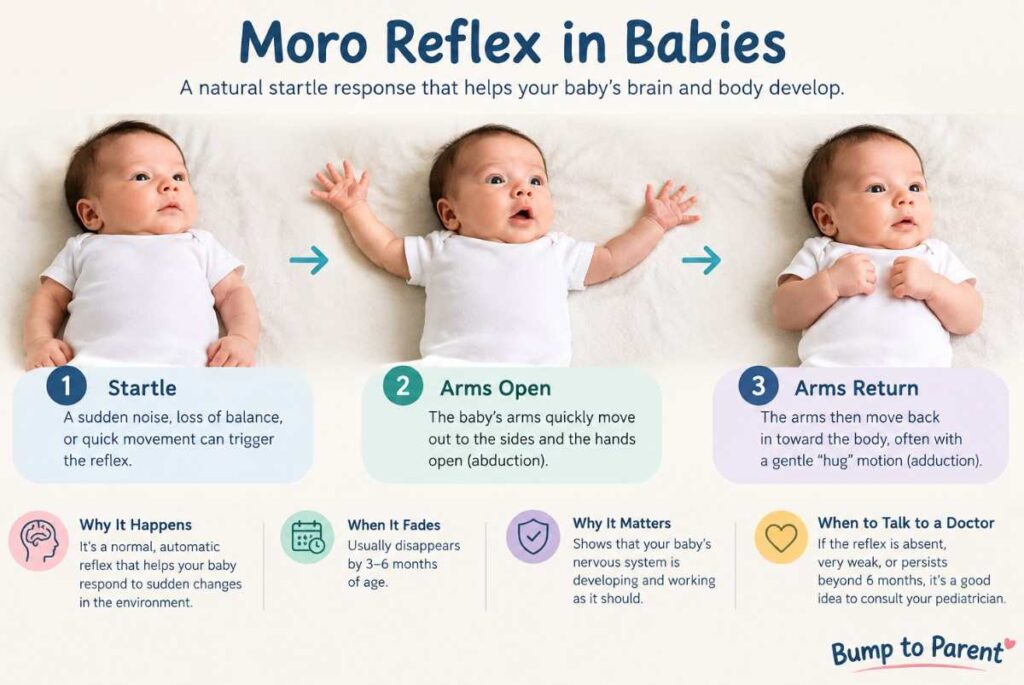

The sudden throwing out of a baby’s arms, opening of the hands, and crying can be surprising for new parents. You may notice it when your baby hears a loud sound, experiences a sudden movement, or seems to feel as though they are falling. This is usually the Moro reflex, also called the startle reflex.
The Moro reflex is a normal newborn reflex controlled by the immature nervous system. It is present from birth and gradually fades as a baby’s nervous system and voluntary motor control develop. It commonly peaks during the first month and begins to disappear after about two months, although normal timing can vary.
Understanding the Moro reflex can help parents distinguish normal newborn behavior from movements that may need medical attention.
What Is the Moro Reflex in Babies?
The Moro reflex is an involuntary response that occurs when a baby is suddenly startled or senses a sudden change in position or support.
It is one of several primitive newborn reflexes that babies are born with. These automatic movements are part of early neurological development and generally become less noticeable as babies gain better control over their muscles and movements.
During a Moro reflex, a baby may suddenly:
- Extend both arms and legs.
- Open their hands and spread their fingers.
- Move their arms outward.
- Bring their arms back toward their body.
- Bend their legs.
- Cry or briefly become upset.
Not every baby reacts with exactly the same intensity. Some babies may startle dramatically, while others may show only a subtle arm movement.
Why Does the Moro Reflex Happen?
The Moro reflex is believed to be an automatic protective response to sudden changes or unexpected stimulation.
A newborn has limited control over their muscles and nervous system. When the baby experiences a sudden stimulus, the brain and nervous system can trigger this involuntary movement before the baby has the ability to consciously respond.
Common triggers include:
- A loud noise.
- Sudden movement.
- A sudden change in head position.
- Being placed down quickly.
- Feeling as though they are falling.
- A sudden touch.
- Bright or unexpected stimulation.
- Losing physical support briefly.
According to the American Academy of Pediatrics, an abrupt shift in the baby’s head position or a sudden loud or unexpected stimulus can trigger the Moro reflex.
What Does the Moro Reflex Look Like?
The response often happens in stages.
Stage 1: Sudden Startle
The baby’s body may suddenly stiffen, and the arms may move away from the body.
Stage 2: Arms and Fingers Open
The baby may extend the arms, open the hands, and spread the fingers.
Stage 3: Arms Come Back In
The baby then brings the arms back toward the body.
Stage 4: Crying
Some babies cry immediately after the movement, while others settle without crying.
The entire response is generally brief. Merck Manual describes the Moro response as including arm extension with the fingers extended, leg movement, and crying following a startle.
When Does the Moro Reflex Start?
The Moro reflex is present around birth and is considered a normal neonatal reflex.
In premature babies, reflexes can develop according to gestational age. Merck Manual notes that the Moro reflex begins developing during the late second to early third trimester and is well established by approximately 37 weeks of gestation.
This means the timing can differ somewhat between premature and full-term babies.
When Does the Moro Reflex Disappear?
The Moro reflex normally becomes less noticeable as a baby’s nervous system matures.
The Moro reflex as appearing at birth and generally disappearing around 2 months, while other pediatric guidance describes it as gradually resolving over the first several months.
There is therefore some variation in published descriptions of the exact age when it disappears.
Parents should not expect every baby to stop showing the reflex on exactly the same day or week.
General Moro Reflex Timeline
| Baby’s Age | What Parents May Notice |
|---|---|
| Birth | Moro reflex is normally present |
| First few weeks | Reflex may be very noticeable |
| Around 1 month | It may be particularly prominent |
| Around 2 months | Reflex often begins fading |
| 3–4 months | It should generally become much less prominent |
| Beyond early infancy | Persistent or unusual reflexes should be discussed with a pediatrician |
The exact timeline can vary, so the baby’s overall movement and development are important when interpreting reflexes.
Is the Moro Reflex Normal?
Yes. In a newborn, the Moro reflex is generally normal and expected.
It does not mean that your baby is frightened in the same emotional sense that an older child or adult might be frightened. The movement is an automatic neurological response.
Newborns have several reflexes that help them respond to their environment, including the rooting, sucking, grasping, and stepping reflexes. These reflexes gradually change as babies develop more purposeful control over their movements.
What Can Trigger the Moro Reflex?
The reflex can occur during everyday activities.
1. Loud Sounds
A sudden door closing, barking dog, loud voice, or other unexpected noise can startle a baby.
2. Sudden Movement
Moving a baby quickly or changing their position unexpectedly may trigger the reflex.
3. Being Put Down
Some babies startle when they are transferred from someone’s arms to a crib or other sleeping surface.
4. Changes in Head Position
A sudden change in the baby’s head or body position can stimulate the reflex.
5. Touch or Temperature Changes
An unexpected sensation, such as sudden touch or a change in the environment, may also cause a baby to startle.
How to Reduce or Eliminate Moro Reflex in Newborn?
You generally cannot stop or eliminate the Moro reflex, because it is a normal newborn reflex that gradually fades as the baby’s nervous system matures. However, you can reduce how often it wakes or startles your baby:
- Swaddle safely: A properly fitted swaddle can limit sudden arm movements. Stop swaddling as soon as your baby shows signs of trying to roll.
- Use gentle movements: Move your baby slowly when picking them up, putting them down, or changing positions.
- Support the head and neck: Keep your baby’s head and body well supported during transfers.
- Reduce sudden stimulation: Keep the sleep environment calm and avoid sudden loud noises or bright lights.
- Try gradual transfers: When putting your baby down, keep them close to your body and lower them slowly while maintaining support.
- Follow safe sleep practices: Always place your baby on their back on a firm, flat sleep surface without pillows, loose blankets, or other soft objects.
- Give it time: The Moro reflex naturally becomes less noticeable during the first few months.
Do not intentionally drop, jerk, or suddenly move your baby to trigger or test the reflex.
If the reflex is consistently present on only one side, seems unusually strong or unusual, or continues well beyond the expected age, discuss it with your pediatrician.
Why Does My Baby Startle While Sleeping?
Parents commonly notice the Moro reflex when their baby is asleep.
A newborn may suddenly move their arms, open their hands, jerk their body, and wake up crying. This can be especially noticeable during lighter stages of sleep.
The newborns may startle themselves awake because of the involuntary Moro reflex.
This does not necessarily mean something is wrong with your baby’s sleep.
Moro Reflex and Swaddling
Some parents use swaddling to reduce the amount of startling that wakes their baby.
A properly used swaddle can make a newborn feel secure and limit sudden arm movements. However, safe-sleep recommendations are important.
A baby should always be placed on their back for sleep, and swaddling should not be used once a baby begins showing signs of trying to roll. The baby’s sleeping environment should also remain free of loose bedding and other soft objects.
Swaddling should never be so tight that it restricts normal breathing or hip movement.
Parents who are unsure how to swaddle safely can ask their pediatrician or another qualified healthcare professional for guidance.
Can the Moro Reflex Wake a Baby?
Yes. The sudden movement associated with the Moro reflex can wake some babies.
A baby may fall asleep peacefully and then suddenly:
- Throw their arms outward.
- Open their hands.
- Move their legs.
- Cry.
- Wake completely.
This can be frustrating for parents, particularly during nighttime sleep, but it is often part of normal newborn development.
As the nervous system matures and the reflex fades, babies typically gain greater voluntary control over their movements.
Moro Reflex vs. Startle Reflex
The terms Moro reflex and startle reflex are often used interchangeably when discussing newborns.
The Moro reflex is a specific primitive reflex involving a characteristic sequence of movements following a sudden stimulus or change in support.
Older babies and children can also have a startle response, but the classic Moro reflex is particularly associated with newborn neurological development.
Is the Moro Reflex the Same on Both Sides?
The Moro reflex is generally expected to appear symmetrically.
Both arms should normally respond in a similar way. The American Academy of Pediatrics specifically advises parents to tell their pediatrician if the reflex appears different on one side or if the baby consistently moves one side of the body better than the other.
An asymmetric response does not automatically mean there is a serious problem, but it deserves professional evaluation.
What If My Baby Does Not Have a Moro Reflex?
A Moro reflex that is absent, very weak, or noticeably different from one side to the other may warrant evaluation by a pediatrician.
Healthcare professionals do not assess the Moro reflex in isolation. They consider the baby’s age, gestational age, muscle tone, movements, feeding, neurological examination, and overall development.
For example, premature babies may have reflexes that develop differently because neurological maturation occurs according to gestational age.
If you are concerned that your baby does not startle or move normally, mention it during a pediatric appointment rather than trying to repeatedly test the reflex at home.
What If the Moro Reflex Is Strong?
Some babies have a very noticeable Moro reflex.
A strong reflex does not necessarily mean that something is wrong. Newborns vary in how dramatically they respond to sounds, movement, touch, and other stimuli.
However, if the movements seem unusual, occur without an apparent trigger, involve repeated rhythmic jerking, or are accompanied by changes in breathing, color, responsiveness, or feeding, medical evaluation is appropriate.
Can You Test the Moro Reflex at Home?
Parents generally do not need to deliberately trigger the Moro reflex.
Healthcare professionals may assess newborn reflexes as part of a neurological examination. Merck Manual describes specific clinical techniques for eliciting the reflex, but these maneuvers are not something parents need to reproduce at home.
Instead, simply observing your baby’s natural movements is usually enough.
Avoid intentionally dropping, jolting, or suddenly moving your baby to see whether the reflex occurs.
When Should Parents Contact a Pediatrician?
Talk with your baby’s pediatrician if you notice:
- The Moro reflex consistently occurs on only one side.
- One arm or leg appears to move less than the other.
- Your baby appears unusually stiff or unusually floppy.
- The reflex seems to persist well beyond the expected newborn period.
- Your baby loses a movement or skill they previously had.
- Your baby has repeated movements that do not appear related to startling.
- You are concerned about your baby’s overall development.
The CDC emphasizes that developmental monitoring helps families and healthcare professionals identify concerns that may require further screening or evaluation.
Seek Urgent Medical Care If
A newborn should receive prompt medical attention if unusual movements occur along with severe breathing difficulty, blue or gray lips or face, inability to wake, marked weakness, or suspected seizures. HealthyChildren.org recommends emergency evaluation for these types of concerning symptoms.
Moro Reflex and Development
The disappearance of primitive reflexes is part of the broader process of neurological maturation.
As babies grow, movements that were once automatic gradually become more purposeful. Instead of simply reacting with a reflex, babies begin to control their head, reach toward objects, move their arms intentionally, and interact with their surroundings.
The American Academy of Pediatrics notes that many newborn reflexes gradually give way to voluntary movements during the first few months of life.
The Moro reflex itself is therefore only one small part of a baby’s neurological development.
Other Common Newborn Reflexes
Babies are born with several reflexes besides the Moro reflex.
| Reflex | Typical Response |
|---|---|
| Moro reflex | Startles and extends then brings arms inward |
| Rooting reflex | Turns toward touch around the cheek or mouth |
| Sucking reflex | Begins sucking when the mouth is stimulated |
| Palmar grasp | Grasps when the palm is touched |
| Stepping reflex | Makes stepping movements when held upright with feet touching a surface |
| Tonic neck reflex | Turns the head and positions the arms in a characteristic posture |
These reflexes have different timelines and purposes. The American Academy of Pediatrics provides approximate ages for when several newborn reflexes disappear, but individual variation is normal.
FAQ’s
Why does my baby suddenly throw their arms out?
A sudden noise, movement, touch, or change in head or body position can trigger the Moro reflex, causing your baby to throw their arms outward.
Does the Moro reflex mean my baby is scared?
Not necessarily. The Moro reflex is an automatic neurological response and does not necessarily indicate that your baby is emotionally frightened.
Is it normal for the Moro reflex to make a baby cry?
Yes. Some babies cry briefly after experiencing the Moro reflex, while others may simply startle and settle without crying.
What if my baby’s Moro reflex is only on one side?
A consistently one-sided Moro reflex should be discussed with a pediatrician because the normal response is generally symmetrical.
Can a strong Moro reflex be a problem?
A strong Moro reflex can be normal in young newborns, but unusual, persistent, or asymmetric movements should be evaluated by a pediatrician.
Can swaddling reduce the Moro reflex?
Swaddling does not remove the reflex, but it can limit sudden arm movements and may help some newborns remain settled. Safe-swaddling and safe-sleep recommendations should always be followed.
What happens if the Moro reflex does not disappear?
If the reflex remains unusually prominent beyond the expected period, or occurs along with abnormal muscle tone, asymmetric movement, or developmental concerns, consult your baby’s pediatrician.
Is the Moro reflex the same as the startle reflex?
The Moro reflex is a specific primitive newborn reflex often described as a startle response. Older babies and children can also have startle responses that are not necessarily the classic Moro reflex.
Why does my baby wake up when I put them down?
A change in position or loss of the sensation of being supported can trigger the Moro reflex, causing some babies to suddenly move their arms and wake.
Does every baby have a Moro reflex?
The Moro reflex is expected in healthy newborns, although its intensity can vary between babies. Premature babies may show reflexes differently depending on their gestational age.
Can the Moro reflex affect baby sleep?
Yes. Sudden arm and body movements caused by the reflex can occasionally wake a newborn or make it harder for them to remain asleep.
When should I worry about the Moro reflex?
Speak with a pediatrician if the reflex is consistently absent, clearly asymmetric, unusually persistent, or associated with unusual movements, stiffness, weakness, feeding problems, or developmental concerns.
How to check Moro reflex in newborn?
Parents do not need to deliberately test the Moro reflex at home because sudden movements can startle or upset a newborn; a pediatrician can safely assess the reflex during a routine examination.
Why is my baby’s Moro reflex so strong?
A strong Moro reflex can be normal during the first weeks of life because newborns have immature nervous systems, but a consistently extreme, one-sided, or unusual response should be discussed with a pediatrician.
When does the Moro reflex become weaker?
The Moro reflex generally becomes less noticeable as the baby’s nervous system matures and usually fades during the first few months of life.
Final Thought
The Moro reflex is a normal startle reflex in newborn babies. It can make a baby suddenly extend their arms, open their hands, move their legs, and sometimes cry after a loud sound or unexpected movement. It is usually strongest during the early weeks and gradually fades as the nervous system matures.
Parents should pay particular attention to persistent asymmetry, unusual movements, changes in muscle tone, loss of developmental skills, or other concerning symptoms. When in doubt, discussing your baby’s movements with a pediatrician is the safest approach.
Sources / References:
About the Author
Written by: Kirti Solanki is a health content researcher who focuses on creating clear, reader-friendly health and wellness content based on reliable medical and scientific sources.
Disclaimer:
This guide is intended for educational and informational purposes only and is not a substitute for professional medical advice, diagnosis, or treatment. Every baby develops differently. If you have concerns about your baby’s reflexes, movements, feeding, breathing, development, or overall health, consult a qualified pediatrician or healthcare professional promptly. In an emergency, seek immediate medical care.
Also Read: