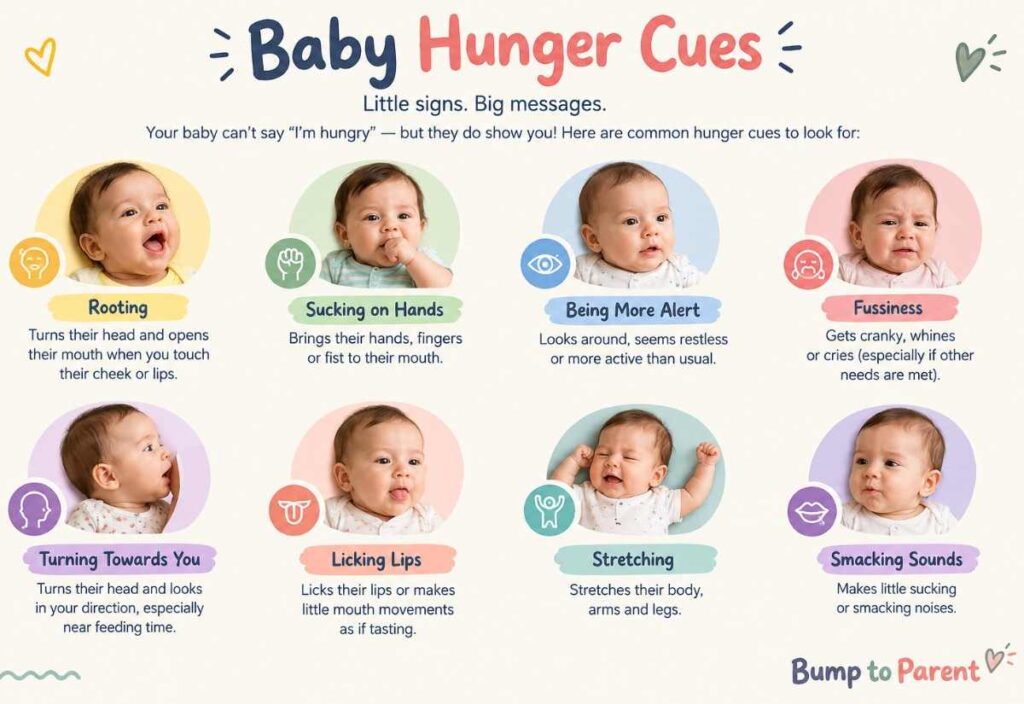

Understanding baby hunger cues can make feeding feel much less stressful, especially during the newborn months. Babies cannot tell you that they are hungry with words, but they communicate through movements, sounds, facial expressions, and changes in behavior.
Learning these early signs can help parents feed their baby before hunger turns into intense crying. This approach is often called responsive feeding, where parents observe and respond to their baby’s hunger and fullness signals rather than relying only on a strict clock-based schedule.
Every baby is different, so hunger cues can vary with age, temperament, feeding method, and individual needs.
What Are Baby Hunger Cues?
Baby hunger cues are the behaviors babies use to communicate that they are ready to feed. These cues can appear before crying and may become easier for parents to recognize with practice.
Common early hunger cues include:
- Opening and closing the mouth
- Smacking or licking the lips
- Moving the head from side to side
- Rooting toward the breast or bottle
- Becoming more alert or active
- Bringing hands toward the mouth
- Sucking on fingers or hands
- Making sucking noises
- Moving arms and legs more actively
- Turning toward the breast or bottle when offered
Crying can also occur when a baby is hungry, but it is generally considered a later hunger cue. A baby who has become very upset may have more difficulty settling down to feed.
Early, Mid and Late Baby Hunger Cues
Recognizing the progression of hunger cues can be particularly helpful for new parents.
| Stage | Common Hunger Cues |
|---|---|
| Early hunger cues | Stirring, waking, opening the mouth, licking lips, moving hands |
| Middle hunger cues | Rooting, sucking hands, increased movement, turning toward the breast or bottle |
| Late hunger cues | Crying, fussing, becoming red or agitated, rapid movements |
Whenever possible, responding to the earlier signs can make feeding more comfortable for both parent and baby.
15 Common Baby Hunger Cues
1. Rooting
Rooting is one of the most recognizable newborn feeding cues. Your baby may turn their head toward your hand or toward the breast when their cheek or mouth is touched.
2. Lip Smacking
A baby may repeatedly smack, lick, or move their lips when they are beginning to feel hungry. This can be an easy cue to miss because it is subtle.
3. Opening the Mouth
Repeatedly opening the mouth, especially while moving the head or turning toward the breast or bottle, can indicate that your baby is ready to feed.
4. Bringing Hands to the Mouth
Babies frequently bring their hands toward their mouth when hungry. Hand-sucking alone does not always mean hunger, but when combined with other cues, it can be meaningful.
5. Sucking Movements
Your baby may begin making sucking motions with their lips or tongue even before feeding begins.
6. Becoming More Alert
A sleepy newborn may suddenly become more awake, look around, or move more actively when they are becoming hungry.
7. Turning the Head From Side to Side
Head movements from side to side may be part of rooting as the baby searches for the breast or bottle.
8. Increased Arm and Leg Movement
Some babies become more physically active when they are ready to eat. You may notice kicking, waving their arms, or increased body movement.
9. Making Small Sounds
Grunting, sucking noises, whimpering, or other small sounds can sometimes accompany early hunger cues.
10. Nuzzling
A baby may move their face against your chest or shoulder, particularly when being held close to the body.
11. Trying to Suck on Objects
A baby may try to suck on their fingers, hands, clothing, or other nearby objects. This can indicate hunger, although sucking is also a normal way babies comfort themselves.
12. Becoming Restless
A previously calm baby may start squirming, moving their head, or becoming restless when they are ready for a feeding.
13. Turning Toward the Bottle
During bottle feeding, a hungry baby may turn toward the bottle and begin opening their mouth when it is offered.
14. Getting Excited When Food Is Offered
Older babies who have started complementary foods may become more interested when food is presented. They may look at food, lean toward it, or open their mouth.
15. Crying
Crying can be a hunger cue, but it is usually better to look for earlier signs whenever possible. Crying can also have many other causes, including tiredness, discomfort, a wet diaper, or the need for soothing. (HealthyChildren.org)
Baby Hunger Cues by Age
Hunger cues can change as your baby develops.
| Baby Age | Common Hunger Cues |
|---|---|
| 0–3 Months | Rooting, opening the mouth, lip smacking, sucking hands, making sucking sounds, becoming more alert, and moving arms or legs. |
| 3–6 Months | Turning toward the breast or bottle, bringing hands to the mouth, sucking fingers, opening the mouth, increased activity, and becoming restless. |
| 6–9 Months | Reaching for food, leaning toward food, opening the mouth when food is offered, becoming excited around mealtimes, and showing continued interest in breast milk or formula. |
| 9–12 Months | Reaching or grabbing for food, pointing toward food, opening the mouth, leaning forward, making sounds for food, and actively participating during meals. |
| 12–24 Months | Asking for food, pointing or gesturing toward food, bringing food to the mouth, becoming interested when meals are served, and communicating hunger through words or sounds. |
Note: Hunger cues vary from baby to baby. Look for several cues together and also watch for fullness signs such as turning away, closing the mouth, slowing down, or pushing food away.
Newborn Baby Hunger Cues
Newborns often show subtle signs such as:
- Stirring from sleep
- Opening their mouth
- Rooting
- Lip movements
- Hand-to-mouth movements
- Increased alertness
- Sucking motions
Newborn feeding can be frequent. Breastfed newborns commonly feed around 8–12 times in 24 hours, although individual feeding patterns vary.
1–3 Month Baby Hunger Cues
As babies become more alert, parents may notice:
- Increased hand-to-mouth activity
- Turning toward the breast or bottle
- Sucking fingers
- Becoming restless
- Making feeding-related sounds
- Increased alertness before feeding
Babies may also begin developing more predictable feeding patterns, although they can still feed frequently.
4–6 Month Baby Hunger Cues
At this age, babies may become more expressive. Hunger may be communicated through:
- Reaching toward the breast or bottle
- Increased excitement around feeding
- Opening the mouth when milk is offered
- Sucking hands
- Becoming restless
- Turning toward the feeding source
Remember that being interested in food does not automatically mean a baby is ready for solid foods.
6–12 Month Baby Hunger Cues
After complementary foods are introduced, babies can communicate hunger through additional behaviors.
They may:
- Reach toward food
- Open their mouth when food is offered
- Lean toward food
- Look closely at food
- Become excited when food appears
- Try to grab food
- Continue breastfeeding or taking formula when hungry
The CDC recommends continuing to follow a baby’s hunger cues during the transition to solid foods.
Signs Your Baby May Be Full
Knowing when your baby is full is just as important as recognizing hunger.
A baby may:
- Stop sucking
- Slow down during feeding
- Turn their head away
- Close their mouth
- Become distracted
- Push the breast or bottle away
- Relax their hands and body
- Fall asleep after feeding
The American Academy of Pediatrics recommends paying attention to both hunger and fullness signals as part of responsive feeding.
For bottle-fed babies, parents should avoid forcing the baby to finish a bottle after the baby shows signs of fullness. CDC guidance specifically recommends stopping when the baby indicates they are full.
Does Crying Always Mean a Baby Is Hungry?
No. Crying does not always mean hunger.
A baby may cry because they are:
- Tired
- Uncomfortable
- Wet or dirty
- Too hot or cold
- Overstimulated
- In need of burping
- Seeking comfort
- Experiencing illness or pain
- Hungry
Looking at several cues together can provide a better indication of what your baby needs than responding to crying alone.
How to Practice Responsive Feeding?
Responsive feeding means paying attention to your baby’s signals and responding appropriately.
A simple approach is:
Notice → Offer → Observe → Respond
- Notice: Look for early hunger cues.
- Offer: Offer breast milk or appropriately prepared infant formula when your baby appears hungry.
- Observe: Watch how your baby feeds.
- Respond: Continue when the baby wants to eat and slow down or stop when fullness cues appear.
Responsive feeding can be used with breastfeeding, bottle feeding, and complementary foods.
Baby Hunger Cues During Breastfeeding
Breastfed babies may show hunger by rooting, opening their mouths, sucking their hands, becoming more alert, or turning toward the breast.
Feeding frequency can vary considerably. Some newborns may want to breastfeed every 1–3 hours, while others may have periods of cluster feeding.
Rather than assuming that every feeding must happen at exactly the same interval, parents can learn to recognize their baby’s individual pattern.
Baby Hunger Cues During Bottle Feeding
Bottle-fed babies can also be fed responsively.
Watch for signs such as:
- Turning toward the bottle
- Opening the mouth
- Sucking motions
- Becoming more alert
- Reaching toward the bottle when older
- Continuing to show active feeding behaviors
During bottle feeding, allow the baby to take breaks and watch for fullness cues. Avoid forcing the baby to finish the bottle.
Baby Hunger Cues When Starting Solid Foods
Around 6 months, babies may begin showing interest in food, but hunger cues are different from signs of readiness for solid foods.
Readiness signs such as being able to sit with little support, having good head control, reaching for food, and showing appropriate interest in food.
Once complementary foods are introduced, babies can show hunger by leaning toward food, opening their mouths, reaching for food, or becoming interested when food is presented.
They may show fullness by closing their mouth, turning away, pushing food away, becoming distracted, or playing with food.
Why Understanding Baby Hunger Cues Matters
Learning your baby’s hunger cues can help:
- Support responsive feeding
- Make feeding more relaxed
- Reduce unnecessary pressure during meals
- Help parents recognize hunger earlier
- Help parents recognize fullness
- Support the baby’s developing ability to respond to hunger and satiety
- Make it easier to understand an individual baby’s feeding pattern
The goal is not to identify every cue perfectly. Babies are learning to communicate, and parents are learning their baby’s individual language.
How Do I Know My Baby Is Getting Enough Milk?
Hunger cues alone cannot determine whether a baby is getting enough milk.
For newborns, healthcare professionals may consider factors such as feeding frequency, swallowing during feeds, wet and dirty diapers, contentment after feeding, and weight gain. Breastfed newborns commonly feed 8–12 times per day and that steady weight gain is an important indicator of adequate intake.
If you are concerned about feeding, weight gain, diaper output, or your baby’s ability to latch or drink effectively, speak with your baby’s pediatrician or a qualified lactation professional.
False Hunger Cues in Newborns
Not every sucking or mouth movement means a newborn is hungry. Newborns naturally suck for comfort, self-soothing, and calming, so some behaviors can look like hunger cues even when the baby has recently fed.
| Behavior | Why It May Not Mean Hunger |
|---|---|
| Sucking hands or fingers | Babies may suck for comfort or self-soothing. |
| Rooting after feeding | Rooting can sometimes be a reflex rather than a sign that more milk is needed. |
| Opening the mouth | Mouth movements can occur naturally, especially during sleep or light sleep. |
| Sucking on a pacifier | Sucking may satisfy a baby’s need to suck without indicating hunger. |
| Fussing | Crying or fussiness can result from tiredness, gas, a wet diaper, overstimulation, or discomfort. |
| Waking shortly after feeding | Newborns have short sleep cycles and may wake for reasons other than hunger. |
| Putting hands near the mouth | Hand-to-mouth movements are normal newborn behaviors and do not always indicate hunger. |
| Making sucking sounds | Babies can make sucking or mouth sounds even when they are not ready for another feed. |
How to Tell Hunger From a False Hunger Cue
Look for several hunger cues together rather than relying on one behavior. A hungry newborn may become more alert, open their mouth, root, lick their lips, make sucking movements, and bring their hands toward their mouth.
If your baby has recently fed and is otherwise comfortable, a single behavior such as hand-sucking or rooting does not necessarily mean they need another feed.
It is also important to watch fullness cues, such as slowing down, stopping sucking, relaxing, closing the mouth, or turning away.
If you are unsure whether your newborn is getting enough milk, especially if there are concerns about wet diapers, feeding, or weight gain, speak with your baby’s pediatrician or a lactation professional.
When to Contact a Pediatrician
Talk with your baby’s healthcare professional if your baby:
- Is consistently difficult to wake for feeds
- Refuses multiple feeds
- Has difficulty sucking or swallowing
- Frequently struggles to stay latched
- Has significantly fewer wet diapers than expected
- Is not gaining weight appropriately
- Appears unusually weak or lethargic
- Vomits repeatedly
- Seems unwell or is crying unusually
- You are worried that your baby is not getting enough milk
Newborns have unique nutritional needs, and feeding concerns should be assessed individually.
FAQ’s
What are the early hunger cues in babies?
Early hunger cues include stirring, opening the mouth, lip smacking, rooting, sucking hands, and becoming more alert.
Do babies suck their hands when they are hungry?
They may. Hand-sucking can be a hunger cue, but babies also suck their hands for comfort or self-soothing.
How often should a newborn feed?
Many breastfed newborns feed about 8–12 times in 24 hours, although feeding patterns vary between babies.
What is the difference between hunger and fullness cues?
Hunger cues include rooting, sucking, mouth opening, and increased activity, while fullness cues may include turning away, closing the mouth, slowing down, or stopping sucking.
Can a baby be hungry without crying?
Yes. Babies often show subtle hunger cues before they begin crying.
Why does my baby root even after feeding?
Rooting can sometimes continue after feeding because babies may be seeking comfort, sucking, or responding to stimulation rather than hunger.
How can I tell if my baby is getting enough milk?
Healthcare professionals look at factors such as feeding, swallowing, wet diapers, and appropriate weight gain to assess whether a baby is getting enough milk.
Should I feed my baby on a schedule or when hungry?
Responsive feeding generally involves watching your baby’s hunger and fullness cues rather than relying only on a fixed schedule.
What are hunger cues in a 6-month-old baby?
A 6-month-old may open their mouth, reach toward food, lean toward food, become more interested in feeding, or continue showing milk-feeding cues.
Can newborns sleep through hunger?
Young newborns generally need frequent feeding, so parents should follow their healthcare professional’s guidance about feeding intervals, particularly if the baby is difficult to wake or has feeding concerns.
When should I worry about my baby’s feeding?
Contact a pediatrician if your baby consistently refuses feeds, is difficult to wake, has feeding difficulties, has concerning diaper output, is not gaining weight appropriately, or seems unusually weak or unwell.
How do I tell if my baby is still hungry after breastfeeding?
If your baby continues rooting, sucking actively, or showing hunger cues after feeding, they may still be hungry. Regular wet diapers and healthy weight gain are better indicators of adequate milk intake.
What are the signs of an overfed baby?
Possible signs include frequent spit-up, vomiting, excessive fussiness, stomach discomfort, bloating, or pulling away during feeding.
How do I check if my baby’s stomach is full?
You cannot reliably check fullness by feeling or pressing a baby’s stomach. Instead, watch for fullness cues such as slowing down, stopping sucking, closing the mouth, relaxing, or turning away.
Final Thought
The most useful baby hunger cues are often subtle and appear before crying. Rooting, lip smacking, opening the mouth, hand-to-mouth movements, sucking motions, increased alertness, and restlessness can all indicate that a baby is ready to feed.
Crying may happen later and does not always mean hunger. By watching both hunger and fullness cues, parents can practice responsive feeding and become more familiar with their baby’s individual communication style.
Sources / References:
Disclaimer:
This guide is for general educational purposes only and does not replace personalized advice from a pediatrician, lactation consultant, or other qualified healthcare professional.
Also Read: