
Breastfeeding can feel natural, but finding a comfortable position often takes a little practice. In the early days, you and your baby are learning together: your baby is learning how to latch, suck, and swallow, while you are learning how to support their body and bring them comfortably to the breast.
There is no single “perfect” breastfeeding position. The best position is one that allows your baby to latch deeply and feed effectively while keeping your shoulders, neck, arms, and back comfortable. As your baby grows, the position that works beautifully today may not be your favorite a few weeks from now.
Changing positions can also be useful when you are recovering from childbirth, dealing with sore nipples or breast fullness, feeding after a cesarean birth, or simply trying to make nighttime feeds more comfortable.
This guide explains common breastfeeding positions, how to use them, which situations they may suit, and how to recognize good positioning and a good latch.
What Are Breastfeeding Positions?
Breastfeeding positions are different ways of holding and positioning your baby while they feed at your breast. Common options include the cradle hold, cross-cradle hold, football or rugby hold, side-lying position, laid-back position, and upright or koala hold.
Different positions change how your baby’s body is supported and how your baby’s mouth approaches the breast. However, the basic principles remain similar: your baby should be close to you, their head and body should remain aligned, and their nose should be positioned near your nipple so they can open their mouth widely and attach effectively.
Why Is Breastfeeding Positioning Important?
Good positioning can make breastfeeding more comfortable and can help your baby attach properly. When a baby’s head and body are aligned and the baby is held close to the breast, they can generally latch and swallow more easily.
Poor positioning may contribute to nipple pain, shallow attachment, frequent slipping off the breast, or difficulty transferring milk. If breastfeeding remains painful or your baby appears unable to feed effectively, a lactation professional or healthcare provider can help assess the latch and positioning.
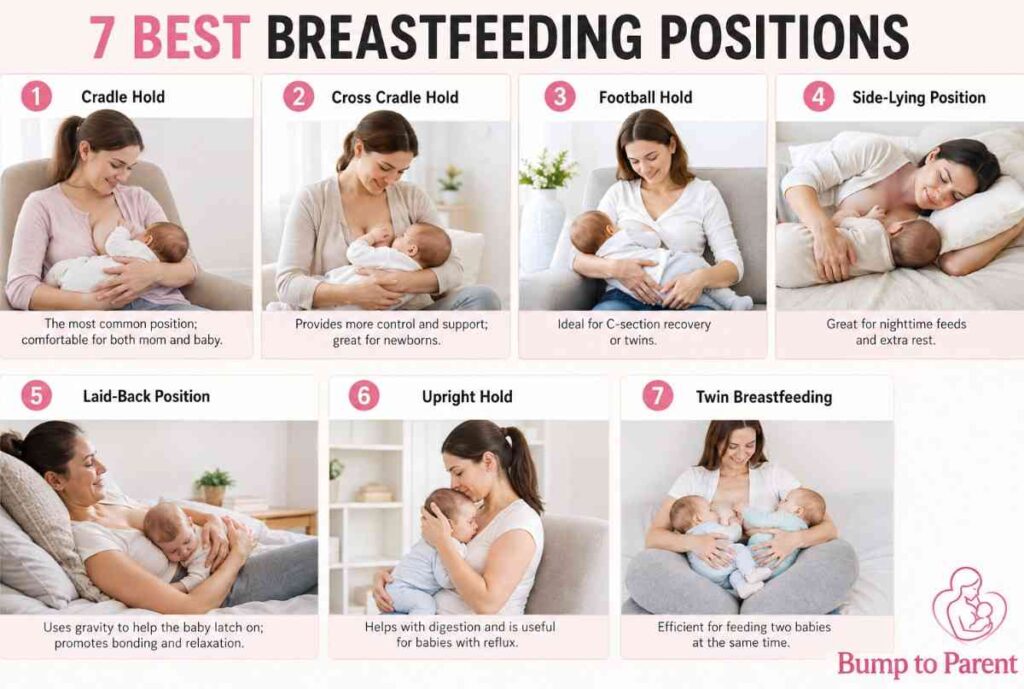
7 Best Breastfeeding Positions
1. Cradle Hold
The cradle hold is one of the most familiar breastfeeding positions. You sit upright with your baby lying across your lap, with your baby’s head resting in the crook of your arm on the same side as the breast being used.
Keep your baby’s chest facing your body rather than allowing the head to turn toward the breast. Support your baby’s back and bottom with your arm, and use pillows underneath your arm if needed.
Best for: Babies who have already developed a fairly comfortable latch and parents who prefer a traditional seated position.
Tip: Keep your feet supported and bring the baby toward you instead of leaning your body forward. This can help reduce back, shoulder, and neck strain.
2. Cross-Cradle Hold
The cross-cradle hold is similar to the cradle hold, but you use the arm opposite the breast you are feeding from to support your baby.
For example, if your baby is nursing from your right breast, your left arm supports the baby’s body and your left hand can help support the neck and upper back. This gives you more control while helping your baby approach the breast.
Best for: Newborns, smaller babies, and parents who are still learning how to achieve a good latch.
Because you have greater control over your baby’s position, the cross-cradle hold can be particularly useful during the early learning stage.
3. Football or Rugby Hold
In the football hold, your baby is positioned beside you rather than across your abdomen. The baby’s body is tucked under your arm on the same side as the breast being used, with the baby’s legs pointing behind you.
Support your baby’s upper back, neck, and head with your arm and hand while keeping their nose approximately level with your nipple.
Best for: Parents recovering from a cesarean birth, mothers with larger breasts, parents of twins, and situations where keeping the baby’s weight away from the abdomen is more comfortable.
This position also allows you to see the baby’s mouth and breast more easily, which may make latch adjustments simpler.
4. Side-Lying Position
Side-lying breastfeeding allows you and your baby to lie on your sides facing each other. Your baby’s body should remain close to yours, with their head positioned near your breast and their nose unobstructed.
Best for: Resting during a feed, nighttime breastfeeding, and parents who find sitting uncomfortable after delivery.
However, side-lying breastfeeding requires particular attention to safety. A baby should not be left unattended in an adult bed after feeding, and the baby should be returned to their own safe sleep space when the feed is finished.
5. Laid-Back Breastfeeding
Laid-back breastfeeding, sometimes called biological nurturing or reclining breastfeeding, involves leaning back in a comfortable, supported position while your baby lies tummy-down against your body.
Use pillows to support your back, shoulders, and neck. Your baby should be supported on your body rather than placed flat underneath you.
Best for: Skin-to-skin contact, relaxed feeds, babies who are restless at the breast, and parents who prefer a more relaxed position.
This position can also be helpful when a baby is having difficulty settling or attaching because it gives the baby an opportunity to use natural feeding behaviors.
6. Upright or Koala Hold
In an upright or koala-style position, your baby sits more vertically against your body while breastfeeding. The baby’s chest faces your chest, and you provide support around the baby’s body as needed.
This position may become more practical as babies gain better head and trunk control. It can also be useful for babies who prefer being more upright during feeds.
Best for: Older babies with better head control and parents who find upright feeding comfortable.
Newborns still need appropriate support for their head, neck, and body.
7. Reclining or Semi-Reclined Position
A reclining position sits between traditional sitting and lying down. You lean back against pillows while keeping your baby supported close to your body.
This can reduce the amount of weight you need to hold with your arms and may make longer feeds more comfortable. It is closely related to laid-back breastfeeding.
Best for: Parents experiencing back or shoulder discomfort and babies who settle well with close body contact.
How to Get Your Baby Into a Good Breastfeeding Position?
Before beginning a feed, make yourself comfortable. Have water nearby and use cushions or pillows to support your arms, back, or legs.
Then bring your baby close to you.
A useful way to remember the main positioning principles is:
- Close: Your baby should be close enough to the breast that they do not need to stretch or pull toward it.
- Head free: Allow your baby to move their head naturally rather than pressing the back of their head toward the breast.
- In line: Your baby’s head, neck, shoulders, and body should generally remain aligned rather than twisted.
- Nose to nipple: Start with your baby’s nose roughly opposite your nipple. This encourages the baby to open their mouth widely and approach the breast with the chin leading.
Rather than leaning your breast toward your baby, bring your baby toward the breast. This helps maintain a stable position throughout the feed.
How to Know If Your Baby Is Latching Well
A comfortable, effective latch is more important than choosing a particular breastfeeding position.
Signs of a good latch may include:
- Your baby’s mouth is wide open.
- Your baby’s lips are turned outward.
- Your baby’s chin is touching or nearly touching your breast.
- Your baby’s head is not twisted away from their body.
- You can see or hear regular swallowing.
- Your baby’s cheeks remain rounded during feeding.
- Breastfeeding is comfortable rather than persistently painful.
- Your baby remains attached instead of repeatedly slipping off the breast.
You may also notice that your breast feels softer after feeding.
What Does a Poor Latch Look Like?
A shallow latch can sometimes cause discomfort and may make breastfeeding less effective. Warning signs include persistent pain, cracked or bleeding nipples, nipples appearing flattened or misshapen after feeding, and a baby repeatedly coming off the breast.
If breastfeeding hurts throughout most or all of a feed, do not assume that you simply need to “get used to it.” Ask a lactation consultant, midwife, doctor, nurse, or other qualified breastfeeding professional to observe a feed and help you adjust the baby’s position and attachment.
Which Breastfeeding Position Is Best After a C-Section?
After a cesarean birth, positions that keep your baby’s weight away from the abdominal incision may feel more comfortable.
The football or rugby hold is one commonly suggested option because the baby’s body rests beside the mother rather than directly across the abdomen. Side-lying and laid-back positions may also be comfortable depending on recovery, mobility, and personal preference.
Your comfort and medical recovery should guide the choice. If movement is painful, ask your healthcare team for help getting into a safe feeding position.
Which Position Is Best for Newborns?
There is no single best position for every newborn. The cross-cradle hold can be particularly helpful when learning because it allows the parent to guide and support the baby’s body while working on attachment.
Laid-back breastfeeding is another option because it encourages close contact and can allow the baby to use natural feeding behaviors.
The most important goal is not mastering a particular hold. It is achieving a comfortable, effective latch while keeping your baby’s head and body aligned.
Breastfeeding Positions for Twins
Parents feeding twins may find the football hold useful because it can allow one baby to be positioned at each side of the body.
However, feeding two babies simultaneously can take practice. Some parents alternate positions or feed one baby at a time, particularly while learning.
A lactation professional can help parents of twins develop a practical routine based on the babies’ feeding patterns and individual needs.
Common Breastfeeding Positioning Mistakes
1. Leaning Forward
One of the most common mistakes is bending your body toward the baby. Instead, keep your back supported and bring your baby toward your breast.
2. Holding the Baby Too Far Away
A baby who is too far from the breast may have difficulty maintaining a deep latch. Keep the baby’s body close to yours.
3. Turning the Baby’s Head
Your baby’s nose should be near your nipple while their body faces you. A twisted neck can make feeding and swallowing more difficult.
4. Pressing the Back of the Baby’s Head
Avoid forcing your baby’s head toward the breast. Giving the baby freedom to tilt the head back can help them open their mouth and attach.
5. Ignoring Persistent Pain
Mild tenderness can occur when breastfeeding is new, but persistent or severe pain deserves attention. A healthcare professional or lactation specialist can check positioning, latch, and other possible causes.
How Often Should You Change Breastfeeding Positions?
You do not have to change positions at every feed. However, switching positions can be useful if one position becomes uncomfortable or if you want to vary pressure on different areas of the breast.
You might use the cradle hold during the day, a football hold when you want more control, and side-lying or laid-back breastfeeding when you need a more relaxed feeding position.
Your baby’s needs and your comfort can change from feed to feed.
Breastfeeding Positioning and Milk Supply
Position alone does not determine milk supply. Frequent and effective milk removal plays an important role in signaling the breasts to continue producing milk. Breastfeeding or expressing milk sends a signal to the breasts to keep making milk.
If you are concerned about low milk supply, poor weight gain, or whether your baby is getting enough milk, do not rely on changing positions alone. Seek professional assessment.
When Should You Get Breastfeeding Help?
Consider getting professional breastfeeding support if:
- Your baby consistently struggles to latch.
- Breastfeeding is persistently painful.
- Your nipples are cracked or bleeding.
- Your baby repeatedly comes off the breast.
- You are worried that your baby is not getting enough milk.
- Your baby is not gaining weight as expected.
- You are experiencing significant breast pain or other breastfeeding problems.
Parents to contact a healthcare provider when they are concerned that their newborn is not getting enough to eat.
A lactation consultant or trained breastfeeding professional can watch a complete feed and provide personalized positioning and latch guidance.
Final Thoughts
Finding the right breastfeeding position is less about following a strict rule and more about discovering what works comfortably for you and your baby. The cradle, cross-cradle, football, side-lying, laid-back, reclining, and upright positions all offer different ways to support breastfeeding.
Remember the basics: keep your baby close, keep their head and body aligned, position the nose near the nipple, and allow your baby to open their mouth widely and attach to the breast.
Most importantly, give yourself time. Breastfeeding is a learned skill for both parent and baby, and it is normal for positioning to improve through practice. If something does not feel right, getting help early can make breastfeeding more comfortable and manageable.
FAQ’s
What is the easiest breastfeeding position?
The cradle hold is often easy once you and your baby are comfortable with breastfeeding, while the cross-cradle hold can provide more control during the early days.
Is side-lying breastfeeding safe?
Side-lying can be used for breastfeeding, but the baby should be returned to a separate, safe sleep surface after feeding, especially if the parent may fall asleep.
What breastfeeding position is best for a deep latch?
The cross-cradle and laid-back positions can make it easier to support the baby and encourage a wide-open mouth for a deeper latch.
Why does breastfeeding hurt in every position?
Persistent pain may be related to a shallow latch, positioning problems, nipple injury, or another breastfeeding issue, so consider getting help from a lactation professional or healthcare provider.
Should the baby’s nose touch the breast while breastfeeding?
The baby’s nose can be close to the breast, but it should not be pressed into it; positioning the baby’s nose near the nipple can help encourage a wide, comfortable latch.
Can I breastfeed while lying down?
Yes, side-lying breastfeeding is an option, but make sure the baby is positioned safely and is returned to their own safe sleep space after the feed.
How do I know if my baby is positioned correctly?
Your baby should be close to you, facing your body, with the head and body aligned and the mouth able to open widely around the breast.
Should I change breastfeeding positions?
You do not have to change positions at every feed, but switching positions can improve comfort and may be useful when one position becomes uncomfortable.
What is the best breastfeeding position for large breasts?
The football hold, cross-cradle hold, or a supported laid-back position may provide better control and comfort, but the best option depends on your body and your baby’s latch.
What is the best breastfeeding position for reflux?
Keeping a baby more upright during and after feeding may be helpful for some babies, but persistent or severe reflux symptoms should be discussed with a pediatrician.
Can breastfeeding position affect milk flow?
Position does not directly determine milk supply, but comfortable positioning and effective attachment can help your baby remove milk effectively.
Is it okay to go braless while breastfeeding?
Yes, it is generally okay to go braless while breastfeeding if you feel comfortable and are not experiencing discomfort, leakage, or breast support needs.
Sources / References
About the Author:
Written by: Kirti Solanki, Health Content Researcher
Kirti Solanki writes research-based health and wellness content with a focus on making complex health information clear, practical, and reader-friendly.
Disclaimer:
This article is for general educational purposes only and does not replace personalized medical advice. If you have breastfeeding difficulties, concerns about your baby’s feeding or growth, or significant pain, consult a qualified healthcare professional or lactation specialist.
Also Read: