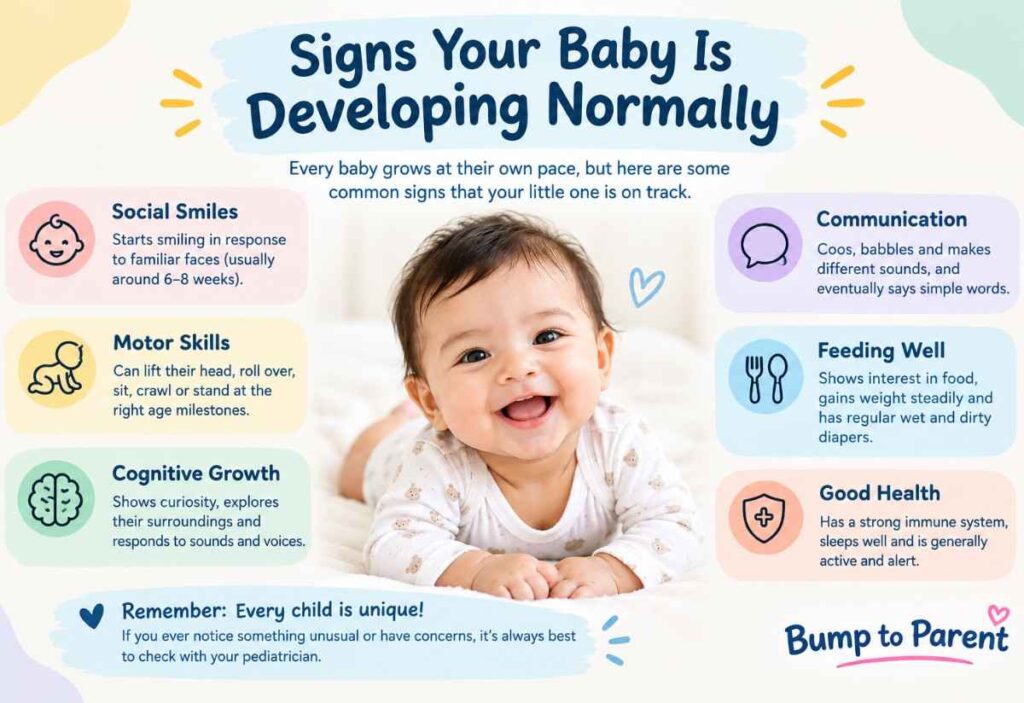

Watching your baby grow is one of the most rewarding experiences of parenthood. From the first smile to those tiny attempts to reach for a toy, every new skill can feel like a special achievement. However, many parents also wonder whether their baby is growing and developing as expected.
The good news is that babies develop at different rates, and there is no single timeline that every child follows. Some babies learn to roll over early, while others spend more time practicing other skills. What matters most is how your baby gradually develops new abilities, responds to the world, and interacts with the people around them.
Recognizing the common signs of healthy development can help you understand your baby’s progress and know when to seek professional guidance. This guide explains 12 signs your baby may be developing normally, important milestones to watch for, and situations when you should talk to a pediatrician.
Signs Your Baby Is Developing and Growing Normally
1. Your Baby Makes Eye Contact
One encouraging sign of early development is your baby’s growing interest in faces. Young babies may look at your face during feeding, observe you while you talk, or briefly focus on your eyes.
As your baby grows, they may begin looking at familiar people for longer periods and watching facial expressions. These moments help babies learn about their surroundings and develop early social connections.
Eye contact varies from baby to baby, especially during the newborn period. Your baby may look away when tired or overstimulated, which is normal. However, if your baby rarely looks toward faces or you have concerns about their visual attention, discuss them with your pediatrician.
2. Your Baby Smiles at You
A baby’s smile can be one of the sweetest signs of growing social awareness. Newborns sometimes smile spontaneously, including during sleep. Around 6 to 8 weeks, many babies begin smiling in response to a parent’s face or voice.
These social smiles often become more frequent as babies grow. Your baby may smile when you lean close, speak gently, or play a familiar game.
Smiling is one part of social development, not a test that your baby must pass on a specific day. If your baby is not smiling at people by around 2 months, mention it to your healthcare professional.
3. Your Baby Responds to Sounds and Voices
Babies begin learning about the world through sound long before they can speak. They may quiet down when they hear a familiar voice, react to sudden noises, or turn their attention toward sounds.
As development continues, babies often begin making cooing sounds, experimenting with different pitches, and responding to the voices of caregivers.
These behaviors are early steps toward communication and language development. However, a baby can have hearing difficulties even if they occasionally respond to loud sounds. If your baby does not seem to react to sounds or you have concerns about their hearing, ask about a hearing assessment.
4. Your Baby Begins Making Different Sounds
Cooing, gurgling, squealing, and babbling are important parts of early communication. In the first few months, your baby may make soft vowel-like sounds. By around 4 to 6 months, many babies experiment with more varied sounds.
Between approximately 6 and 9 months, babies often begin repeating combinations of sounds, such as “ba-ba” or “da-da.” These sounds do not necessarily have a specific meaning yet, but they help babies practice the skills needed for speech.
You can encourage this development by talking to your baby, responding to their sounds, reading simple books, and singing songs. Your baby does not need to speak actual words during early infancy to be developing communication skills.
5. Your Baby Watches and Follows Moving Objects
Developing vision helps babies explore the people and objects around them. In the early weeks, your baby may focus best on faces and objects held relatively close. Over time, they may begin following a moving toy or watching you as you walk across the room.
By around 2 to 3 months, many babies can follow moving objects more smoothly. As they grow, they become increasingly interested in colorful toys, familiar faces, and things happening around them.
If your baby consistently has difficulty focusing on faces or following objects as expected, mention it to your pediatrician. Early assessment can help identify vision concerns when treatment or support may be needed.
6. Your Baby Moves Their Arms and Legs
Movement is another important indicator of development. Young babies often stretch, kick, wave their arms, and move their hands while exploring their bodies.
At first, these movements may appear uncoordinated. Gradually, your baby may begin bringing their hands toward their mouth, reaching for toys, and moving both sides of their body more purposefully.
Every baby has an individual movement pattern, but their movements should generally become more controlled as they grow. Persistent stiffness, unusual floppiness, or a clear difference in movement between the two sides of the body deserves medical attention.
7. Your Baby Gains Head Control
Head control develops gradually during the first several months. Newborns need their heads supported because their neck muscles are still developing.
Over time, babies become better at lifting their heads during supervised tummy time and holding their heads steadier when supported upright. By around 4 months, many babies can hold their heads relatively steady without support.
You can encourage this skill through short, supervised periods of tummy time while your baby is awake. Always place your baby on their back for sleep.
If your baby struggles to hold their head steady around the expected age or seems unusually weak or stiff, consult your pediatrician.
8. Your Baby Reaches for and Holds Objects
Reaching for toys is an exciting step because it combines vision, movement, and coordination. Around 3 to 4 months, many babies begin reaching toward nearby objects. By approximately 5 to 6 months, some can grasp toys and bring them toward their mouths.
Your baby may initially miss a toy several times before successfully grabbing it. These repeated attempts are part of learning.
Offer safe, lightweight toys that are easy to hold, and supervise your baby during play. Avoid small objects that could cause choking.
If your baby does not show increasing interest in reaching for objects or seems unable to use their hands as expected, discuss your concerns with a healthcare professional.
9. Your Baby Recognizes Familiar People
Babies gradually become familiar with the people who care for them. Your baby may relax when you pick them up, respond differently to your voice, or show excitement when a familiar person approaches.
As babies get older, they may smile, move their arms, or make sounds when they see someone they know. Some babies also become wary of unfamiliar people during the second half of their first year.
These behaviors reflect developing memory, social awareness, and emotional connections. Your baby may express recognition differently from another child, so look at their overall pattern of interaction rather than expecting one particular response.
10. Your Baby Shows Interest in Their Surroundings
Curiosity is an important part of learning. Your baby may watch ceiling fans, examine their fingers, look toward a pet, or become interested in a new sound.
As they grow, babies often explore toys by touching, shaking, mouthing, and transferring them between their hands. These activities help them learn about shapes, textures, movement, and cause and effect.
You can support curiosity by providing age-appropriate toys, talking about what your baby sees, and allowing safe opportunities to explore.
A baby who is tired, hungry, or overstimulated may show less interest in their surroundings temporarily. What matters is the broader pattern of alertness and engagement over time.
11. Your Baby Progresses Toward Sitting, Rolling, and Crawling
Gross motor skills develop in stages, although the order and timing can vary. Many babies begin rolling during the first half of their first year and gradually develop the strength and balance needed to sit.
By around 6 months, many babies can sit with support and may begin rolling in both directions. By 9 months, many can sit without support, while some begin moving around by crawling, scooting, or other methods.
Not every baby crawls in the traditional way. Some babies bottom-shuffle, roll to move around, or move directly toward standing and walking.
Provide a safe floor space for movement and always supervise your baby. If your baby is not making progress toward expected movement milestones, ask your pediatrician for an assessment.
12. Your Baby Shows Emotional Responses
Emotional development begins early. Babies communicate comfort, discomfort, hunger, tiredness, and the need for closeness through facial expressions, body movements, and crying.
As your baby grows, you may notice more varied expressions, excitement during play, enjoyment of familiar routines, and attempts to attract your attention. They may also seek comfort from a caregiver when upset.
These behaviors are part of developing relationships and learning to regulate emotions. Babies cannot manage their feelings independently, so responding calmly to their needs helps them feel safe.
Remember that crying, fussiness, and occasional difficulty settling do not automatically mean something is wrong with development. Consider the baby’s overall behavior, feeding, sleep, and progress.
Other Signs That Your Baby Is Growing Well
Development involves more than learning new skills. Other reassuring signs may include:
- Steady growth: Your baby gains weight and grows in length and head circumference along an individual growth pattern.
- Regular feeding: Your baby feeds effectively for their age and generally shows signs of getting enough milk or formula.
- Adequate wet diapers: Your baby has an age-appropriate number of wet diapers, which can help indicate hydration.
- Periods of alertness: Your baby has times when they are awake, responsive, and interested in people or their surroundings.
- Developing sleep patterns: Sleep gradually changes with age, although frequent waking is common during infancy.
- Growing interaction: Your baby increasingly responds to voices, faces, touch, and familiar routines.
No single sign can confirm that development is normal. Pediatric checkups, growth measurements, developmental screening, and hearing and vision assessments all contribute to a fuller picture.
Baby Development Milestones by Age
The following table provides a general guide to common developmental milestones. Babies do not all reach these skills at exactly the same time.
| Age | Common developmental signs |
|---|---|
| 2 months | Looks at faces, reacts to loud sounds, and may smile when spoken to |
| 4 months | Holds the head steadier, makes sounds, and brings hands toward the mouth |
| 6 months | Laughs, reaches for toys, recognizes familiar people, and may roll over |
| 9 months | Sits without support, responds to their name in many situations, and babbles repeated sounds |
| 12 months | May pull up to stand, use gestures such as waving, and understand some familiar words |
These examples are not a diagnostic checklist. Some milestones appear earlier or later, and skills may develop unevenly. Use age-specific guidance from your pediatrician rather than comparing your baby with another child.
When Should You Be Concerned About Your Baby’s Development?
Every baby develops at their own pace, but certain signs deserve prompt attention. Contact your pediatrician if your baby:
- Does not seem to react to loud sounds or has concerns about hearing.
- Rarely looks toward faces or has difficulty tracking objects.
- Is not showing expected social responses, such as smiling at people by around 2 months.
- Has difficulty controlling their head around the expected age.
- Does not seem to reach for or explore objects as they grow.
- Shows persistent stiffness, unusual floppiness, or markedly uneven movements.
- Is not progressing toward age-appropriate milestones.
- Loses a skill they previously had, such as babbling, sitting, or making eye contact.
Losing previously acquired skills is especially important to discuss with a healthcare professional promptly. Do not wait for the next routine checkup if you notice developmental regression.
Seek urgent medical care if your baby has difficulty breathing, is unusually difficult to wake, has a seizure, or appears seriously unwell.
A concern does not automatically mean your baby has a developmental disorder. Many differences have straightforward explanations, but an early assessment can help identify whether additional support is needed.
How Can You Support Your Baby’s Healthy Development?
You do not need expensive toys or complicated activities to help your baby learn. Everyday interactions provide many opportunities for development.
- Talk throughout the day: Describe what you are doing, respond to your baby’s sounds, and use a warm, natural voice.
- Read simple books: Point to pictures, name familiar objects, and let your baby look at the pages.
- Practice supervised tummy time: Offer short sessions while your baby is awake to encourage strength and movement.
- Play face-to-face: Smile, make gentle expressions, and allow your baby time to respond.
- Offer safe toys: Choose age-appropriate objects that encourage reaching, grasping, and exploration.
- Respond to your baby’s needs: Comfort your baby when upset and pay attention to hunger and tiredness cues.
- Maintain regular checkups: Keep track of growth, vaccinations, and developmental screening recommendations.
- Create a safe environment: Use safe sleep practices and supervise movement and play to reduce preventable injuries.
The most valuable part of supporting development is consistent, responsive interaction. Your baby learns through everyday experiences with the people who care for them.
Final Thoughts
The signs your baby is developing normally often appear in small, everyday moments: looking at your face, smiling in response to your voice, reaching for a toy, making new sounds, and gradually gaining control of their movements.
Remember that development is a process, not a competition. Your baby may reach some milestones early and others later. Focus on their individual progress, attend regular pediatric checkups, and share any concerns with a healthcare professional.
You know your baby best. If something about their development does not seem right to you, it is reasonable to ask questions. Seeking guidance early can provide reassurance and help your baby receive appropriate support when needed.
FAQ’s
What are the first signs of healthy baby development?
Early signs may include looking at faces, reacting to sounds, moving the arms and legs, focusing on nearby objects, and beginning to smile at people.
Is it normal for babies to reach milestones at different times?
Yes. Babies develop at different rates, and some variation is normal. However, missed milestones, persistent concerns, or loss of previously acquired skills should be discussed with a pediatrician.
When should a baby start smiling?
Many babies begin showing social smiles by around 6 to 8 weeks, although individual timing varies. Mention it to your pediatrician if your baby is not smiling at people by around 2 months.
What are the warning signs of developmental delay in babies?
Possible warning signs include limited response to sounds, difficulty with age-appropriate movement, persistent differences in muscle tone, limited social responses, and loss of previously acquired skills. A healthcare professional can determine whether further evaluation is needed.
Does a quiet baby mean developmental delay?
No. Some babies are naturally quieter than others. What matters is whether your baby responds to people and sounds, shows interest in their surroundings, and makes progress in communication and other developmental areas.
Can a baby develop normally without crawling?
Yes. Some babies crawl in different ways, scoot, or skip traditional crawling. Sitting, coordination, movement, and overall developmental progress are more useful to consider together than crawling alone.
How often should my baby’s development be checked?
Follow your pediatrician’s recommended schedule for well-child visits and developmental screening. Ask for an earlier appointment whenever you notice a concern or your baby loses a previously acquired skill.
How do I know if my baby is reaching milestones?
Observe your baby’s progress in skills such as smiling, making sounds, reaching for toys, holding their head steady, and sitting. Regular pediatric checkups help assess development.
Is it normal for babies to develop at different rates?
Yes, babies develop at different speeds. However, persistent concerns, missed milestones, or developmental regression should be discussed with a healthcare professional.
Does a baby who is not crawling have a developmental problem?
Not necessarily. Some babies crawl differently, scoot, or skip traditional crawling. Overall motor development and progress are more important than crawling alone.
Can a baby be healthy but sleep a lot?
Yes, young babies need substantial sleep. However, if your baby is unusually difficult to wake, feeds poorly, or seems seriously unwell, seek prompt medical attention.
What does normal behavior look like in a 3-month-old baby?
A 3-month-old baby may smile at people, make cooing sounds, follow moving objects with their eyes, move their arms and legs, and hold their head more steadily. Development varies, so discuss any concerns with a pediatrician.
How can I tell if my baby is learning new skills?
You may notice your baby gradually reaching for toys, making new sounds, recognizing familiar people, controlling movements more effectively, or responding differently to everyday experiences. Small changes over time can reflect learning and development.
What are the signs of emotional development in babies?
Signs include smiling at familiar people, seeking comfort from caregivers, showing excitement during play, expressing discomfort, and gradually responding to familiar routines.
Is it normal for babies to prefer one parent?
Yes, babies may show a stronger preference for one caregiver, especially as they become more familiar with people and develop separation awareness. This preference is generally normal and does not necessarily indicate a problem.
What are the signs of healthy social development in infants?
Signs may include looking at faces, smiling at people, responding to voices, enjoying interaction, making sounds during play, and gradually showing recognition of familiar caregivers.
Is it normal for babies to explore everything with their mouths?
Yes, mouthing objects is a common way babies explore their surroundings. Offer only age-appropriate, clean toys without small or detachable parts, and supervise your baby to reduce choking risks.
Sources / References:
- CDC — Developmental Milestones
- American Academy of Pediatrics — Developmental Surveillance and Screening
- HealthyChildren.org — Ages and Stages
- MedlinePlus — Infant and Newborn Development
- World Health Organization — Child Growth Standards
Disclaimer:
This guide is for educational purposes only and does not replace professional medical advice, diagnosis, or treatment. Consult your baby’s pediatrician about developmental concerns or missed milestones.
Also Read:



Pingback: Why Do Babies Kick Their Legs? 10 Common Reasons
Pingback: Why Do Babies Move Their Arms? 10 Common Reasons
Pingback: Why Do Babies Rub Their Eyes? 9 Reasons & What to Do