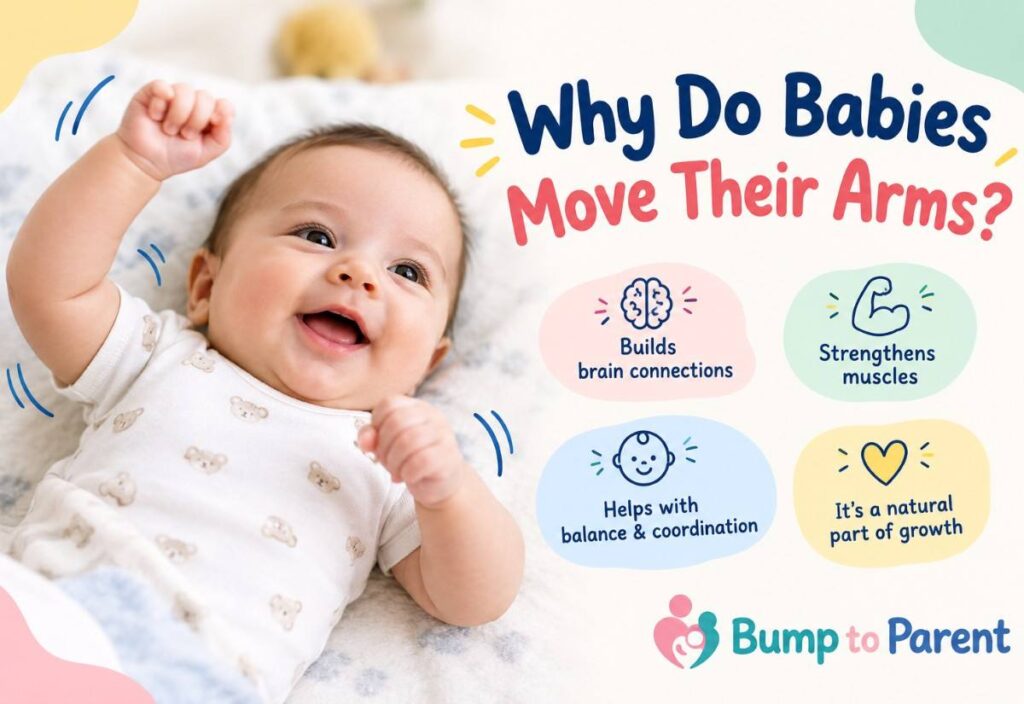

Babies are constantly discovering the world around them, and their little arms are often on the move. From waving their hands in the air to stretching, flapping, and suddenly throwing their arms outward, these movements can be fascinating for parents to watch. Sometimes, they are simply part of normal development. Other times, they may be a way for babies to express excitement, respond to sounds, or communicate their needs.
If you have ever wondered why your baby moves their arms so much, you are not alone. Many parents notice these movements during feeding, sleeping, playing, or even when their baby is quietly lying in a crib.
The good news is that most arm movements in babies are a normal part of growth and development. However, understanding the type of movement, your baby’s age, and any other symptoms can help you recognize when something deserves medical attention.
In this guide, we will explore 10 common reasons babies move their arms, what different movements may mean, and when parents should speak with a pediatrician.
Why Do Babies Move Their Arms?
Babies move their arms for several reasons, including developing motor skills, exploring their surroundings, expressing emotions, responding to sounds, and reacting to their reflexes. Newborns often have limited control over their movements, while older babies gradually learn to reach, grab, wave, and use their arms intentionally.
10 Common Reasons Babies Move Their Arms
1. Developing Motor Skills
One of the most common reasons babies move their arms is that they are learning to control their bodies. During the first few months, babies gradually develop coordination between their brains, nerves, and muscles.
At first, their movements may appear jerky or unplanned. Over time, they begin reaching toward objects, bringing their hands together, and moving their arms with greater purpose.
These early movements help build the foundation for future skills, such as grasping toys, sitting up, crawling, and feeding themselves.
2. Exploring Their Surroundings
Babies learn about their environment through movement and touch. Moving their arms helps them discover their hands, interact with nearby objects, and understand how their bodies work.
You may notice your baby waving their arms when a colorful toy appears or reaching toward your face while you hold them. These actions are early forms of exploration.
As their vision and coordination improve, babies gradually become better at reaching for specific objects instead of moving their arms randomly.
3. Expressing Excitement
Have you noticed your baby waving their arms when you enter the room, talk to them, or show them a favorite toy?
This may be a sign of excitement or increased interest. Young babies often express emotions through their whole bodies because they cannot yet communicate with words.
Arm waving, kicking, smiling, and making happy sounds may occur together when a baby is excited. As your child grows, these movements may become more coordinated and intentional.
4. The Moro Reflex or Startle Reflex
The Moro reflex is a normal newborn reflex that can make a baby suddenly throw their arms outward and then bring them back toward their body.
It may happen when a baby hears a sudden noise, feels a change in position, or experiences a sensation of falling. Sometimes, it occurs without an obvious trigger.
This reflex is present at birth and usually fades by around four to six months of age. Its strength and timing can vary.
The Moro reflex is different from ordinary arm waving because it typically involves a sudden, recognizable sequence of movements. If you are concerned that your baby’s startle response is absent, unusually asymmetric, or continuing well beyond the expected age, ask your pediatrician for an assessment.
5. Communicating Hunger or Discomfort
Babies use body movements alongside crying, facial expressions, and sounds to communicate their needs. Arm movements may sometimes accompany early hunger cues, such as bringing hands toward the mouth, rooting, or becoming more alert.
A baby who is uncomfortable may also stretch, squirm, wave their arms, or move their body during a diaper change or after feeding.
However, arm movements alone cannot reliably tell you whether your baby is hungry, tired, or uncomfortable. Look at the full picture, including feeding patterns, facial expressions, crying, and the timing of the movement.
6. Practicing Hand-Eye Coordination
As babies grow, they begin learning how to coordinate what they see with how they move. This skill is known as hand-eye coordination.
Your baby may initially swing an arm toward a toy without touching it. With practice, they become more accurate at reaching, touching, holding, and eventually transferring objects between their hands.
You can encourage this development by offering age-appropriate toys within comfortable reach while supervising your baby. Give them time to explore without expecting every movement to be purposeful.
7. Responding to Sounds and Voices
Babies often respond to sounds by changing their facial expressions, moving their bodies, or becoming more alert. A familiar voice, a song, or a sudden noise may be accompanied by arm movements.
These reactions can be part of normal sensory development. Babies are gradually learning to notice sounds and respond to what is happening around them.
If your baby moves their arms while you sing or talk, they may simply be alert, excited, or responding to the stimulation. The movement by itself does not prove that they understand the words or are deliberately communicating a message.
8. Feeling Tired or Overstimulated
A baby who is becoming tired or overstimulated may wave their arms, turn their head away, fuss, or have difficulty settling down.
Bright lights, loud sounds, frequent handling, and lots of activity can sometimes overwhelm a young baby’s developing ability to regulate stimulation.
If your baby seems unsettled, try reducing noise and lighting, speaking softly, and offering a calm environment. Look for other tiredness cues, such as yawning, rubbing their eyes, or becoming less engaged.
Arm movements are not a reliable sign of tiredness on their own, so consider your baby’s overall behavior and usual sleep routine.
9. Moving During Sleep
Babies may twitch, stretch, jerk, or briefly move their arms while sleeping. These movements can be associated with normal sleep patterns and the development of the nervous system.
Some newborns also startle themselves awake with sudden arm movements. Such movements are often harmless when they are brief and the baby otherwise appears well.
Nevertheless, not every movement during sleep is normal. Repeated rhythmic jerking, episodes that consistently affect one side, or movements accompanied by breathing changes, unusual color, or difficulty waking require prompt medical attention.
Always place your baby on their back to sleep on a firm, flat surface, without loose blankets, pillows, or soft toys.
10. Developing Strength and Body Awareness
Arm movements help babies practice using their muscles and learn where their bodies are in space. Reaching, pushing against a surface during supervised tummy time, and bringing their hands together all contribute to developing strength and control.
As babies get older, their movements often become smoother and more purposeful. They may begin extending their arms to be picked up, reaching for caregivers, or using their hands to explore toys.
Every baby develops at their own pace. Rather than comparing individual movements with those of other babies, pay attention to progress over time and discuss any developmental concerns with your pediatrician.
Is It Normal for Babies to Move Their Arms a Lot?
Yes, frequent arm movements are usually normal, particularly during the newborn period and early infancy. Babies are learning to control their muscles, respond to sensory information, and explore their surroundings.
Normal movements may include:
- Waving both arms while awake.
- Stretching after waking up.
- Bringing hands toward the mouth.
- Reaching for toys or familiar faces.
- Brief startles in response to sudden sounds.
- Occasional twitches or jerks during sleep.
- Moving their arms while excited or engaged.
What matters most is the pattern of movement, your baby’s age, and whether they are otherwise feeding, growing, and behaving as expected.
If the movements seem unusual, repetitive, persistently one-sided, or are accompanied by other concerning symptoms, seek medical advice rather than assuming they are part of normal development.
Why Do Babies Throw Their Arms Up Suddenly?
Babies may suddenly throw their arms upward or outward because of the Moro reflex, a change in position, a sudden sound, or ordinary spontaneous movement.
In newborns, the Moro reflex is a particularly common explanation. A baby may appear startled, extend their arms, and then bring them back toward their chest.
If your baby repeatedly throws their arms up in clusters, especially with stiffening, head movements, eye deviation, or changes in responsiveness, contact a healthcare professional promptly. Brief movements can have several causes, and unusual episodes may require assessment.
Why Do Babies Flap Their Arms When Excited?
Some babies wave or flap their arms when they are excited, happy, or highly engaged. These movements may occur when they see a familiar person, hear a favorite sound, or play with an interesting object.
Arm flapping alone does not indicate a developmental disorder. Babies use a wide range of movements while learning to express themselves.
If repetitive movements continue as your child grows and you also notice concerns about communication, social interaction, play, or developmental progress, discuss these observations with your pediatrician. Looking at the child’s overall development is more informative than judging one movement in isolation.
Why Do Babies Move Their Arms While Breastfeeding or Bottle-Feeding?
Babies may move their arms during feeding because they are alert, adjusting their position, touching the caregiver, or responding to hunger and fullness cues.
Some babies bring their hands toward their mouths before feeding, while others move their arms as they become excited or restless.
Gentle arm movements are usually not concerning if your baby feeds comfortably and gains weight as expected. However, repeated coughing, choking, difficulty coordinating sucking and swallowing, unusual stiffness, or poor feeding should be discussed with a healthcare professional.
How Can You Encourage Healthy Arm Movement?
You do not need special equipment to support your baby’s developing arm control. Everyday interactions provide plenty of opportunities to practice.
- Offer supervised tummy time: When your baby is awake and directly supervised, tummy time helps develop strength in the shoulders, arms, neck, and upper body.
- Use age-appropriate toys: Place a safe toy within comfortable reach to encourage your baby to look, stretch, and reach.
- Talk and interact: Smiling, talking, singing, and responding to your baby encourage engagement and sensory exploration.
- Allow free movement: When appropriate, give your baby time to move their arms on a safe, flat play surface without restrictive clothing or unnecessary restraints.
- Follow your baby’s cues: Stop or change an activity if your baby becomes distressed, tired, or overwhelmed.
- Attend regular checkups: Routine pediatric visits help track motor skills and overall development.
Never force your baby’s arms into a position or try to train away normal movements. If a movement seems unusual, ask your pediatrician before attempting exercises or interventions.
When Should You Worry About Your Baby’s Arm Movements?
Most arm movements are harmless, but certain patterns deserve medical attention. Trust your observations if something seems different from your baby’s usual behavior.
Contact your pediatrician if you notice:
- Persistent one-sided movement: Your baby consistently moves one arm much less than the other or appears to have weakness on one side.
- Unusual stiffness or floppiness: Your baby’s arms are persistently very rigid or unusually limp.
- Repeated rhythmic jerking: Movements occur in a repeated pattern, particularly in clusters or with changes in responsiveness.
- Loss of previously acquired skills: Your baby stops doing movements or skills they had already developed.
- Developmental concerns: Your baby is not progressing as expected or has difficulty reaching, grasping, or using their arms as they grow.
- Pain or distress: Arm movement appears to cause pain, or your baby cries persistently when an arm is moved.
Seek emergency medical care if your baby has a first suspected seizure, repeated seizure-like episodes, difficulty breathing, blue or gray discoloration, or becomes unusually unresponsive. If seizure-like movements occur, keep your baby safe, do not restrain their limbs, and do not put anything in their mouth. If possible, note how long the episode lasts.
FAQ’s
Is it normal for newborns to move their arms constantly?
Yes, frequent arm movements are usually normal in newborns because their muscles and nervous systems are still developing.
Why do babies move their arms while sleeping?
Babies may stretch, twitch, or jerk their arms during sleep as part of normal sleep patterns and nervous system development.
Is arm flapping a sign of autism in babies?
Arm flapping alone does not indicate autism. Developmental concerns should be assessed by considering communication, social interaction, play, and other behaviors.
When do babies gain better control of their arms?
Babies gradually develop better arm control during infancy, progressing from spontaneous movements to purposeful reaching and grasping.
Can excessive arm movements be a sign of a medical problem?
Sometimes. Persistent one-sided movements, unusual stiffness, repeated rhythmic jerking, or movements accompanied by changes in responsiveness should be evaluated by a healthcare professional.
Why does my baby flap their arms when happy?
Babies may wave or flap their arms when excited, interested, or emotionally engaged. Arm flapping alone is not enough to identify a developmental condition.
Should I stop my baby from waving their arms?
No. Normal arm waving is part of learning and exploring. Allow safe movement, and seek medical advice if the movements appear painful, unusual, or associated with other symptoms.
Can arm movements be a sign of a seizure?
Some seizure-related movements may involve jerking, stiffening, or repeated episodes with changes in responsiveness. Many ordinary baby movements can look similar, so unusual or suspected seizure activity needs prompt medical assessment.
At what age is arm flapping a concern?
Arm flapping can be normal in infancy. Consult a pediatrician if it persists alongside developmental concerns, unusual movements, or delays in communication and social interaction.
Do babies with autism move their hands a lot?
Some babies with autism show repetitive hand movements, such as flapping or waving. However, frequent hand movements alone do not indicate autism; overall developmental patterns are more important.
Conclusion
Babies move their arms for many reasons, from developing motor skills and exploring their surroundings to expressing excitement and responding to normal reflexes. In most cases, these movements are a healthy part of infancy and gradually become more controlled as babies grow.
Pay attention to your baby’s overall behavior, developmental progress, and the pattern of movement rather than focusing on one action alone. If movements are persistent, unusual, one-sided, or accompanied by other concerning symptoms, consult your pediatrician.
Disclaimer:
This guide is for informational purposes only and does not replace professional medical advice, diagnosis, or treatment. Contact your pediatrician if you have concerns about your baby’s movements or development.
Sources / References:
- MedlinePlus
- Cleveland Clinic
- Centers for Disease Control and Prevention
- American Academy of Pediatrics – HealthyChildren.org
- National Institute of Neurological Disorders and Stroke
Disclaimer:
This guide is for informational purposes only and does not replace professional medical advice, diagnosis, or treatment. Contact your pediatrician if you have concerns about your baby’s movements or development.
Also Read:



Pingback: Why Do Babies Rub Their Eyes? 9 Reasons & What to Do
Pingback: Why Do Babies Arch Their Back? 10 Causes & When to Worry
Pingback: Why Do Babies Clench Their Fists? 7 Causes & When to Worry