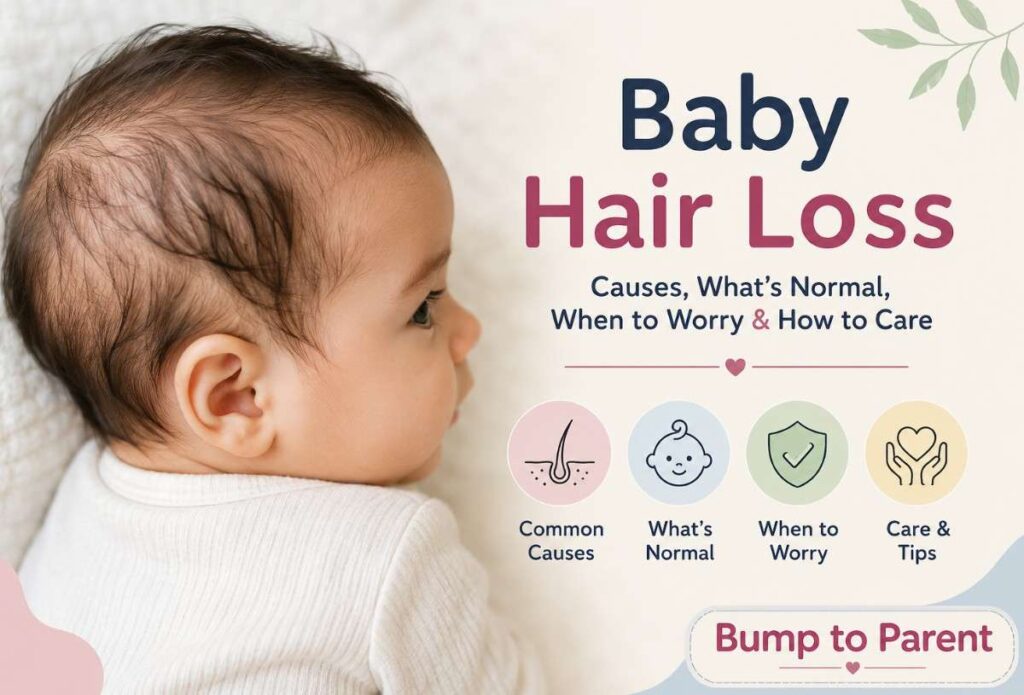

Baby hair loss can be surprising for new parents. One day your baby may have a full head of soft hair, and a few weeks later you may notice thinning, shedding, or even a bald patch on the back of the head. In most young babies, this is a normal part of early development rather than a sign that something is wrong.
Hair loss is very common in newborns and young babies. Many babies lose some or even most of their hair during the first few months, and it generally grows back.
Still, not every type of baby hair loss is the same. Hormonal changes, normal friction, cradle cap, infections, and certain medical conditions can all affect a baby’s scalp and hair. Knowing what is typical can help parents avoid unnecessary worry while also recognizing when professional advice is appropriate.
What Is Baby Hair Loss?
Baby hair loss refers to the natural shedding or thinning of hair from a newborn’s or infant’s scalp.
It is common during the first months of life. Some babies lose only a small amount of hair, while others temporarily lose most of the hair they were born with. The replacement hair may look different from the original hair in color, thickness, texture, or curl pattern.
Baby hair loss is usually temporary because the hair follicles remain healthy. As the baby’s hair cycle changes, new hair begins to grow.
A baby can also develop a bald-looking area, particularly on the back of the head. This is often caused by repeated rubbing against a mattress, crib surface, infant seat, or another firm surface.
Is Baby Hair Loss Normal?
Yes. Hair loss during the first few months of life is usually normal.
Almost all babies lose some of their newborn hair during the first few months. Some babies lose more hair from the back of the head than elsewhere, and this hair normally grows back.
For many parents, the timing can be unexpected. A baby may be born with thick hair, then gradually become noticeably thinner-haired. Another baby may have very little hair at birth and experience only subtle shedding.
Neither situation necessarily predicts how much hair the child will have later.
Why Does Baby Hair Fall Out?
There are several reasons a baby’s hair may become thinner or fall out.
1. Natural Hormonal Changes
One of the most common explanations is the normal hormonal adjustment that happens after birth.
During pregnancy, babies are exposed to hormones from the mother. After birth, those hormone levels change significantly. This can influence the baby’s hair-growth cycle and cause some of the hair present at birth to enter a resting phase and shed. Cleveland Clinic notes that hormonal changes around about three months can contribute to newborn head-hair loss.
This process does not usually damage the hair follicles, so new hair can grow afterward.
2. Normal Hair-Cycle Changes
Hair does not grow continuously. Individual hairs naturally move through different phases of growth, transition, and rest.
After birth, some newborn hairs transition out of their growth phase. As they shed, new hairs eventually take their place.
This explains why a baby can temporarily appear almost bald even though the scalp itself is healthy.
3. Friction From Sleeping
A bald spot on the back of a baby’s head is often related to friction.
Babies spend a great deal of time lying on their backs, and repeated head movement against a firm surface can gradually rub away hair. This is particularly common around 3 to 6 months of age.
This type of hair loss generally improves as babies become more mobile and spend more time changing head positions.
Importantly, parents should always place babies on their backs for sleep. Do not change a baby’s safe sleep position simply to prevent a bald spot.
4. Cradle Cap
Cradle cap, also known as infantile seborrheic dermatitis, can sometimes contribute to temporary hair loss.
It usually appears as greasy, yellowish or brownish scales on the scalp. When scales loosen and come away, some hairs may come with them.
This can look alarming, but the hair generally grows back. NHS guidance recommends gentle scalp care and advises against picking or scraping the scales.
5. Illness or Physical Stress
Older infants and children can sometimes experience temporary hair shedding after significant physical stress, such as a serious illness or high fever.
This type of shedding is called telogen effluvium. It can occur after a stressful event because the hair-growth cycle is temporarily disrupted.
It is different from the normal hair loss seen in many newborns, but it is another possible explanation when noticeable shedding occurs after illness.
6. Fungal Infection
A fungal infection of the scalp, commonly called scalp ringworm or tinea capitis, can cause hair loss.
Unlike ordinary newborn shedding, a fungal infection may cause areas of scaling, redness, itching, inflammation, broken hairs, or distinct patches of hair loss. The American Academy of Pediatrics identifies scalp ringworm as an important cause of patchy hair loss in children that requires medical treatment.
Parents should not attempt to treat suspected scalp infection with random creams or home remedies. A pediatrician should evaluate the scalp and recommend appropriate treatment.
What Does Normal Baby Hair Loss Look Like?
Normal baby hair loss can look different from one child to another.
You may notice:
- Hair gradually becoming thinner.
- Hair appearing on the baby’s clothing or bedding.
- A temporary bald area on the back of the head.
- Most of the newborn hair disappearing.
- Fine new hairs appearing as older hairs shed.
- Hair growing back with a different texture or color.
Some babies lose their hair slowly, while others may appear to lose a significant amount within a relatively short period.
The American Academy of Pediatrics states that newborn hair is temporary and is commonly replaced by mature hair during infancy.
When Does Baby Hair Loss Usually Start?
Hair loss can begin during the first weeks or months after birth.
Newborn hair may begin shedding around the first month, with hair loss commonly peaking around 3 months. New hair may begin appearing around 6 months, although the timing varies between babies.
A baby’s hair may continue changing throughout the first year.
This means there is no single “correct” age at which every baby’s hair should look full again.
When Will Baby Hair Grow Back?
For most babies, hair gradually grows back during infancy.
Normal newborn hair is replaced by mature hair, with normal hair commonly coming in between approximately 6 and 12 months.
However, individual babies develop at different rates. Some may have noticeable new growth earlier, while others remain relatively fine-haired for longer.
The replacement hair may also surprise parents. A baby born with straight, dark hair might later develop lighter or curlier hair. Hair color and texture can change as the child grows.
Baby Hair Loss on the Back of the Head
A bald patch at the back of the head is one of the most common patterns parents notice.
This usually happens because infants spend considerable time lying on their backs. Turning the head from side to side can create repeated friction between the scalp and the surface underneath.
The good news is that this usually resolves as the baby becomes more mobile and spends less time rubbing the same area.
Parents should not place pillows, loose blankets, positioners, or other objects under a sleeping baby’s head to prevent hair loss, because these can create serious sleep-safety risks.
Instead, continue following recommended safe-sleep practices.
Baby Hair Loss and Cradle Cap
Cradle cap is common and usually harmless.
If your baby has mild cradle cap, gentle care is generally preferable to aggressive treatment. NHS guidance recommends gently washing the scalp with baby shampoo and using a soft brush to loosen scales. Parents should avoid picking or scratching crusts because this can irritate the skin and increase the risk of infection. (nhs.uk)
Some hair may come away with the scales, but it generally grows back.
If the scalp becomes very red, swollen, bleeds, leaks fluid, or the condition does not improve, contact your baby’s healthcare professional.
How to Care for a Baby’s Hair?
You do not need an elaborate hair-care routine for a newborn.
1. Use Gentle Hair Products
Choose products designed specifically for babies and avoid unnecessarily harsh or heavily fragranced products.
2. Wash the Scalp Gently
Baby hair does not need aggressive scrubbing. Gently massage the scalp during bathing and rinse thoroughly.
3. Use a Soft Brush
If your baby has loose flakes or tangled hair, a soft baby brush can be useful. Avoid pulling on the hair.
4. Avoid Tight Hairstyles
For babies with longer hair, avoid tight ponytails, braids, clips, or other styles that pull on the scalp.
Repeated tension can damage hair and contribute to traction-related hair loss in children.
5. Do Not Pick at the Scalp
If your baby has cradle cap, resist the temptation to scrape or peel the scales away.
6. Avoid Adult Hair Products
Adult shampoos, strong styling products, fragrances, and other unnecessary products may irritate delicate infant skin. NHS guidance specifically recommends avoiding adult shampoos and fragranced products for cradle-cap care.
Can You Prevent Baby Hair Loss?
In most cases, there is nothing that needs to be done to prevent normal newborn hair shedding.
Hormonal changes and the natural hair cycle are part of normal development.
For friction-related hair loss, normal supervised tummy time while the baby is awake can help babies develop movement and spend less time continuously rubbing the same area. However, tummy time should never replace safe sleep positioning.
The goal should not be to force hair growth but to keep the baby’s scalp healthy and avoid unnecessary irritation or pulling.
Should You Cut or Shave Baby Hair to Make It Grow Thicker?
No. Shaving or cutting a baby’s hair does not change the number, size, or health of the hair follicles. It may make newly growing hair appear temporarily thicker because the cut ends are blunt, but it does not actually increase hair growth.
There is also no need to shave a baby’s head simply because the newborn hair is falling out. Natural shedding and regrowth are usually sufficient.
Should You Use Hair Oils for Baby Hair Loss?
Parents sometimes use coconut oil, baby oil, or other oils because they believe these products will make hair grow faster.
There is no need to use a special oil to treat normal newborn hair shedding.
If your baby has cradle cap, certain emollients may be recommended as part of gentle scalp care. However, parents should follow age-appropriate guidance and avoid products that could irritate the baby’s skin or create an allergy risk. NHS guidance, for example, advises against peanut oil and certain fragranced products for cradle-cap care. (nhs.uk)
Never apply essential oils or herbal preparations to a baby’s scalp without discussing them with a healthcare professional.
When Should You Worry About Baby Hair Loss?
Most newborn hair loss is harmless, but some patterns deserve medical evaluation.
Contact your baby’s pediatrician if:
- Hair loss is severe or continues without improvement.
- A bald patch has no obvious explanation.
- The scalp is very red, swollen, painful, or bleeding.
- There are thick crusts or unusual sores.
- The scalp is itchy or appears infected.
- There are circular patches of hair loss with scaling.
- Hairs appear broken close to the scalp.
- Hair loss occurs along with other concerning symptoms.
- Hair does not appear to be returning as expected.
- You are simply worried about the appearance of your baby’s scalp.
A doctor may examine the scalp and, depending on the situation, recommend further testing or referral to a pediatric dermatologist.
Baby Hair Loss vs. Something More Serious
The appearance of the scalp can provide useful clues.
- Normal newborn shedding: Hair becomes gradually thinner, often during the first several months, without significant scalp inflammation.
- Friction-related hair loss: Hair is thinner or absent mainly on the back of the head, where repeated rubbing occurs.
- Cradle cap: Hair may come away with greasy or flaky scales, but the condition is generally mild.
- Scalp fungal infection: Hair loss may occur in distinct patches alongside scaling, redness, itching, or broken hairs.
- Other forms of alopecia: Persistent or unusual patches may require examination to determine whether an underlying condition is involved.
Because several conditions can look similar to parents, diagnosis based only on photographs or internet searches can be unreliable.
FAQ’s
Why is my baby’s hair falling out at 3 months?
Around 3 months, many babies naturally shed their newborn hair because of hormonal changes and the normal hair-growth cycle.
Why does my baby have a bald spot on the back of the head?
A bald patch on the back of the head is commonly caused by friction from lying and moving the head against a mattress or other firm surface.
Does shaving a baby’s head make hair grow thicker?
No. Shaving does not increase the number or size of hair follicles. It may only make newly growing hair appear thicker because the ends are blunt.
Can cradle cap cause baby hair loss?
Yes. Some hair can come away with cradle-cap flakes or scales, but it usually grows back after the scalp improves.
Is baby hair loss a sign of vitamin deficiency?
Usually not. Normal newborn hair shedding is generally related to natural hair-cycle and hormonal changes. Persistent or unusual hair loss should be evaluated by a pediatrician.
Can tummy time help prevent a baby’s bald spot?
Supervised tummy time while your baby is awake can reduce the amount of time spent resting on the back of the head. However, babies should always be placed on their backs for sleep.
Can baby hair change color or texture after growing back?
Yes. New hair may be a different color, thickness, or texture from the hair your baby had at birth.
How long does baby hair loss last?
The timing varies, but newborn hair is commonly replaced during the first year of life. Some babies regrow hair sooner than others.
Is baby hair loss permanent?
Usually no. Most newborn hair loss is temporary, and the hair grows back naturally as the baby’s hair cycle matures.
When does baby hair grow back after falling out?
Baby hair usually starts growing back during the first year. Many babies begin showing new growth around 6 months, but the timing varies.
How to identify the newborn hair loss stage?
Newborn hair loss commonly starts during the first few months. You may notice gradual thinning, shedding, or a bald patch on the back of the head. New fine hairs eventually begin appearing as the hair cycle changes.
How to stop baby hair loss naturally?
Normal newborn hair loss usually cannot and does not need to be stopped. Gentle scalp care, avoiding tight hairstyles and harsh products, and allowing natural hair growth are generally best. Always follow safe-sleep practices and consult a pediatrician if hair loss is unusual or persistent.
Is baby hair loss normal at 6 months?
Some babies may still have thinning or changing hair at 6 months. New growth often becomes more noticeable around this time.
Can I use coconut oil for baby hair loss?
There is generally no need to use coconut oil to treat normal newborn hair loss. Use only products appropriate for your baby’s age and skin.
Does cutting baby hair make it grow faster?
No. Cutting or shaving does not make hair follicles grow faster or produce thicker hair.
Why is my baby’s hair growing slowly?
Hair growth rates vary considerably between babies. Slow growth alone does not necessarily indicate a problem.
Can baby hair change after it grows back?
Yes. New hair can be different in color, thickness, texture, or curl pattern from the hair your baby had at birth.
Should I brush my baby’s hair every day?
Daily brushing is not necessary. If you brush it, use a soft baby brush and avoid pulling or tugging on the hair.
Final Thoughts
Baby hair loss can look dramatic, especially when a newborn starts life with a thick head of hair and then develops noticeable thinning or a bald patch. In most cases, however, it is simply one of the many physical changes that happen during the first year of life.
Normal hormonal changes, the natural hair cycle, and friction from lying down are common explanations. Cradle cap can also cause some temporary hair loss.
The best approach is gentle care and patience. Avoid aggressive brushing, tight hairstyles, unnecessary products, and attempts to force hair growth. Most importantly, never compromise safe sleep practices to prevent a bald spot.
If the hair loss looks unusual, continues longer than expected, or is accompanied by scalp inflammation, scaling, sores, or other symptoms, a pediatrician can determine whether further evaluation is needed.
Sources / References:
- American Academy of Pediatrics – Hair Loss (Alopecia) in Children
- Cleveland Clinic – Why Is My Baby Hairy? Newborn Body Hair Explained
- NHS – Cradle Cap
- DermNet NZ – Hair Loss (Alopecia)
- American Family Physician – Hair Loss in a Child
- MSD Manual – Alopecia (Hair Loss)
About the Author:
Written by: Kirti Solanki, Health Content Researcher
Kirti Solanki writes evidence-informed health and wellness content designed to make medical and nutrition topics easier for general readers to understand. Health information is researched using reputable medical and public-health sources.
Disclaimer:
This article is for general educational purposes only and is not a substitute for professional medical advice. If you are concerned about your baby’s hair loss, scalp, growth, or overall health, consult a qualified pediatrician.
Also Read: