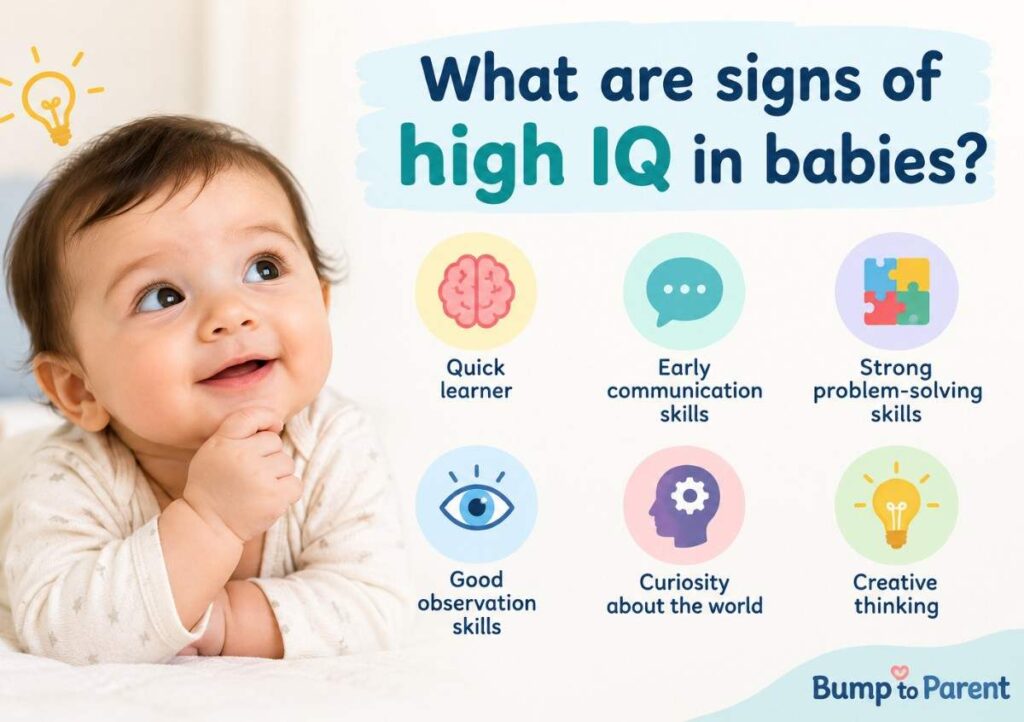

Every parent wonders about their baby’s development at some point. You may notice that your baby pays close attention to faces, responds quickly to familiar voices, remembers favorite toys, or seems unusually curious about the world. These behaviors can make you wonder whether your little one is especially intelligent.
So, what are the signs of high IQ in babies?
Some babies show early signs of advanced learning, curiosity, memory, communication, or problem-solving. However, no single behavior can prove that a baby has a high intelligence. Babies develop at different rates, and early milestones do not necessarily predict intelligence later in childhood.
Developmental milestones help parents understand how children learn, communicate, play, and move as they grow. These milestones are useful for monitoring development, but they are not intelligence tests. In this article, we explore 12 possible signs of advanced development in babies, what these behaviors may mean, and how parents can support their child’s learning without creating unnecessary pressure.
Can You Tell If a Baby Has a High IQ?
It is difficult to determine a baby’s IQ accurately during infancy. Intelligence involves several abilities, including reasoning, memory, language, attention, and problem-solving, which develop over time.
A baby who learns certain skills early may have advanced abilities in one area without being ahead in every other area. For example, one baby may be particularly attentive to sounds, while another may show strong visual curiosity or physical coordination.
Parents should focus on their baby’s overall development rather than trying to assign an intelligence label too early. Regular pediatric checkups and age-appropriate developmental screening provide a more meaningful picture of how a child is progressing.
12 Possible Signs of High IQ in Babies
The following behaviors may reflect curiosity, learning, or advanced development in some babies. They are not proven indicators of a high IQ, and many babies who do not show them early can develop excellent cognitive abilities later.
1. Strong Curiosity About the Environment
Some babies appear fascinated by their surroundings. They may spend time looking at moving objects, studying toys, watching people, or exploring different textures.
This curiosity gives babies opportunities to learn about the world. As they grow, they may explore objects in different ways, reach for interesting items, and investigate how things work.
2. Strong Attention to Faces and Voices
A baby who carefully watches your face while you speak may be learning to recognize facial expressions, sounds, and patterns in communication.
Babies often show interest in familiar caregivers and gradually become more responsive to social interaction. Paying attention to faces and voices is a normal part of early development, rather than proof of exceptional intelligence.
3. Early Recognition of Familiar People
Some babies quickly become familiar with the faces, voices, and routines of their caregivers. They may smile when a parent approaches or respond differently to familiar people and strangers.
Recognizing familiar people is an important developmental skill. It reflects learning and memory, although the timing varies from baby to baby.
4. Good Memory for Familiar Objects
A baby may repeatedly look for a favorite toy, recognize a familiar object, or anticipate what happens during a familiar game.
As object permanence develops, babies begin to understand that objects continue to exist even when they cannot see them. For example, an older baby may look for a toy hidden beneath a blanket.
This behavior demonstrates developing memory and understanding, but it does not independently establish a high IQ.
5. Quick Learning Through Observation
Babies learn a great deal by watching people around them. Some quickly imitate facial expressions, gestures, clapping, or simple actions.
For example, a baby may observe a caregiver waving and later attempt to copy the movement.
Imitation helps babies learn social behaviors and new skills. The speed and type of learning vary with age, opportunity, and individual development.
6. Interest in Exploring Objects
A curious baby may turn a toy around, shake it, tap it, or transfer it between hands to explore what it can do.
These actions help babies learn about shape, sound, movement, and cause and effect. Repeated exploration is a valuable part of cognitive development and does not necessarily mean that a child is gifted.
7. Early Understanding of Cause and Effect
Some babies begin to notice that their actions produce predictable results. They might shake a rattle to make a sound, kick a toy to move it, or repeatedly drop an object to observe what happens.
As their understanding develops, babies become more interested in experimenting with their surroundings.
These everyday discoveries are important building blocks for later problem-solving.
8. Interest in Communication
Babies communicate long before they can speak. They may make eye contact, coo, babble, respond to familiar voices, or use sounds to attract attention.
Some babies show an early interest in taking turns making sounds with caregivers. As they get older, they may begin to respond to familiar words or gestures.
Early communication is an important developmental area, but babies who start talking later are not automatically less intelligent. Language development varies considerably.
9. Strong Interest in Books, Pictures, or Music
Some babies enjoy looking at colorful pictures, listening to stories, or responding to music. They may watch a page closely, turn toward a familiar song, or become excited when a favorite book appears.
These interests can provide opportunities to develop attention, listening skills, and early language understanding.
However, enjoying books or music is not a reliable way to measure a baby’s IQ. Temperament, exposure, and personal preferences also influence these behaviors.
10. Persistent Attempts to Solve Simple Problems
An older baby may try different ways to reach a toy that is just out of reach. They might stretch, move closer, change position, or reach around an obstacle.
Such attempts can show developing coordination, persistence, and problem-solving skills.
It is important to distinguish safe exploration from frustration. Babies need support, supervision, and opportunities to try age-appropriate tasks without being expected to solve every problem independently.
11. Strong Interest in New Experiences
Some babies are eager to investigate unfamiliar toys, sounds, or surroundings. They may carefully observe something new before reaching toward it or exploring it.
A willingness to investigate new experiences can support learning. Other babies may take longer to feel comfortable with unfamiliar things, and that is normal too.
A cautious temperament does not mean a baby has lower intelligence.
12. Reaching Developmental Milestones Early
A baby may acquire certain skills earlier than other babies of the same age, such as sitting, using gestures, understanding familiar words, or imitating actions.
Early achievement can be worth discussing with a pediatrician as part of the baby’s overall developmental history. However, reaching physical milestones early does not necessarily mean a baby has a high IQ.
Physical, social, language, and cognitive skills develop along different timelines. A baby can be advanced in one area and develop other skills at a typical pace.
The American Academy of Pediatrics (AAP) recommend monitoring development across multiple areas rather than judging a child by a single milestone.
Signs of Advanced Development by Baby’s Age
The behaviors you notice may change as your baby grows. The following table provides examples of age-related skills to observe, not a checklist for identifying gifted babies.
| Baby’s age | Skills and behaviors to observe |
|---|---|
| 0–3 months | Watching faces, responding to sounds, beginning social smiles, and becoming familiar with caregivers |
| 4–6 months | Reaching for toys, exploring objects, laughing, and taking turns making sounds |
| 7–9 months | Exploring objects in different ways, responding to familiar people, and looking for objects that disappear from view |
| 10–12 months | Imitating gestures, responding to familiar words, searching for hidden objects, and using objects in simple ways |
| 12–18 months | Following simple directions, pointing to communicate, copying actions, and trying new ways to use toys |
These are general examples, not a measure of intelligence. Expected milestones depend on age, and a baby may develop some skills before others.
What Makes a Baby Intelligent?
Intelligence is not one single skill. It involves several abilities that gradually develop through a combination of biological factors, everyday experiences, relationships, and learning opportunities.
Some important aspects of early cognitive development include:
- Memory: Recognizing familiar people, objects, and routines.
- Attention: Looking at objects or people and responding to interesting sounds.
- Learning: Acquiring new behaviors through observation and repetition.
- Communication: Using sounds, facial expressions, gestures, and eventually words.
- Problem-solving: Experimenting with objects and learning how actions produce results.
- Social understanding: Responding to familiar people and gradually interpreting social cues.
A baby does not need to be ahead in every area to be developing well. Children have different strengths, and these abilities continue to change throughout childhood.
Can a Baby’s IQ Be Tested?
IQ testing is generally not a reliable way to determine a young baby’s future intelligence. Infants are developing rapidly, and their performance can be affected by attention, mood, familiarity with the examiner, and other factors.
Healthcare professionals can assess a baby’s development using age-appropriate screening tools and, when indicated, more detailed developmental evaluations. These assessments help identify strengths, possible delays, and areas where support may be useful; they are not the same as predicting a child’s future IQ.
The AAP recommends standardized developmental screening at specific ages, including 9, 18, and 30 months, with additional screening whenever concerns arise.
If you believe your baby is developing unusually quickly in one or more areas, mention your observations at the next pediatric appointment. A healthcare professional can help interpret them in the context of your baby’s age and overall development.
How to Support Your Baby’s Brain Development
Simple everyday activities can encourage learning without putting pressure on your baby to reach milestones early.
1. Talk to Your Baby:
Speak during everyday activities, describe what you are doing, and respond to your baby’s coos and babbling. These interactions provide opportunities to hear language and practice communication.
2. Read Together:
Use sturdy, age-appropriate books with simple pictures. Point to objects, name them, and let your baby look, touch, and respond at their own pace.
3. Offer Safe Opportunities to Explore:
Provide age-appropriate toys with different textures, shapes, and sounds. Supervise play and keep small objects, loose parts, and choking hazards away from your baby.
4. Play Interactive Games:
Games such as peek-a-boo, gentle imitation, and taking turns making sounds can support social interaction, attention, and learning.
5. Prioritize Sleep and Routine:
Provide age-appropriate sleep opportunities, responsive care, and predictable routines. Place babies on their backs for every sleep on a firm, flat surface without loose bedding.
The goal is not to make a baby appear gifted. It is to create a safe, responsive environment where the child can explore, build relationships, and develop at their own pace.
When Should Parents Talk to a Pediatrician?
Early milestones are only one part of development. It is equally important to recognize when a baby may need additional assessment or support.
Speak with your baby’s healthcare professional if:
- Your baby is not meeting expected developmental milestones.
- Your baby seems consistently unresponsive to sounds or social interaction.
- You have concerns about your baby’s vision, hearing, movement, or communication.
- Your baby loses a skill they previously had.
- You notice a persistent change in how your baby responds, learns, or interacts.
A missed milestone does not automatically mean that a child has a developmental disorder. However, developmental concerns deserve timely attention, and losing previously acquired skills should be discussed with a healthcare professional promptly.
Do not wait for your child to become older if you are concerned. A pediatrician can review developmental history, assess milestones, and recommend further evaluation or early-intervention services when appropriate.
FAQ’s
How can I tell if my baby is intelligent?
Observe how your baby explores objects, responds to familiar people, learns through play, and develops communication skills. Remember that babies develop at different rates, and no single behavior can determine intelligence.
What are the signs of a high IQ in a 3-month-old baby?
A 3-month-old baby may show interest in faces, respond to familiar voices, follow moving objects with their eyes, and begin smiling socially. These are typical developmental behaviors rather than reliable indicators of a high IQ.
What are the signs of a high IQ in a 6-month-old baby?
A 6-month-old may show curiosity about toys, recognize familiar caregivers, explore objects with their hands and mouth, and respond to sounds. These behaviors support learning but cannot confirm giftedness.
What are the signs of a high IQ in a 9-month-old baby?
Possible signs of developing cognitive skills include looking for partially hidden objects, imitating gestures, exploring toys in different ways, and responding to familiar words. These skills vary among babies and do not predict a specific IQ.
What are the signs of a high IQ in a 1-year-old baby?
A 1-year-old may imitate actions, use gestures to communicate, understand familiar words, search for hidden objects, and explore how toys work. These behaviors reflect developing language, memory, and problem-solving abilities.
Do babies with high IQ smile earlier?
Not necessarily. Early smiling is influenced by age, temperament, and social development. Smiling earlier than another baby does not establish that a child has a higher IQ.
Do babies with high IQ make eye contact?
Some babies pay close attention to faces and social interactions, but eye contact alone is not a reliable measure of intelligence. Social development varies, and persistent concerns about interaction should be discussed with a pediatrician.
Do intelligent babies recognize their parents early?
Babies gradually become familiar with their caregivers’ faces, voices, and smells. Early recognition is a normal part of development and does not independently indicate a high IQ.
Do babies who learn quickly have a high IQ?
Learning a skill quickly may indicate a strength in that particular area. However, overall intelligence involves multiple abilities, and early learning speed cannot reliably predict a child’s future IQ.
Are babies who sleep less more intelligent?
No. Sleep duration is not a reliable indicator of intelligence. Babies have different sleep patterns, and adequate sleep supports healthy brain development.
Can a baby be gifted at 6 months?
A 6-month-old may show strong curiosity, attention, or interest in exploring objects. However, these behaviors alone cannot establish giftedness or predict future intellectual ability.
Does early talking mean a baby is more intelligent?
Early talking can reflect advanced language development, but it does not automatically mean a child has a higher IQ. Children develop speech at different rates and may have different strengths.
Do intelligent babies reach milestones earlier?
Some babies acquire certain skills earlier than others, but early milestones do not reliably predict future intelligence. Every baby develops at an individual pace.
Can parents increase a baby’s IQ?
Parents cannot guarantee a particular IQ, but they can support healthy development through responsive interaction, talking, reading, safe play, adequate nutrition, and regular healthcare.
Does a baby who understands things quickly have a high IQ?
Quick learning may indicate that a baby is developing a particular skill well. However, understanding one activity quickly is not enough to determine overall intelligence.
Are quiet babies more intelligent than active babies?
No. A baby’s activity level, quietness, and temperament do not reliably indicate intelligence. Both quiet and active babies can develop a wide range of cognitive abilities.
When can a child’s IQ be assessed more meaningfully?
A qualified professional can recommend an age-appropriate assessment when there is a specific reason to evaluate a child’s development or learning. The reliability and interpretation of intelligence testing depend on the child’s age and the assessment used.
At what age does giftedness appear?
Giftedness may become noticeable in early childhood, but it is difficult to identify reliably in babies. Early milestones do not guarantee future intelligence.
Conclusion
Recognizing possible signs of high IQ in babies can be interesting for parents, especially when a child seems curious, attentive, or quick to learn. These behaviors may reflect emerging cognitive abilities, but no single sign—or combination of everyday behaviors—can confirm that a baby has a high IQ.
The best approach is to encourage your baby’s natural curiosity, provide loving interaction, and monitor development through regular pediatric checkups. Rather than comparing your baby with others, celebrate individual progress and seek professional advice whenever you have concerns.
Sources and References:
Disclaimer:
This guide is for informational purposes only and does not replace professional medical advice, diagnosis, or developmental assessment. Consult your child’s pediatrician if you have concerns about growth or development.
Also Read:



Pingback: Why Do Babies Stare at People? 10 Common Reasons
Pingback: Why Do Babies Smile in Their Sleep? 7 Reasons & When to Worry