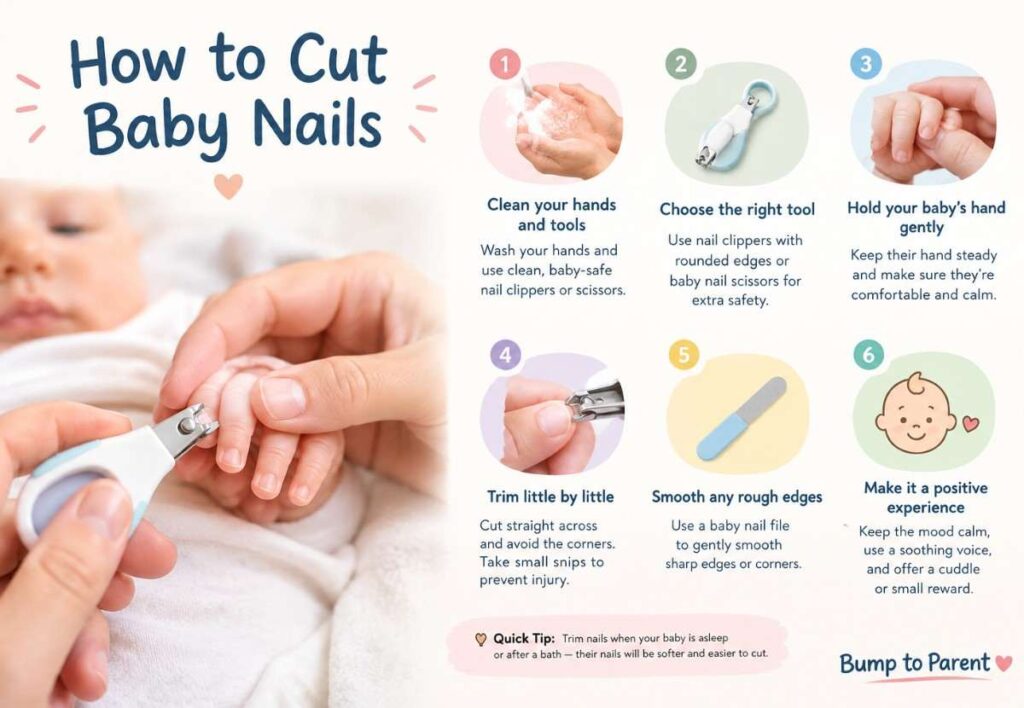

Cutting a baby’s nails can feel surprisingly stressful. Newborn fingers are tiny, their nails can be very thin and flexible, and babies rarely keep their hands still for long. Yet keeping the nails trimmed is an important part of basic baby care because long or sharp fingernails can cause accidental scratches to the baby’s face and skin.
The good news is that with the right tools, timing, and technique, trimming baby nails becomes much easier. Using a soft nail file, baby nail clippers, or blunt-nosed baby scissors and taking care to avoid the fingertip.
Why Is It Important to Cut Baby Nails?
Newborn fingernails grow quickly and can become sharp even when they still look soft and delicate. A baby may accidentally scratch their cheeks, nose, or other areas while moving their hands.
In the first few weeks, some babies may need their fingernails trimmed or filed about twice a week, although the exact frequency depends on how quickly the nails grow.
Regular nail care can:
- Reduce accidental facial scratches.
- Keep sharp nail edges from catching on clothing.
- Help keep the hands clean.
- Prevent nails from becoming excessively long.
- Make everyday baby care more comfortable.
When Can You Cut a Newborn’s Nails?
There is no need to wait until your baby reaches a particular age before caring for the nails. If the nails are long or sharp enough to scratch the baby, they can be carefully trimmed or filed.
Some parents find it easiest to trim nails while the baby is asleep because the hands are less likely to move suddenly. Another convenient time can be after a bath if the baby is calm and willing to keep their hands still.
What You Need to Cut Baby Nails
Before starting, gather everything you need so you do not have to move away from your baby during the process.
1. Baby Nail Clippers
Choose small clippers specifically designed for babies. They should be clean and easy for you to control.
2. Baby Nail Scissors
Blunt-nosed baby scissors can be another option. They should be designed specifically for infant nail care.
3. Soft Baby Nail File
A soft emery board can be useful for gently smoothing sharp edges and may be particularly helpful if you are nervous about using clippers.
4. Good Lighting
Make sure you can clearly see the nail and the skin underneath it. Good lighting can make it easier to distinguish the nail from the fingertip.
How to Cut Baby Nails Safely? Step by Step
1. Choose a Calm Time
Pick a time when your baby is relaxed. Sleeping is often convenient because there is less hand movement. You can also try after a bath if your baby remains calm.
2. Wash Your Hands
Wash your hands before handling your baby’s fingers and make sure the nail-trimming tool is clean.
3. Hold Your Baby’s Hand Securely
Gently hold your baby’s hand and work on one finger at a time. Avoid squeezing the finger because newborn skin is delicate.
4. Separate the Fingertip From the Nail
Gently press the pad of the finger downward and away from the nail. This creates a small gap between the nail and fingertip. This is one of the most important steps because it helps reduce the chance of accidentally cutting the skin.
5. Trim Only the Nail
Use small, controlled movements and trim the portion of the nail that extends beyond the fingertip. Do not rush. If you feel uncertain, stop and use a soft nail file instead.
6. Smooth Any Sharp Edges
After trimming, gently file any remaining sharp or rough edges. This can help prevent scratches.
7. Check Each Finger
Look at each nail after trimming. Make sure there are no sharp corners or pieces that could scratch your baby’s skin.
How to Cut Baby Nails Without Cutting the Skin
Accidentally nicking the fingertip is one of the biggest concerns for new parents. A few simple habits can make nail trimming safer.
- Hold the finger firmly: A gentle but secure grip helps prevent sudden movements.
- Push the fingertip skin away: Move the skin below the nail away from the cutting area before trimming.
- Use small cuts: Avoid trying to remove a large portion of nail in one movement.
- Use good lighting: Make sure you can clearly see where the nail ends and the skin begins.
- Take breaks: If your baby becomes restless, stop and try again later.
- Consider filing: If you are uncomfortable using clippers, a soft baby nail file can gradually shorten and smooth the nails.
Is It Better to Cut Baby Nails While Sleeping?
For many parents, yes. A sleeping baby is generally less likely to move their fingers unexpectedly, making the process easier to control.
The AAP specifically suggests trimming or filing nails while the baby is asleep because the hands are less active.
However, you do not need to wait for sleep if your baby is calm and cooperative. The most important thing is having enough control and visibility to trim safely.
Can You File Baby Nails Instead of Cutting Them?
Yes. Filing is an alternative to clipping or cutting.
A soft emery board can gradually shorten the nail while helping smooth rough or sharp edges. It may be a good choice for parents who are worried about accidentally cutting the fingertip.
A soft emery board alongside baby nail clippers and blunt-nosed scissors as options for baby nail care.
How Often Should You Cut Baby Fingernails?
There is no fixed schedule for every baby because nails grow at different rates.
During the early weeks, some babies may need their fingernails trimmed or filed approximately twice a week. Others may need attention less frequently. The best approach is to check the nails regularly rather than waiting for a particular day.
What About Baby Toenails?
Baby toenails generally grow more slowly than fingernails and are usually soft and flexible.
Baby toenails may only need trimming once or twice a month, although this varies between babies.
Do not try to aggressively cut into the corners of a baby’s toenails. If the skin around a toenail becomes red, inflamed, hard, or painful, contact your child’s healthcare professional.
Should You Bite Your Baby’s Nails?
No. Parents should avoid biting or peeling a baby’s nails.
Although it may seem like an easy solution when the nails are very soft, biting can introduce germs into tiny breaks in the skin. The AAP specifically advises against this practice because it can increase the risk of infection, including herpetic whitlow, a finger infection associated with herpes simplex virus.
Should You Use Baby Mittens Instead of Cutting Nails?
Mittens may temporarily reduce scratches, but they are not a substitute for appropriate nail care.
Good early nail trimming can help avoid scratches and that babies should also have opportunities to freely explore with their hands as they develop.
If your baby’s nails are scratching their face, trimming or filing them is generally a better long-term approach than keeping the hands covered continuously.
What If You Accidentally Cut Your Baby’s Finger?
Even with careful technique, a small nick can occasionally happen.
If you accidentally cut the fingertip, remain calm. Apply gentle pressure with clean gauze or a clean cloth to help stop minor bleeding.
If the cut is significant, bleeding does not stop, the finger becomes increasingly swollen or painful, or you are concerned about the injury, contact your pediatrician or seek medical care.
Common Mistakes to Avoid When Cutting Baby Nails
- Cutting too quickly: Rushing increases the chance of catching the fingertip.
- Trimming when the baby is moving: Wait for a calmer moment rather than trying to force the process.
- Using adult-sized tools: Baby-specific nail clippers or blunt-nosed scissors are easier to control.
- Leaving sharp edges: Smooth rough edges with a soft nail file.
- Biting the nails: Avoid this because it can introduce germs and potentially cause infection.
- Cutting too deeply: Only remove the excess nail rather than cutting close to the skin.
- Poor lighting: Make sure you can clearly see the nail before making each cut.
A Simple Baby Nail-Cutting Routine
For new parents, this simple routine can make nail care less intimidating:
- Choose a calm or sleeping time.
- Wash your hands.
- Clean the baby nail tool.
- Hold one finger securely.
- Gently push the fingertip skin down.
- Trim only the excess nail.
- File sharp edges if needed.
- Check the finger before moving to the next one.
- Repeat when the nails become long or sharp.
With practice, this routine usually becomes a normal part of baby care rather than a stressful task.
When Should You Contact a Pediatrician?
Most routine nail trimming does not require medical attention. However, contact your baby’s healthcare professional if you notice:
- Persistent redness around the nail.
- Swelling around a nail.
- Increasing warmth around the finger or toe.
- Pus or drainage.
- Significant bleeding.
- Persistent pain or tenderness.
- A nail that appears severely damaged or separated from the surrounding tissue.
- A suspected infection.
Changes such as redness, swelling, warmth, or pain around a nail can be signs of inflammation or infection and should not be ignored.
FAQ’s
When can you start cutting a baby’s nails?
You can trim your baby’s nails whenever they become long or sharp enough to cause scratches, including during the newborn period.
What is the safest way to cut baby nails?
Use baby nail clippers, blunt-nosed baby scissors, or a soft baby nail file while gently holding the finger and keeping the fingertip away from the cutting edge.
How often should I cut my baby’s fingernails?
Baby fingernails can grow quickly and may need trimming or filing about twice a week, depending on how fast they grow.
Can I use nail clippers on a newborn?
Yes, baby-specific nail clippers can be used on newborns when handled carefully and with good lighting.
How often should baby toenails be trimmed?
Baby toenails generally grow more slowly than fingernails and may only need trimming once or twice a month.
Why are my baby’s nails so sharp?
Baby nails can be thin but surprisingly sharp, especially because newborns frequently move and wave their hands near their faces.
Can baby mittens replace nail trimming?
Mittens may reduce scratching temporarily, but regular nail trimming or filing is still an important part of baby nail care.
Can I use an emery board on a newborn?
Yes. A soft emery board is one of the options recommended by the AAP for caring for baby nails.
What age should you cut baby fingernails?
Baby fingernails can be trimmed from the newborn period when they become long or sharp enough to cause scratches.
Is it okay to cut a baby’s nails at night?
Yes, you can trim your baby’s nails at night, especially if the baby is calm or asleep and you have good lighting.
What happens if you don’t cut a baby’s toenails?
Long toenails can catch on clothing, become uncomfortable, or potentially scratch the skin, so they should be trimmed when they become too long.
How do you cut a 1-year-old’s nails?
Hold your child’s finger securely, use baby nail clippers or scissors, and make small cuts while keeping the skin away from the cutting edge.
What is the best nail cutter for babies?
A small, baby-specific nail clipper with a comfortable grip and a design that allows good visibility is a practical choice.
When should you use a baby nail trimmer?
A baby nail trimmer can be used when your baby’s nails become long or sharp and need shortening or smoothing.
What is the difference between a baby nail cutter and a trimmer?
A nail cutter clips the nail directly, while an electric or manual baby nail trimmer generally files or gently buffs the nail down.
Can you paint a 2-month-old baby’s nails?
It is generally best to avoid nail polish on a 2-month-old baby’s nails because infants may put their fingers in their mouths and nail polish can contain chemicals that should not be ingested.
Final Thoughts
Learning how to cut baby nails can feel intimidating at first, but it becomes much easier with practice. Choose a calm time, use an appropriate baby nail tool, make small controlled movements, and keep the fingertip safely away from the cutting edge.
If you are particularly nervous about using clippers, filing is a useful alternative. Most importantly, never rush the process. A few careful minutes can help keep your baby’s nails short, smooth, and less likely to cause scratches.
Sources / References
Disclaimer
This guide is for general educational purposes and is not a substitute for professional medical advice. Consult your pediatrician if your baby has a nail injury, infection, or other concerning symptoms.
Also Read:


Pingback: How to Care for a Newborn’s Umbilical Cord? Cleaning & Healing
Pingback: Baby Witching Hour: Causes, Signs, Timeline & Ways to Calm