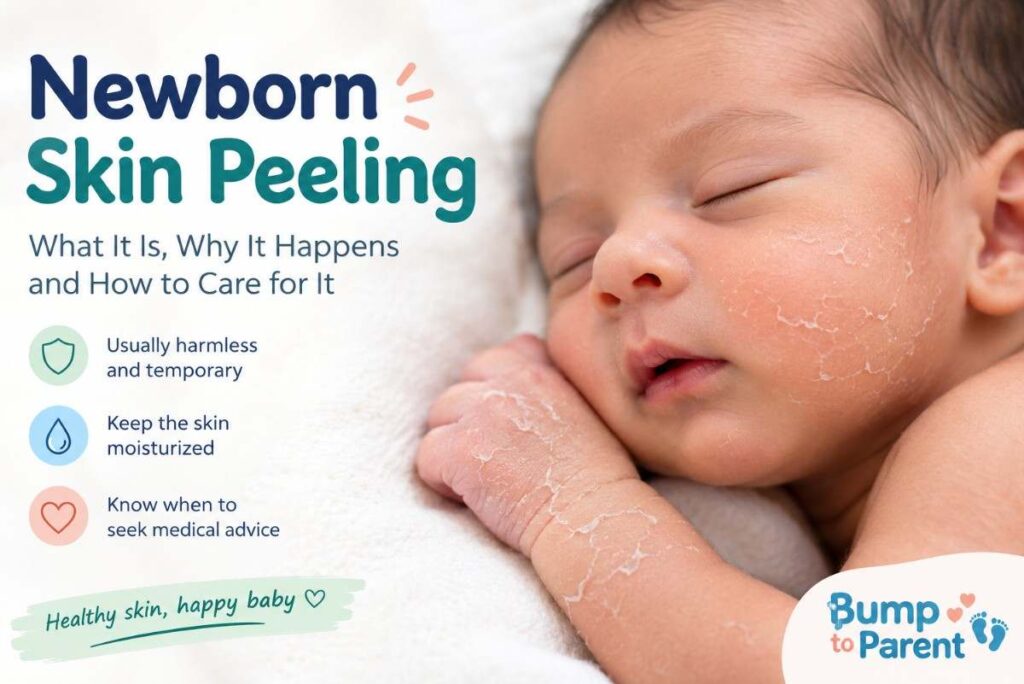

Seeing your newborn’s skin peel or flake during the first days after birth can be surprising, especially when you expect your baby’s skin to be perfectly smooth. In most cases, however, newborn skin peeling is a normal part of the skin adjusting to life outside the womb.
The peeling may appear on the hands, feet, ankles, wrists, legs, abdomen, or other areas of the body. It can look dry, flaky, or slightly cracked, but healthy newborns generally do not need special treatment for ordinary peeling. Peeling skin is normal in newborns and usually requires no treatment.
Understanding why it happens and how to care for your baby’s delicate skin can help you avoid unnecessary products and know when professional advice is needed.
What Is Newborn Skin Peeling?
Newborn skin peeling is the shedding or flaking of the outermost layer of a baby’s skin during the early days or weeks after birth.
Before birth, the baby’s skin develops in a warm, fluid-filled environment inside the uterus. After delivery, the skin suddenly encounters air, clothing, bathing, diapers, and changes in temperature and humidity. The outer layer gradually adapts and matures.
Many babies develop some degree of dry or peeling skin during this transition. The top layer of newborn skin sheds during the first few days while the natural protective skin barrier develops.
Is Newborn Skin Peeling Normal?
Yes, mild skin peeling is usually normal in newborns.
It may begin a few days after birth and can be particularly noticeable on the hands and feet. Some babies have only a small amount of flaking, while others may have more obvious peeling over larger areas.
Peeling can occur in babies born at term as well as babies born early or late. Babies who are overdue may sometimes have drier or more cracked-looking skin because much of their protective vernix has already been absorbed before birth.
If your baby is otherwise feeding well, behaving normally, and has healthy-looking skin underneath the peeling, it is generally not a cause for concern.
What Causes Newborn Skin Peeling?
1. Natural Skin Adjustment
The most common reason is the normal maturation of the newborn’s outer skin layer. The skin is still developing its protective barrier during the early weeks of life.
2. Exposure to Air
Inside the womb, your baby’s skin is surrounded by amniotic fluid. After birth, exposure to relatively dry air can contribute to dryness and flaking.
3. Loss of Vernix
Vernix caseosa is the white, creamy protective coating found on many newborns at birth. It acts as a natural moisturizer and helps protect the skin during the early period after birth.
4. Frequent Washing
Too much bathing or the use of unnecessary soaps and cleansers can contribute to dryness because newborn skin is delicate.
5. Overheating
Excessive warmth and sweating can irritate sensitive newborn skin and contribute to various skin problems.
6. Premature Birth
Premature babies have less mature skin barriers and may require specialized skin care. Their skin can remain particularly fragile for longer than that of full-term babies.
When Does Newborn Skin Start Peeling?
Peeling commonly becomes noticeable during the first several days after birth.
Some babies begin peeling almost immediately, while others develop noticeable flaking later during the first week. The amount and timing vary from baby to baby.
There is no single day when newborn skin peeling starts or stops because each baby’s skin matures at a slightly different rate.
How Long Does Newborn Skin Peeling Last?
For many healthy newborns, peeling gradually improves over the first couple of weeks.
The peeling should slowly decrease as the baby’s natural skin barrier becomes more mature. Newborns commonly go through a peeling phase during the first two weeks of life.
If peeling continues, becomes increasingly severe, or is accompanied by redness, swelling, blisters, oozing, or significant discomfort, speak with your pediatrician.
Where Does Newborn Skin Usually Peel?
Peeling can occur almost anywhere, but it is commonly noticed on:
- Hands
- Fingers
- Feet
- Toes
- Ankles
- Wrists
- Legs
- Arms
- Abdomen
- Back
The appearance can vary depending on your baby’s skin tone, environment, and individual skin characteristics.
What Does Normal Newborn Skin Peeling Look Like?
Normal peeling may look like:
- Small flakes of dry skin
- Fine white or light-colored scales
- Slightly rough skin
- Loose pieces of outer skin
- Dry patches without significant redness
- Mild cracking without bleeding
The skin underneath is usually healthy-looking.
Important: Do not judge your baby’s skin only by color. On darker skin tones, redness or inflammation can be less obvious, so changes in texture, warmth, swelling, tenderness, or oozing can also be important.
How to Care for Peeling Newborn Skin?
The best approach is usually gentle care rather than aggressive treatment.
1. Avoid Picking the Peeling Skin
Do not pull, scratch, or peel loose skin from your baby’s body. Allow it to shed naturally.
Picking can create tiny breaks in the skin and increase irritation.
2. Keep Bathing Gentle
Newborns generally do not need frequent baths. The American Academy of Dermatology recommends bathing babies about two to three times a week, provided the diaper area is cleaned properly between baths.
3. Use Lukewarm Water
Hot water can dry and irritate delicate skin. Use comfortably lukewarm water when bathing your baby.
4. Avoid Strong Fragrances
Choose gentle, fragrance-free products if a cleanser or moisturizer is needed. Fragrances and unnecessary additives may irritate sensitive skin.
5. Keep the Skin Dry but Not Overwashed
After bathing, gently pat the skin dry rather than rubbing it with a towel.
Pay attention to skin folds around the neck, groin, and armpits, where moisture can collect.
6. Keep Your Baby Comfortable
Avoid overheating your baby. Excessive heat and sweating can contribute to irritation and other newborn skin problems.
7. Follow Your Pediatrician’s Advice
If your baby was premature, has very dry or damaged skin, or has another skin condition, follow the individualized skin-care instructions provided by your healthcare professional.
Should You Moisturize Newborn Peeling Skin?
Not every newborn with peeling skin needs a moisturizer.
Different pediatric and dermatology guidelines vary somewhat regarding when and which moisturizers should be introduced. The important principle is to avoid unnecessary products during the earliest period and use only products appropriate for newborn skin when needed.
The NHS recommends plain water for cleansing during the first weeks in some newborn-care guidance, a fragrance-free moisturizer may be considered when a baby’s skin is dry after bathing.
If your baby’s skin is significantly dry, cracked, or irritated, ask your pediatrician which product is appropriate rather than experimenting with multiple oils, creams, or lotions.
Can You Use Baby Oil for Newborn Skin Peeling?
Parents often consider baby oil or natural oils when they see peeling skin. However, peeling skin does not automatically require oil treatment.
If you want to use an oil for massage or skin care, discuss the choice with your baby’s pediatrician, particularly during the newborn period. Indian Academy of Pediatrics guidance supports newborn massage but recommends particular oils over others and cautions against some vegetable oils because of their effects on the skin barrier.
Avoid applying products containing strong fragrances, essential oils, or unverified herbal ingredients to a newborn’s delicate skin.
Is Newborn Skin Peeling a Sign of Dehydration?
Usually, ordinary skin peeling by itself does not mean your baby is dehydrated.
However, dehydration can be serious in newborns. Instead of relying on peeling skin alone, parents should pay attention to feeding, wet diapers, alertness, and other signs of illness.
If your newborn is feeding poorly, has significantly fewer wet diapers, is unusually sleepy or difficult to wake, has a dry mouth, or you are concerned about dehydration, contact your pediatrician promptly.
Does Newborn Skin Peeling Mean My Baby Has Eczema?
Not necessarily.
Normal newborn peeling is different from eczema. Eczema may cause persistent dry, inflamed, irritated, or itchy-looking skin and can develop after the newborn period.
If your baby’s skin becomes increasingly red, inflamed, cracked, weepy, crusted, or uncomfortable, a healthcare professional should assess it. NHS guidance recommends seeking medical advice when a baby’s skin is broken, inflamed, blistered, crusty, or weeping.
Newborn Skin Peeling vs. Other Skin Conditions
| Skin Finding | What It May Look Like | Usually Concerning? |
|---|---|---|
| Normal peeling | Dry flakes or mild scaling | Usually no |
| Cradle cap | Greasy yellow or white scales, mainly on scalp | Usually no |
| Baby acne | Small pimples on face | Usually no |
| Heat rash | Small bumps, often after overheating | Usually mild |
| Eczema | Dry, inflamed, irritated patches | Needs assessment if persistent or severe |
| Infection | Redness, swelling, warmth, pus, spreading rash or blisters | Needs prompt medical attention |
Not every flaky patch is simple newborn peeling. The overall appearance and your baby’s behavior matter.
When Should You Call a Doctor?
Contact your baby’s pediatrician if peeling skin is accompanied by:
- Significant redness or swelling
- Blisters
- Bleeding
- Open or broken skin
- Yellow crusting or pus
- Oozing or discharge
- Fever
- Significant tenderness
- A rapidly spreading rash
- Severe cracking
- Poor feeding
- Unusual sleepiness or difficulty waking
- Signs of dehydration
- A baby who seems generally unwell
For a newborn, it is better to seek advice when you are unsure rather than trying multiple home treatments.
Can Newborn Skin Peeling Be Prevented?
You may not be able to prevent normal newborn peeling because it is part of natural skin development.
However, gentle skin care can reduce unnecessary irritation:
- Avoid excessive bathing.
- Use lukewarm rather than hot water.
- Avoid heavily fragranced products.
- Do not scrub or exfoliate the skin.
- Do not pick peeling skin.
- Avoid unnecessary lotions and medicated products.
- Keep your baby comfortably warm without overheating.
- Use appropriate, gentle cleansing methods.
- Follow your pediatrician’s recommendations.
What About Vernix on a Newborn?
Vernix is an important natural protective substance. It is a white, creamy material that covers some newborns at birth.
Rather than aggressively washing it away immediately, many current recommendations support allowing vernix to remain on the skin for a period after birth. The American Academy of Pediatrics describes vernix as a natural moisturizer and notes its potential protective benefits for delicate newborn skin.
Indian Academy of Pediatrics guidance also recommends that vernix caseosa should not be removed.
Newborn Skin Peeling: A Simple Daily Care Routine
A simple routine is often enough:
- Morning: Keep the baby’s skin clean and dry, especially around skin folds and the diaper area.
- During diaper changes: Clean the diaper area gently and change wet or soiled diapers regularly.
- Bath days: Use lukewarm water and keep bathing gentle and brief.
- After bathing: Pat the skin dry instead of rubbing.
- Throughout the day: Avoid overheating and unnecessary fragranced products.
- For persistent dryness: Ask your pediatrician whether a suitable fragrance-free moisturizer is appropriate.
Warning Signs of Newborn Skin Peeling
Normal newborn skin peeling is usually mild and temporary. However, parents should contact a pediatrician if peeling is accompanied by any of these warning signs:
- Severe Redness: The skin becomes noticeably red, inflamed, or increasingly irritated.
- Blisters: Fluid-filled blisters or widespread peeling develop.
- Swelling: The affected skin becomes swollen or unusually warm.
- Bleeding: Peeling causes bleeding, open wounds, or deep cracks.
- Oozing or Pus: Yellow discharge, pus, or crusting may indicate an infection.
- Fever: A newborn with a temperature of 100.4°F (38°C) or higher needs prompt medical evaluation.
- Rapidly Spreading Rash: Skin changes spread quickly to other parts of the body.
- Significant Pain: Your baby appears uncomfortable or cries when the affected skin is touched.
- Poor Feeding: The baby suddenly feeds less than usual or has difficulty feeding.
- Fewer Wet Diapers: A noticeable reduction in wet diapers can be a sign of dehydration.
- Unusual Sleepiness: The baby is difficult to wake, unusually weak, or less responsive than normal.
- Persistent or Severe Peeling: Peeling does not improve or becomes progressively worse rather than gradually settling.
Important: Newborns can become seriously ill quickly. If your baby has a fever, difficulty breathing, is difficult to wake, is not feeding, or looks seriously unwell, seek urgent medical care rather than treating the skin problem at home.
FAQ’s
Should I remove my baby’s peeling skin?
No. Do not pull, scratch, or scrub peeling skin. Allow it to shed naturally.
Can I use lotion on newborn peeling skin?
If the skin is very dry, a pediatrician may recommend a suitable fragrance-free moisturizer. Avoid unnecessary or heavily fragranced products.
Is peeling skin common in overdue babies?
Yes, peeling or dry-looking skin may be more noticeable in babies born after their due date.
Can I bathe my baby when their skin is peeling?
Yes. Keep baths gentle and use lukewarm water. Avoid frequent bathing and harsh soaps or cleansers.
When should I worry about newborn skin peeling?
Seek medical advice if peeling occurs with blisters, significant redness, swelling, bleeding, pus, oozing, fever, or if your baby seems unwell.
Is newborn skin peeling more common on the hands and feet?
Yes. Peeling is often particularly noticeable on the hands, fingers, feet, and toes.
What to put on peeling newborn skin?
Usually, nothing is needed. Keep the skin clean and avoid picking or scrubbing. If it is very dry, ask your pediatrician about a gentle, fragrance-free moisturizer.
Why does my newborn’s skin look like it’s peeling?
Newborn skin is adapting to the outside environment after birth, and the outer layer naturally sheds during the first days or weeks.
How do I stop my newborn’s skin from peeling?
You usually cannot completely stop normal peeling. Gentle bathing, avoiding harsh soaps, and not picking the skin can help prevent additional irritation.
Does breast milk help baby peeling skin?
There is not enough good evidence to recommend applying breast milk to peeling skin. For dry or irritated skin, use newborn-safe products recommended by your pediatrician.
Is newborn skin peeling worse after a bath?
It can look more noticeable after bathing because water and drying can temporarily make flaky skin easier to see.
Can I use coconut oil on newborn peeling skin?
It is best to ask your pediatrician before using coconut oil or other oils on a newborn’s skin, especially during the first weeks.
Can I use Vaseline on newborn peeling skin?
A pediatrician may recommend petroleum jelly for certain areas of dry or irritated skin, but it is best to confirm what is appropriate for your baby’s skin.
Does newborn peeling skin hurt?
Normal mild peeling usually does not hurt. Pain, significant cracking, bleeding, or swelling should be evaluated by a healthcare professional.
Why is my newborn’s skin peeling around the ankles?
The ankles can become dry and flaky as the outer layer of newborn skin sheds naturally. Friction from clothing or socks may also make peeling more noticeable.
Can newborn skin peeling happen on the face?
Yes, mild dryness or flaking can occur on the face, although persistent facial redness or scaling may have another cause.
Does newborn skin peeling mean the baby is allergic?
Usually not. Normal peeling is generally part of newborn skin development and does not necessarily indicate an allergy.
Can newborn skin peeling be caused by dry weather?
Dry air can contribute to skin dryness and make peeling more noticeable, but normal newborn skin shedding can happen regardless of weather.
Is newborn skin peeling common in premature babies?
Premature babies have less mature skin barriers, so their skin may require additional protection and specialized care.
Can I use baby powder on peeling skin?
Baby powder is generally unnecessary for peeling skin. Avoid applying powders near the baby’s face because inhaling powder can be harmful.
Should I use soap on peeling newborn skin?
Newborns generally do not need frequent soap use. If a cleanser is needed, choose a mild, fragrance-free product suitable for newborns.
Final Thought
Newborn skin peeling is usually a temporary and normal part of early skin development. The best approach is gentle care, limited bathing, avoiding unnecessary or fragranced products, and allowing the skin to shed naturally. Most mild peeling improves as the baby’s protective skin barrier matures. If the skin becomes inflamed, blistered, infected-looking, severely cracked, or your baby seems unwell, contact a pediatrician.
Sources / References:
Disclaimer:
This guide is for general educational purposes only and does not replace professional medical advice. If your newborn has severe or unusual skin changes, fever, poor feeding, or appears unwell, consult a pediatrician promptly.
Also Read: