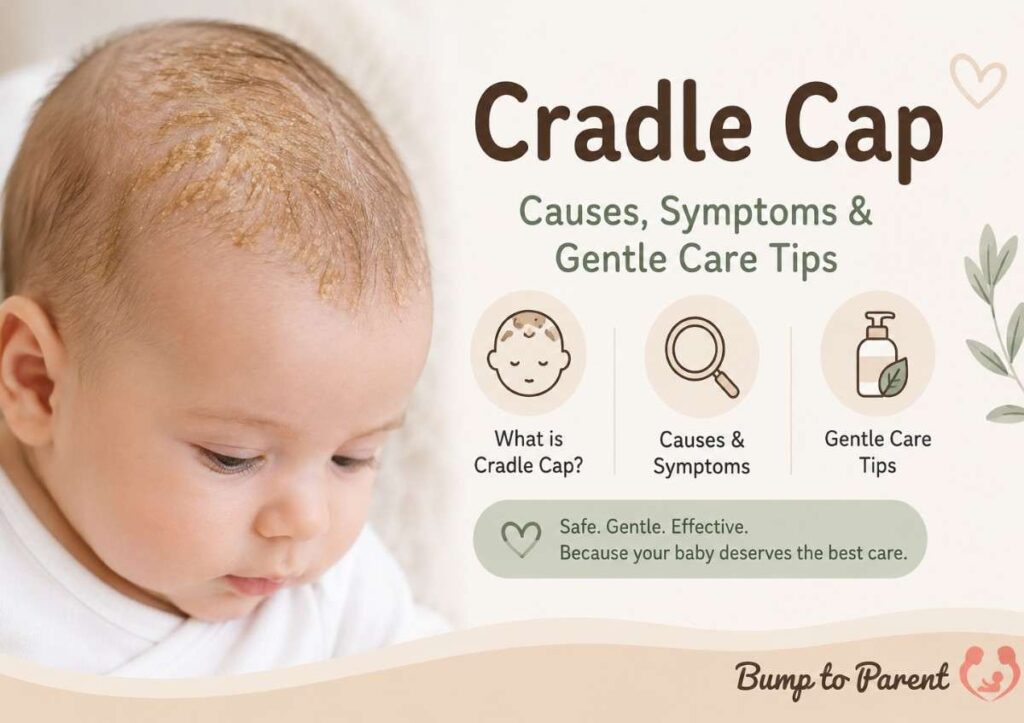

Cradle cap is a common skin condition that can make a baby’s scalp look dry, flaky, greasy, or covered with yellowish crusts. Although it can look concerning, cradle cap is usually harmless, does not mean a baby has poor hygiene, and generally does not cause pain or significant discomfort.
For most babies, cradle cap improves naturally over several weeks or months. Gentle scalp care can help loosen the scales without irritating the delicate skin.
What Is Cradle Cap?
Cradle cap is the common name for infantile seborrheic dermatitis, a type of skin condition that commonly affects a baby’s scalp. It typically appears during the first few weeks or months of life.
It can cause:
- White, yellow, or brownish scales
- Greasy or oily patches
- Thick crusts on the scalp
- Mild redness or changes in skin color around the affected area
- Flaking around the eyebrows, forehead, ears, neck folds, or other skin folds
Cradle cap can occur on different skin tones. The scales may look similar, while the skin underneath may appear pink, red, lighter, darker, or purplish depending on the baby’s natural skin tone.
Is Cradle Cap Normal in Babies?
Yes. Cradle cap is very common in infants. It can begin as early as around 3 weeks of age and is particularly common during the first few months.
It is usually not a sign that anything is wrong with your baby’s health.
Cradle cap is also not contagious, so your baby cannot catch it from another child.
What Does Cradle Cap Look Like?
Cradle cap can look different from baby to baby. Common appearances include:
1. Yellow or White Scales
The scalp may develop yellowish or whitish flakes that have an oily or greasy appearance.
2. Thick Crusts
Some babies develop thicker layers of scales that stick to the scalp and hair.
3. Dry Flaking
Instead of greasy scales, some babies may have relatively dry flakes that resemble dandruff.
4. Red or Discolored Skin
The skin underneath or around the scales can become red in lighter skin tones or appear lighter, darker, or purplish in darker skin tones.
5. Cradle Cap Outside the Scalp
Seborrheic dermatitis can sometimes affect the eyebrows, behind the ears, neck folds, face, armpits, or diaper area.
What Causes Cradle Cap?
The exact cause of cradle cap is not completely understood.
One possible explanation is increased activity of the baby’s oil-producing glands. Researchers have also suggested that naturally occurring yeast on the skin may contribute to seborrheic dermatitis.
Importantly, cradle cap is not caused by poor hygiene and is not usually an allergic reaction or an infection.
Is Cradle Cap Contagious?
No. Cradle cap is not contagious.
A baby cannot develop cradle cap because another baby has it, and parents do not need to isolate their baby because of the condition.
Does Cradle Cap Hurt or Itch?
Usually, no.
Most babies with cradle cap are not bothered by it, and the condition generally does not cause significant itching or pain.
However, if your baby appears uncomfortable, develops significant itching, or seems to be in pain, it is worth speaking with a pediatrician because another skin condition may be involved.
How to Treat Cradle Cap?
Most cases do not require medical treatment. The goal of home care is mainly to soften the scales and gently remove those that are already loose.
1. Wash the Baby’s Scalp Gently
Use a mild, fragrance-free baby shampoo and gently wash the scalp.
Washing a baby’s hair as frequently as every other day may help soften and reduce the scales for many babies.
2. Massage the Scalp Gently
While shampooing, use your fingertips to gently massage the scalp.
Avoid vigorous rubbing because a baby’s scalp is delicate.
3. Use a Soft Baby Brush
After washing, a soft baby brush can help loosen scales that are already coming away from the scalp.
A baby comb may also be used gently when appropriate.
4. Soften Thick Scales Before Washing
If scales are firmly attached, a small amount of an appropriate emollient or baby-safe oil may help soften them before washing.
A non-food-based oil such as baby oil for loosening stubborn scales, followed by shampooing.
The NHS advises against using olive oil and peanut oil on a baby’s scalp.
5. Wash Away the Oil
Do not leave excessive oil sitting on the scalp for prolonged periods.
After softening the scales, gently shampoo the baby’s hair and remove the oil.
6. Never Pick the Crusts
It may be tempting to peel thick flakes from the scalp, but picking or scratching can damage the skin and increase the risk of infection.
Skin Care Routine for Babies With Cradle Cap
Morning
- Gently wipe your baby’s face and skin with lukewarm water.
- Use a mild, fragrance-free moisturizer if the skin looks dry.
- Avoid heavily fragranced lotions, soaps, and essential oils.
During Bath Time
- Use lukewarm rather than hot water.
- Wash the scalp gently with a mild, fragrance-free baby shampoo.
- Massage the scalp lightly with your fingertips; do not scratch or peel the scales.
- Rinse the shampoo thoroughly and gently pat the skin dry.
After Bathing
- Apply a gentle, fragrance-free baby moisturizer to dry areas.
- If the scalp has thick, stuck-on scales, you can soften them before washing with a small amount of suitable oil or emollient, then shampoo it out.
- Use a soft baby brush to loosen only scales that are already coming away easily.
Before Bed
- Check the scalp for irritation, redness, bleeding, or scratching.
- Keep your baby’s fingernails short to reduce accidental scratching.
- Keep the scalp clean and avoid excessive brushing.
Important Tips
- Do not pick, scrape, or forcibly remove cradle cap.
- Avoid adult dandruff shampoos unless recommended by a pediatrician.
- Avoid products containing strong fragrances or irritating ingredients.
- Cradle cap usually improves naturally, so aggressive treatment is unnecessary.
- See a pediatrician if the scalp becomes painful, swollen, bleeding, oozing, or develops a bad smell.
What Not to Do for Cradle Cap?
Some home remedies commonly recommended online may not be appropriate for a baby’s sensitive skin.
Avoid:
- Scratching or peeling the scales
- Using adult dandruff shampoos without medical advice
- Strong soaps
- Fragranced products
- Essential oils
- Harsh exfoliants
- Peanut oil because of allergy concerns
- Olive oil, which the NHS advises against for cradle cap
- Excessive brushing
- Trying to remove scales that are firmly attached
The parents should use appropriate baby shampoo and gentle scale removal rather than harsh treatment.
Can You Use Coconut Oil for Cradle Cap?
Coconut oil is sometimes suggested for loosening cradle cap.
The coconut oil as one option that can be lightly massaged onto the scalp to help loosen scales.
However, babies have sensitive skin, and individual reactions can vary. If you choose to use it, use only a small amount and wash the scalp afterward.
If your baby develops redness, irritation, swelling, or worsening symptoms, stop using it and speak with a healthcare professional.
Can Cradle Cap Cause Hair Loss?
You may notice some hair coming away with the scales.
This can look alarming, but hair usually grows back normally.
Do not pull on attached scales simply to remove them. Gentle care is safer than trying to make the scalp completely clear in one session.
How Long Does Cradle Cap Last?
Cradle cap usually improves on its own within weeks to several months. Some babies may continue to have mild flaking for longer. Cradle cap tends to improve by around 6 to 12 months of age.
There is no need to remove every scale immediately. Consistent, gentle care is usually more appropriate than aggressive treatment.
When Should You See a Doctor?
Although cradle cap is usually harmless, some symptoms require medical assessment.
Contact your pediatrician or healthcare professional if:
- The rash is spreading significantly beyond the scalp.
- The scalp becomes swollen.
- The skin bleeds.
- There is pus or fluid coming from the affected area.
- The rash develops an unpleasant odor.
- Your baby seems to be in pain.
- Your baby has significant itching.
- The rash becomes severely inflamed.
- Your baby’s hair is falling out in noticeable patches.
- The condition continues to worsen despite gentle care.
Bleeding, leaking fluid, swelling, or worsening inflammation can indicate infection or another skin condition.
Cradle Cap vs. Baby Eczema
Cradle cap and eczema can sometimes look similar, but they are not the same condition.
| Feature | Cradle Cap | Baby Eczema |
|---|---|---|
| Typical appearance | Greasy or yellowish scales | Dry, irritated, inflamed patches |
| Common location | Scalp | Face, cheeks, body, folds |
| Itching | Usually minimal | Often itchy |
| Discomfort | Usually little or none | Can be significant |
| Common age | Early infancy | Often begins during infancy |
| Treatment | Often resolves naturally | May require regular skin care and medical treatment |
A baby can have both cradle cap and eczema, so persistent or unusual rashes should be assessed by a pediatrician or dermatologist.
Can Cradle Cap Be Prevented?
There is no guaranteed way to prevent cradle cap because its exact cause is not fully understood.
However, once the scales have improved, regular gentle hair washing with a mild baby shampoo may help reduce buildup and recurrence. The focus should be on gentle skin care rather than trying to keep the scalp completely free of flakes.
Complications of Cradle Cap
Cradle cap is usually harmless and does not cause serious complications. However, problems can occur if the scalp is scratched, picked, or becomes severely irritated.
- Skin Infection: Scratching or picking the scales can create small breaks in the skin, allowing bacteria to enter and cause infection.
- Bleeding: Removing firmly attached scales can cause the delicate scalp to bleed.
- Skin Irritation: Excessive brushing, rubbing, or harsh products can make the scalp more red and irritated.
- Worsening Rash: Using unsuitable oils, fragrances, or strong shampoos may aggravate the baby’s sensitive skin.
- Temporary Hair Loss: Some hairs may come away with thick scales, although permanent hair loss is uncommon.
- Spread to Other Areas: Seborrheic dermatitis may also affect areas such as the eyebrows, behind the ears, face, neck folds, or diaper area.
- Persistent Symptoms: Occasionally, symptoms may continue or become more extensive and require evaluation by a pediatrician.
- Secondary Infection: Increasing redness, swelling, warmth, pus, fluid, crusting, or an unpleasant smell can indicate an infection and should be medically assessed.
FAQ’s
Is cradle cap painful for babies?
Usually not. Most babies with cradle cap do not experience significant pain or discomfort.
How can I get rid of cradle cap?
Gentle shampooing and softly brushing loose scales can help. Avoid picking or scratching the scalp.
Can cradle cap spread to the face?
Yes. Similar seborrheic dermatitis can sometimes affect the eyebrows, behind the ears, face, neck folds, or other areas.
Should I pick off cradle cap?
No. Picking or scratching firmly attached scales can damage the skin and increase the risk of infection.
Can cradle cap come back?
Yes. It can return during infancy, but it usually becomes less noticeable as the baby grows.
Is cradle cap serious?
Usually, no. Cradle cap is generally harmless and often disappears without treatment.
Can I wash my baby’s hair with cradle cap?
Yes. Gentle washing with a mild, fragrance-free baby shampoo can help soften and remove scales.
Does cradle cap mean my baby has poor hygiene?
No. Cradle cap is not caused by poor hygiene.
Can cradle cap spread?
Seborrheic dermatitis can affect areas such as the eyebrows, behind the ears, neck folds, and diaper area.
Should I use dandruff shampoo on my baby?
Do not use adult dandruff shampoo on a baby unless your pediatrician specifically recommends it. The American Academy of Dermatology recommends appropriate baby shampoo for routine cradle-cap care.
Can breast milk cure cradle cap?
There is no strong medical evidence that breast milk cures cradle cap. Gentle scalp care and mild baby shampoo are generally recommended.
Is cradle cap a fungal infection?
No. Cradle cap is a form of seborrheic dermatitis. Natural yeast on the skin may play a role, but it is not considered a typical fungal infection.
Why shouldn’t you remove cradle cap?
Avoid picking or scratching cradle cap because it can damage the baby’s delicate scalp, cause bleeding, and increase the risk of infection. Loose scales can be gently brushed away.
Which shampoo is best for cradle cap?
A mild, fragrance-free baby shampoo is usually a good choice. Avoid adult dandruff shampoos unless your pediatrician recommends one.
Do all babies with cradle cap lose their hair?
No. Most babies do not experience significant hair loss. Some hairs may come away with the scales, but hair usually grows back normally.
Does cradle cap smell?
Cradle cap usually does not have a strong smell. An unpleasant odor, especially with redness, swelling, pus, or oozing, may indicate infection and should be checked by a doctor.
My baby is scratching their cradle cap. What should I do?
Keep your baby’s nails short and gently wash the scalp. Avoid picking at the scales. If your baby is very itchy or the skin becomes irritated, consult a pediatrician.
Final Thought
Cradle cap is a common and usually harmless condition in babies. It often appears as greasy, yellowish or white scales on the scalp and usually disappears naturally over time. Gentle shampooing, careful scale removal, and avoiding scratching are generally enough for mild cases.
If the scalp becomes swollen, painful, infected-looking, bleeding, or starts producing fluid, contact your baby’s healthcare professional rather than relying on home treatment.
Sources / References:
About the Author:
Written by: Kirti Solanki (Health Content Researcher): This article is based on information from established medical and public-health sources, including the American Academy of Pediatrics, American Academy of Dermatology, and NHS. It is written for educational purposes and reviewed against current guidance to provide practical, parent-friendly information.
Disclaimer:
This guide is for general educational purposes and does not replace advice from a pediatrician or other qualified healthcare professional. If your baby has severe, spreading, painful, bleeding, or infected-looking skin changes, seek medical advice.
Also Read: