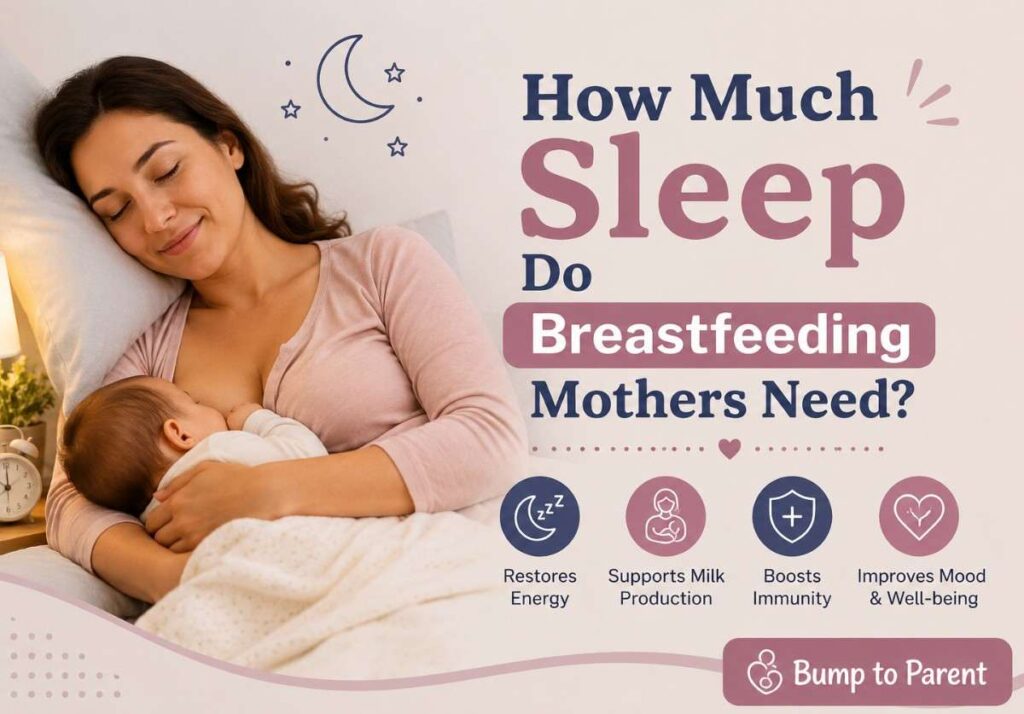

The newborn stage is often described as beautiful, exhausting, emotional, and rewarding all at once. For breastfeeding mothers, one of the biggest challenges can be getting enough sleep. A baby may wake several times during the night to feed, leaving the mother wondering, “How much sleep do I actually need while breastfeeding?”
The short answer is that breastfeeding mothers generally need the same amount of sleep as other adults—at least 7 hours in a 24-hour period—but getting that sleep may be much harder during the early postpartum months. The goal is not necessarily to sleep for seven uninterrupted hours. Instead, total sleep across nighttime sleep and naps can help the body recover.
For a breastfeeding mother, however, the reality is often more complicated. Newborns have small stomachs and commonly wake during the night to feed. Their sleep patterns are also very different from an adult’s.
How Many Hours of Sleep Does a Breastfeeding Mother Need?
A breastfeeding mother should aim for at least 7 hours of total sleep in a 24-hour period, although individual needs can vary.
This does not mean that you must sleep seven hours continuously. During the first weeks and months after birth, uninterrupted sleep may be unrealistic because your baby may wake for feeding, diaper changes, comfort, or other needs.
Instead, think about sleep as a 24-hour total.
For example, a mother might get:
- 5 hours of broken nighttime sleep
- 1-hour morning nap
- 1-hour afternoon nap
That adds up to approximately 7 hours of sleep.
While fragmented sleep is not necessarily as restorative as uninterrupted sleep, getting additional opportunities to rest can be helpful when nighttime waking is unavoidable.
ACOG recommends that postpartum care include discussion of sleep and fatigue and encourages mothers to involve family and friends in helping with care responsibilities.
Why Is Sleep So Difficult While Breastfeeding?
Breastfeeding itself is not necessarily the only reason a mother feels exhausted. Several factors overlap during the postpartum period.
1. Frequent Night Feedings
Newborn babies often need to feed frequently, including during the night. Babies have small stomachs and may wake repeatedly because they need nutrition, hydration, comfort, or closeness.
A mother may therefore wake every few hours, breastfeed, burp or settle the baby, change a diaper, and then try to fall asleep again. By the time she falls back asleep, the baby may wake again.
2. Postpartum Recovery
The mother’s body is recovering from pregnancy and childbirth while simultaneously adapting to the demands of caring for a newborn.
Pain, hormonal changes, physical discomfort, recovery from a cesarean birth or vaginal delivery, and emotional changes can all affect sleep. Lack of sleep, fatigue, pain, breastfeeding difficulties, and stress as common challenges during the postpartum period.
3. Breastfeeding Responsibilities
Breastfeeding can make it difficult to divide nighttime responsibilities equally, particularly during the early weeks when the baby is feeding frequently.
However, breastfeeding does not mean that the mother must handle every nighttime task.
A partner or family member can often help with diaper changes, burping, settling the baby, preparing the mother’s water or snacks, and taking over household responsibilities.
Is 5 or 6 Hours of Sleep Enough While Breastfeeding?
Occasionally getting only 5 or 6 hours of sleep does not necessarily mean something is wrong. New parents commonly experience periods of reduced sleep.
However, regularly sleeping less than 7 hours may not provide enough sleep for optimal adult health.
Adults obtain at least 7 hours of sleep regularly and notes that chronic insufficient sleep is associated with several health and safety concerns.
For breastfeeding mothers, the practical goal is therefore to look beyond a single night’s sleep.
If you slept only 5 hours last night, try to find opportunities for additional rest during the day or the following night rather than feeling that you have failed. The postpartum period is not the time to expect a perfect sleep schedule.
Does Breastfeeding Make Mothers More Sleepy?
Breastfeeding involves hormonal changes that can influence relaxation and sleep. Some mothers find that they become sleepy during or after breastfeeding, particularly during nighttime feeds.
However, individual experiences differ.
Some breastfeeding mothers fall asleep quickly after feeding, while others remain awake because they are anxious, uncomfortable, checking the baby, pumping, or dealing with postpartum sleep problems.
The important issue is not whether breastfeeding automatically makes you sleepy. It is whether you are getting enough safe and restorative opportunities for sleep.
Can Breastfeeding Mothers Sleep When the Baby Sleeps?
Yes. In fact, sleeping or resting while the baby sleeps can be one of the most practical ways to recover lost sleep during the newborn stage.
Trying to sleep when your baby sleeps and suggests prioritizing rest over household chores when necessary.
This advice can be difficult to follow because a baby’s nap may seem like the only opportunity to:
- Take a shower
- Wash dishes
- Prepare food
- Do laundry
- Answer messages
- Work
- Clean the house
But not every nap needs to become productive time.
Sometimes the most productive thing a tired mother can do is sleep.
How Can Breastfeeding Mothers Get More Sleep?
There is no single solution that works for every family, but several strategies can make the postpartum period more manageable.
1. Sleep When You Can
If your baby sleeps during the day and you are exhausted, consider sleeping rather than automatically using that time for chores.
Even a short nap can provide an opportunity to rest.
2. Share Non-Feeding Tasks
If another adult is available, ask them to take responsibility for tasks that do not require breastfeeding.
For example, a partner can change the diaper, bring the baby to you for feeding, burp the baby, settle the baby afterward, or handle the morning routine.
Asking a partner for help with tasks such as nappies and dressing so that a breastfeeding mother can return to sleep.
3. Prepare for Night Feedings
Keeping essential items nearby can reduce the amount of time you spend fully waking up.
A comfortable feeding area can include:
- A water bottle
- A small healthy snack
- Burp cloths
- Nursing supplies
- A dim light
- A phone charger
The goal is to make nighttime feeding as simple and calm as possible.
4. Let Someone Else Handle the Morning
If a partner or family member is available, they may be able to take over baby care after a morning breastfeeding session.
This can give the mother another uninterrupted period of sleep.
5. Accept Help With Housework
A clean house is helpful, but adequate rest is more important during recovery.
If someone offers to cook, wash dishes, grocery shop, or do laundry, allowing them to help can create valuable time for sleep.
6. Avoid Trying to “Catch Up” With Everything
New mothers sometimes feel pressure to return immediately to their previous routine.
The postpartum period is different.
Your body has undergone a major physical event, your baby requires frequent care, and breastfeeding can require substantial time and energy. Reducing unnecessary tasks can protect the limited time available for sleep.
What Happens If a Breastfeeding Mother Does Not Get Enough Sleep?
Sleep deprivation can affect more than energy levels.
Insufficient or poor-quality sleep can affect daily functioning, reaction time, mistakes, and safety.
A severely sleep-deprived mother may experience:
- Daytime exhaustion
- Difficulty concentrating
- Irritability
- Slower reactions
- Trouble making decisions
- Reduced motivation
- Headaches
- Feeling emotionally overwhelmed
- Difficulty completing everyday tasks
Sleep loss can also make the emotional challenges of the postpartum period feel harder.
This is one reason postpartum support should not focus exclusively on the baby. The mother’s sleep, physical recovery, mental health, nutrition, and emotional well-being matter too.
Can Lack of Sleep Affect Breast Milk Supply?
Sleep and breastfeeding are connected, but it is too simplistic to say that one poor night’s sleep will automatically reduce milk supply.
Milk production is influenced by several factors, including how frequently and effectively milk is removed from the breasts, the baby’s feeding pattern, and individual maternal and infant factors.
Night feeding can also be important during the early breastfeeding period. Some breastfeeding guidance notes that prolactin, a hormone involved in milk production, is higher at night.
Therefore, mothers should not routinely eliminate nighttime feeds simply to get more sleep without considering the baby’s age, feeding needs, growth, and their breastfeeding goals.
If you are worried about milk supply, your baby’s weight gain, feeding frequency, or whether nighttime feeds can safely be reduced, speak with a pediatrician, midwife, doctor, or qualified lactation professional.
Does a Breastfeeding Mother Need More Sleep Than Other Adults?
There is no universally established separate sleep-duration recommendation specifically for breastfeeding mothers.
The general adult recommendation remains at least 7 hours per night on a regular basis.
However, a breastfeeding mother may need more opportunities for rest because she is recovering from childbirth while also caring for and feeding an infant.
This distinction is important.
Breastfeeding does not necessarily change the official number of hours adults are advised to sleep, but the physical and emotional demands of breastfeeding and newborn care can make adequate sleep more difficult to obtain.
What Is More Important: Sleep Duration or Sleep Quality?
Both matter.
Seven hours of fragmented sleep may feel very different from seven hours of uninterrupted sleep.
A mother who wakes several times to breastfeed may technically accumulate enough hours but still feel exhausted because her sleep is repeatedly interrupted.
Sleep quality, regularity, and timing also contribute to healthy sleep—not just the total number of hours.
For this reason, mothers should pay attention to how they feel during the day.
If you regularly feel exhausted despite having opportunities to sleep, it may be worth discussing the problem with a healthcare professional.
Safe Sleep Is Especially Important When You Are Exhausted
Extreme tiredness can increase the likelihood that a parent may accidentally fall asleep while feeding or holding a baby.
One particularly important safety point is to avoid falling asleep with a baby on a sofa or armchair. NHS guidance warns that sleeping with a baby on a sofa can be particularly dangerous.
Parents should follow current safe-sleep recommendations for their baby and plan nighttime feeding arrangements with safety in mind.
If you are extremely sleepy during nighttime feeds, consider asking another adult to stay nearby when possible and make sure the baby has a safe sleep space.
When Should a Breastfeeding Mother Talk to a Doctor About Sleep?
Not every tired mother has a sleep disorder. Caring for a newborn is naturally tiring.
However, persistent or severe sleep problems deserve attention.
Talk with your healthcare provider if:
- You have ongoing difficulty falling or staying asleep even when your baby is sleeping.
- You feel exhausted almost all the time.
- You are struggling to function during the day.
- You feel unusually anxious, hopeless, or overwhelmed.
- You cannot sleep even when someone else is caring for your baby.
- You are experiencing persistent sadness or loss of interest.
- You are having frightening or intrusive thoughts.
- You are worried that exhaustion is making it difficult to safely care for yourself or your baby.
ACOG emphasizes the importance of assessing postpartum sleep, fatigue, and emotional well-being.
Postpartum depression and anxiety can also affect sleep, energy, mood, and concentration. If you are experiencing concerning emotional symptoms, seek professional help rather than assuming that everything is simply “new-mom tiredness.”
A Simple Sleep Goal for Breastfeeding Mothers
Instead of asking, “How can I sleep through the night?” a more realistic question during early parenthood may be:
“How can I get enough total sleep and rest across the entire 24-hour period?”
A practical approach may look like this:
| Sleep Strategy | What It Can Look Like |
|---|---|
| Nighttime sleep | Sleep whenever possible between feeds |
| Daytime naps | Rest when the baby sleeps if you are tired |
| Partner support | Let your partner handle non-feeding tasks |
| Family support | Accept help with cooking, cleaning, and baby care |
| Night preparation | Keep feeding essentials nearby |
| Personal expectations | Prioritize recovery over household perfection |
| Professional support | Discuss persistent sleep or mood problems with a healthcare provider |
Remember that your baby’s sleep pattern will change with age. Some babies gradually begin sleeping for longer periods, while others continue waking frequently. Babies vary considerably in their sleep patterns and that night waking is common, particularly in the early months.
Final Thoughts
So, how much sleep do breastfeeding mothers need?
As a general target, breastfeeding mothers should aim for at least 7 hours of total sleep in a 24-hour period, although individual sleep needs vary. The challenge is that newborn feeding schedules can make uninterrupted sleep difficult, especially during the first few months.
The solution is not to expect yourself to function normally on very little sleep.
Instead, protect your sleep whenever possible. Sleep when your baby sleeps, accept practical help, share non-feeding responsibilities, and make rest a legitimate part of postpartum recovery.
Most importantly, remember that taking care of yourself is not selfish. A rested mother is better positioned to care for herself and her baby.
If you are persistently exhausted, unable to sleep when you have the opportunity, or experiencing concerning changes in your mood or mental health, speak with your doctor or another qualified healthcare professional.
FAQ’s
Does breastfeeding make you more tired?
Breastfeeding can contribute to tiredness because feeding requires time and energy, while frequent nighttime feeds can interrupt sleep. Postpartum recovery and the demands of caring for a newborn can also contribute to fatigue.
Can I breastfeed at night and still get enough sleep?
Yes, although frequent nighttime feeding can make this challenging. Sharing diaper changes and other non-feeding responsibilities with a partner or family member can give you more opportunities to sleep.
What should I do if I cannot sleep even when my baby is sleeping?
If you consistently cannot sleep despite having an opportunity to rest, talk with your healthcare provider. Anxiety, stress, postpartum mood changes, pain, or a sleep disorder may be contributing to the problem.
Is it normal to feel exhausted while breastfeeding?
Some tiredness is extremely common after childbirth, particularly during the first few months. However, severe or persistent exhaustion that interferes with daily life should be discussed with a healthcare professional.
Can a breastfeeding mother take naps during the day?
Yes. Daytime naps can be useful when nighttime sleep is repeatedly interrupted. Even a short nap may provide an opportunity to rest, particularly when another adult can care for the baby.
How can my partner help me get more sleep while breastfeeding?
A partner can handle tasks that do not require breastfeeding, such as changing diapers, burping and settling the baby, preparing meals, doing household chores, and caring for the baby between feeds.
Is it safe to fall asleep while breastfeeding?
Accidentally falling asleep while feeding can happen when a mother is extremely tired, but safety is important. Avoid feeding or sleeping with your baby on a sofa or armchair, and follow recommended safe-sleep practices for your baby.
When should a breastfeeding mother seek help for sleep problems?
Speak with a healthcare professional if you cannot sleep even when you have the opportunity, feel persistently exhausted, have significant anxiety or sadness, or feel unable to safely manage daily activities or care for yourself or your baby.
Does a breastfeeding mother need uninterrupted 7 hours of sleep?
No. The general recommendation refers to total sleep over a 24-hour period. During the newborn stage, sleep may be divided between nighttime sleep and daytime naps because babies commonly wake for feeds.
Sources / References:
About the Author:
Written by: Kirti Solanki (Health Content Researcher)
Kirti Solanki is a health content researcher who focuses on creating reader-friendly, evidence-informed content on nutrition, women’s health, pregnancy, postpartum care, and everyday wellness. Her work emphasizes clear explanations, reputable health references, and practical information for general readers.
Disclaimer:
This article is for general educational purposes only and does not replace medical advice, diagnosis, or treatment. Every mother’s postpartum recovery and breastfeeding experience is different. If you have concerns about sleep, breastfeeding, milk supply, postpartum recovery, or your mental health, consult a qualified healthcare professional.
Also Read: