
A baby’s sleep can be one of the most peaceful parts of the day, but it can also be a source of worry for new parents. Questions such as “Should my baby sleep on the back or side?”, “Is stomach sleeping safe?”, and “What if my baby rolls over?” are extremely common.
The good news is that safe-sleep guidance is quite clear: the safest sleeping position for a baby is on their back, for every nap and nighttime sleep, until their first birthday. This recommendation applies to healthy babies, including babies born prematurely and babies with reflux, unless a healthcare professional has given specific medical instructions otherwise.
Safe sleep is not only about position, however. The baby’s sleep surface, bedding, clothing, room-sharing arrangements, and what caregivers do when the baby starts rolling all matter.
This guide explains the safest sleeping position for babies, why back sleeping is recommended, what to do about side and stomach sleeping, reflux, rolling, swaddling, tummy time, and common safe-sleep mistakes.
What Is the Safest Sleeping Position for a Baby?
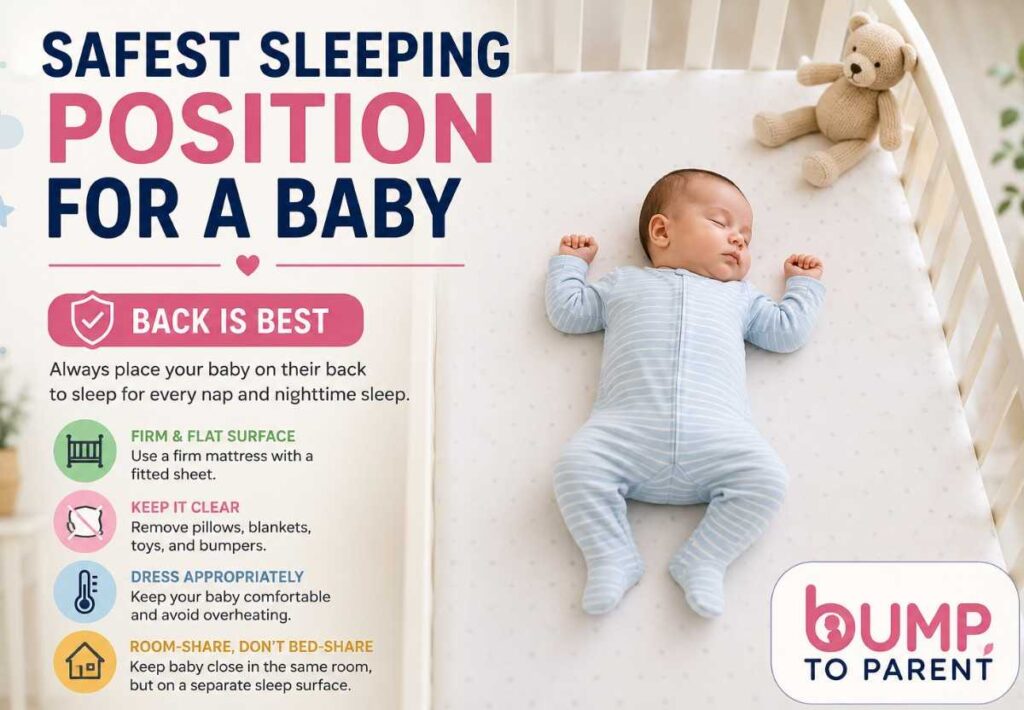
The safest sleeping position for an infant is lying flat on their back.
Parents and caregivers should place babies wholly on their backs for every sleep, including nighttime sleep and naps. Babies should not routinely be placed on their sides or stomachs to sleep. Back sleeping has the lowest risk of sudden infant death syndrome (SIDS) compared with stomach or side sleeping.
This recommendation should continue throughout the first year of life.
It is important that everyone who cares for the baby follows the same rule. A baby who normally sleeps safely on their back should not be placed on their stomach or side “just for one nap.”
Why Is Back Sleeping Safest for Babies?
The exact cause of SIDS is not completely understood, but research has consistently identified sleep position as an important modifiable risk factor.
When babies sleep on their stomachs, they may be more vulnerable to rebreathing exhaled air, reduced oxygen, overheating, and other changes that can interfere with normal breathing and arousal. Stomach sleeping is associated with a higher risk of SIDS.
Side sleeping is not considered a safe alternative because an infant can easily move or roll from the side onto the stomach. The side position is therefore unstable compared with starting sleep on the back.
Back sleeping gives parents a simple, consistent starting position for every sleep.
Does Sleeping on the Back Increase the Risk of Choking?
This is one of the biggest concerns parents have, particularly when a baby spits up or has reflux.
For most babies, sleeping on the back does not increase the risk of choking.
Healthy infants have protective airway mechanisms that help prevent stomach contents from entering the airway. Current safe-sleep guidance therefore recommends back sleeping even for babies with gastroesophageal reflux.
Parents should not routinely place a baby on their stomach to prevent choking.
If your baby has a diagnosed medical condition involving the airway or another unusual circumstance, follow the individualized advice of your pediatrician.
What About Side Sleeping?
Side sleeping is not recommended for routine infant sleep.
Although it may look like a compromise between back and stomach sleeping, the side position is unstable. A young baby may roll onto the stomach without having the strength or coordination to move back.
For this reason, caregivers should begin every sleep by placing the baby on their back rather than on the side.
What About Stomach Sleeping?
Babies should not be intentionally placed on their stomachs to sleep.
Stomach sleeping is associated with a higher risk of SIDS and other sleep-related infant deaths. The stomach position may also increase the chance of rebreathing exhaled air and can make it harder for a baby to maintain an open airway.
There is an important distinction, though: tummy time is beneficial when the baby is awake and supervised.
Tummy time helps babies develop neck, shoulder, and upper-body strength. It should happen when the baby is awake and an adult is watching. It should not replace back sleeping.
What If My Baby Rolls Onto Their Stomach?
This is a very common concern as babies become more mobile.
If your baby can roll independently from back to stomach and from stomach to back, you do not need to continually turn them back during sleep after initially placing them on their back. You should continue starting every sleep with the baby on their back.
If your baby can roll only in one direction, Safe to Sleep guidance advises repositioning them onto their back if they roll onto their stomach during sleep.
The important thing is to keep the sleep environment clear so that if your baby rolls, there are no pillows, blankets, toys, bumpers, or other objects around them.
What Is the Safest Sleep Surface?
Baby’s position is only one part of safe sleep. The sleep surface should be:
- Firm
- Flat
- Level
- Non-inclined
- Covered with a fitted sheet designed for the mattress
A crib, bassinet, or portable play yard designed to meet applicable safety standards is recommended.
A firm mattress is important because a soft surface can allow an infant’s head or body to sink into it. This can create pockets where breathing may become difficult.
Safest Sleeping Position by Age
| Baby’s Stage | Recommended Sleep Position |
|---|---|
| Newborn | On the back for every sleep |
| 1–3 months | On the back for every sleep |
| 4–6 months | Continue starting sleep on the back |
| 6–12 months | Continue starting sleep on the back |
| Baby who rolls both ways | Start on the back; allow baby to find their own position |
| Awake tummy time | On the stomach only while supervised |
The first year remains an important period for following safe-sleep recommendations. SIDS can occur throughout infancy, although risk is particularly concentrated in younger babies.
Should Babies Sleep With a Pillow?
No. Pillows should not be placed in an infant’s sleep area. The same applies to stuffed animals, quilts, comforters, loose blankets, crib bumpers, positioners, and other soft objects.
A baby’s crib may look unusually empty to an adult, but that “bare” sleep environment is intentional.
The safest setup is essentially a firm mattress with a properly fitted sheet and nothing else around the baby.
Are Baby Sleep Positioners Safe?
Parents may see products advertised as helping babies stay on their backs or preventing rolling. However, sleep positioners and similar products should not be used routinely.
Anything placed around or under an infant can create a risk of entrapment, suffocation, or airway obstruction. Safe-to-Sleep guidance recommends keeping these products out of the baby’s sleep area.
Instead of trying to hold a baby in one position with a device, begin each sleep by placing the baby on their back on a safe, empty sleep surface.
What About Inclined Sleepers or Raising the Mattress?
Raising one end of the crib or using an inclined sleep surface may seem helpful for babies with reflux or congestion, but it is not recommended as a routine sleep solution.
An inclined surface can allow a baby’s body to slide downward while the head moves forward. This can place the baby in a position that interferes with breathing.
For routine sleep, the surface should remain flat and level.
If your baby has reflux, discuss symptoms with their pediatrician rather than changing the sleeping angle yourself.
Is It Safe to Swaddle a Baby?
Swaddling can calm some newborns and may help them settle, but it does not eliminate the need for safe sleep practices.
If you swaddle your baby:
- Always place the baby on their back.
- Keep the swaddle comfortably snug rather than tight.
- Make sure the baby’s hips and legs can move freely.
- Never use weighted swaddles.
- Stop swaddling as soon as the baby shows signs of trying to roll.
Once a baby starts rolling, swaddling can increase the risk of suffocation because the baby may have difficulty moving out of a stomach or side position.
Parents should also remember that swaddling does not reduce SIDS risk.
Should Babies Sleep in Their Parents’ Bed?
The safest arrangement is generally room-sharing without bed-sharing.
Keeping the baby’s sleep space in the same room as the parents can make feeding and monitoring easier, while giving the baby a separate sleep surface.
The American Academy of Pediatrics recommends that infants sleep in their own sleep space rather than sharing an adult bed.
Adult mattresses, pillows, blankets, and other bedding are not designed with infant safety in mind.
Couches and armchairs can be particularly hazardous if an adult falls asleep while holding or feeding a baby.
What If My Baby Falls Asleep in a Car Seat?
Car seats are essential for safe transportation, but they are not intended to be a baby’s regular sleep space.
If a baby falls asleep while traveling, the car seat is appropriate while the vehicle is being used as intended. Once you arrive, move the baby to an appropriate firm, flat, level sleep surface as soon as reasonably possible.
The same principle applies to swings, bouncers and other sitting devices: they should not become routine sleeping spaces.
How Can Parents Create a Safe Baby Sleep Environment?
A simple safe-sleep routine can make things easier for exhausted parents.
1. Start Every Sleep on the Back
Place your baby on their back for every nap and nighttime sleep.
2. Use a Firm, Flat Mattress
The mattress should fit the crib, bassinet, or portable play yard correctly without dangerous gaps.
3. Keep the Sleep Space Empty
Remove pillows, blankets, stuffed toys, bumpers, positioners, and other loose objects.
4. Avoid Overheating
Dress your baby appropriately for the room rather than piling on blankets. Overheating is a known risk factor associated with sleep-related infant death.
5. Keep Smoke Away From the Baby
Exposure to smoking during pregnancy and secondhand smoke after birth are associated with increased SIDS risk.
6. Give Supervised Tummy Time
Place your baby on their stomach while awake and supervised to support healthy motor development.
7. Tell Every Caregiver
Grandparents, babysitters, relatives, and childcare providers should know that the baby must be placed on their back for sleep.
Can Back Sleeping Cause a Flat Head?
Some babies develop a flattened area at the back of the head from spending time lying on their backs. This is sometimes called positional plagiocephaly.
The possibility of a flat spot should not be a reason to place a baby on their stomach or side for sleep. Safe-to-Sleep notes that these flat spots are usually not dangerous and often improve as babies become more mobile and spend more time sitting upright.
Supervised tummy time while awake can also help reduce prolonged pressure on the back of the head.
If you notice significant changes in your baby’s head shape, discuss them with your pediatrician.
Unsafe Sleeping Positions for Babies
For babies, the safest position for every nap and nighttime sleep is on the back. Some positions may look comfortable but can increase the risk of suffocation, airway obstruction, or sleep-related infant death.
1. Sleeping on the Stomach
Stomach sleeping is unsafe for routine infant sleep. Babies placed on their stomachs have a higher risk of SIDS and other sleep-related deaths. Always place a baby on their back to start sleep.
2. Sleeping on the Side
Side sleeping is not considered a safe sleep position. A baby can easily roll from their side onto their stomach, particularly during the early months when they cannot reliably reposition themselves.
3. Sleeping Face-Down
A baby’s face should never be pressed against a mattress, pillow, blanket, or another soft surface. Face-down sleeping can interfere with breathing and increase the risk of suffocation.
4. Sleeping Propped Up With Pillows
Babies should not sleep propped up with pillows or cushions. Pillows can obstruct the airway or allow the baby’s face to become covered.
5. Sleeping in an Inclined Position
Inclined sleep surfaces are not recommended for routine infant sleep. A baby can slide downward, causing the head and neck to move into a position that may interfere with breathing.
6. Sleeping With Loose Blankets
Loose blankets can cover a baby’s face or become wrapped around the body. Instead, parents can consider an appropriately sized wearable blanket or sleep sack.
7. Sleeping Surrounded by Stuffed Toys
Stuffed animals and soft toys should be kept out of an infant’s sleep area. They can accidentally cover the baby’s nose or mouth.
8. Sleeping Against a Bumper or Positioner
Crib bumpers and sleep positioners should not be used to control a baby’s sleeping position. These products can create risks of suffocation, entrapment, or strangulation.
9. Sleeping in an Adult Bed
Bed-sharing can expose a baby to pillows, blankets, mattresses, and accidental overlay. The safer arrangement is to have the baby sleep in their own approved sleep space in the same room as the parents.
10. Sleeping on a Couch or Armchair
Couches and armchairs are particularly unsafe places for babies to sleep. A baby can become trapped between an adult and the furniture or cushions.
11. Sleeping in a Car Seat Outside the Car
A car seat is designed for transportation. If a baby falls asleep while traveling, they should be moved to an appropriate firm, flat, level sleep surface once the journey is over.
12. Sleeping in a Swing or Bouncer
Swings, bouncers, and similar sitting devices should not be used as routine sleeping spaces. If a baby falls asleep in one, move them to a safe sleep surface when practical.
Quick Safe-Sleep Rule:
Remember the simple ABC of safe infant sleep:
- Alone: No pillows, blankets, toys, or other objects in the sleep space.
- Back: Place the baby on their back for every sleep.
- Crib: Use a firm, flat, approved sleep surface.
Common Baby Sleep Mistakes to Avoid
Several practices may seem harmless but can make an infant’s sleep environment less safe.
- Putting a baby to sleep on the stomach: Stomach sleeping increases SIDS risk and should not be used as the routine sleep position.
- Using a pillow to keep the baby comfortable: Pillows can create suffocation hazards and are unnecessary for infants.
- Adding blankets to the crib: Loose bedding can cover a baby’s face or become wrapped around the body.
- Using crib bumpers: Bumpers can create risks of suffocation, entrapment, and strangulation.
- Using an inclined sleeper for reflux: Inclined sleep surfaces can create dangerous body positioning.
- Continuing swaddling after rolling begins: Once a baby attempts to roll, swaddling can interfere with their ability to reposition themselves.
- Allowing routine sleep in a car seat or swing: These devices are not intended to replace a safe, flat sleep surface.
- Assuming one caregiver’s habits are enough: Safe sleep works best when everyone who cares for the baby follows the same recommendations.
FAQs
Is it safe for a baby to sleep face down?
No. Always place your baby on their back for sleep to reduce the risk of SIDS.
What are signs of unsafe baby sleep?
Unsafe signs include stomach or side sleeping, loose bedding, pillows, soft mattresses, or sleeping on a couch or armchair.
Can my newborn sleep on my chest?
Only while you are fully awake and supervising. If you feel sleepy, move your newborn to their own firm, flat sleep surface.
How can I sleep without worrying about my newborn?
Follow safe-sleep basics: place your baby on their back, use a firm mattress, keep the crib clear, and room-share without bed-sharing.
Is it safe for a newborn to sleep on their side?
No. Side sleeping is not recommended because a newborn can roll from the side onto the stomach. Always place your newborn on their back.
What if my baby rolls onto their stomach while sleeping?
Continue placing your baby on their back at the start of every sleep. Once a baby can independently roll both from back to stomach and stomach to back, you generally do not need to keep turning them back.
Can babies with reflux sleep on their backs?
Yes. Babies with reflux should generally still sleep on their backs on a firm, flat surface. Do not use pillows, wedges, or inclined sleepers unless specifically instructed by a healthcare professional.
Should I use a pillow to keep my baby on their back?
No. Pillows, sleep positioners, wedges, and similar products should not be placed in an infant’s sleep area because they can create suffocation or entrapment hazards.
Can a baby sleep with a blanket?
Loose blankets are not recommended in an infant’s sleep space. A properly fitted sleep sack or wearable blanket can help keep a baby comfortable without loose bedding.
Is tummy time safe for babies?
Yes. Tummy time is beneficial for development when the baby is awake and supervised. It should not be used as a sleeping position.
When can a baby sleep on their stomach?
Parents should continue putting babies to sleep on their backs throughout the first year. If a baby can independently roll both ways, they can generally be allowed to remain in the position they choose after being placed on their back.
What should be inside a baby’s crib?
Ideally, the sleep space should contain only a firm, flat mattress covered with a properly fitted sheet. Keep pillows, loose blankets, stuffed toys, bumpers, and other soft objects outside the crib.
Does a baby need a pillow?
No. Babies do not need pillows for sleeping. Pillows can increase the risk of suffocation and should not be placed in an infant’s sleep area.
Is sleeping on the back safe for all babies?
Back sleeping is recommended for most babies, including premature babies, but babies with specific medical conditions may occasionally require individualized advice. Parents should follow their pediatrician’s instructions when a medical condition affects sleep.
Final Thoughts
When it comes to infant sleep, simple is safest. Place your baby on their back for every nap and nighttime sleep, use a firm and flat sleep surface, and keep the sleep area free of pillows, blankets, toys, bumpers, and other loose items.
You do not need complicated sleep gadgets to create a safer sleep environment. Consistency matters more: parents, grandparents, babysitters, and other caregivers should all follow the same basic recommendations.
And remember that safe sleep does not mean preventing every movement. As babies grow, they naturally learn to roll, move, and change positions. Your job is to provide a safe starting position and a safe environment in which they can sleep.
If your baby has a medical condition that makes you concerned about sleep position, breathing, reflux, or frequent nighttime waking, speak with your pediatrician rather than changing the baby’s sleep position on your own.
Sources / References:
- Safe to Sleep
- American Academy of Pediatrics
- NIH – Safe Sleep for Baby
- NICHD
- CDC – Providing Care for Babies to Sleep Safely
- World Health Organization
About the Author:
Kirti Solanki is a Health Content Researcher who creates clear, reader-friendly content on pregnancy, newborn care, parenting, nutrition, and general health. Her articles are researched using reliable medical and public-health sources to provide practical, evidence-informed information for parents and families.
Disclaimer:
This article is for general education and is not a substitute for medical advice. Always consult your pediatrician or qualified healthcare professional for advice specific to your baby.
Also Read: