
A baby’s sleep can feel unpredictable, especially during the first few months. One day your baby may sleep for long stretches, and the next day it may seem like they wake every hour. This is normal. Babies do not arrive with a fully developed sleep-wake pattern, and their sleep needs change rapidly as they grow.
A baby sleep schedule is not meant to force a baby to sleep at a particular time. Instead, it provides a gentle daily rhythm for feeding, playing, napping, and nighttime sleep. Understanding your baby’s age, wake windows, sleepy cues, and total sleep needs can make bedtime less stressful for the whole family.
The most important thing is to remember that every baby is different. A schedule that works beautifully for one baby may not work for another. The goal is to create predictable routines while remaining flexible enough to respond to your baby’s needs.
What Is a Baby Sleep Schedule?
A baby sleep schedule is a general pattern that helps organize a baby’s naps and nighttime sleep throughout the day. It usually includes:
- Morning wake-up time
- Feeding times
- Awake or play periods
- Daytime naps
- Bedtime routine
- Nighttime sleep and feeds
Newborns generally cannot follow a strict clock-based schedule because they wake frequently to feed and their sleep cycles are still developing. The American Academy of Pediatrics notes that newborns may sleep around 16–17 hours in a day but often sleep for only one or two hours at a time. More regular sleep cycles generally develop around 4 months.
For this reason, a flexible routine is usually more appropriate than a rigid schedule during early infancy.
How Much Sleep Does a Baby Need?
Sleep needs vary considerably by age.
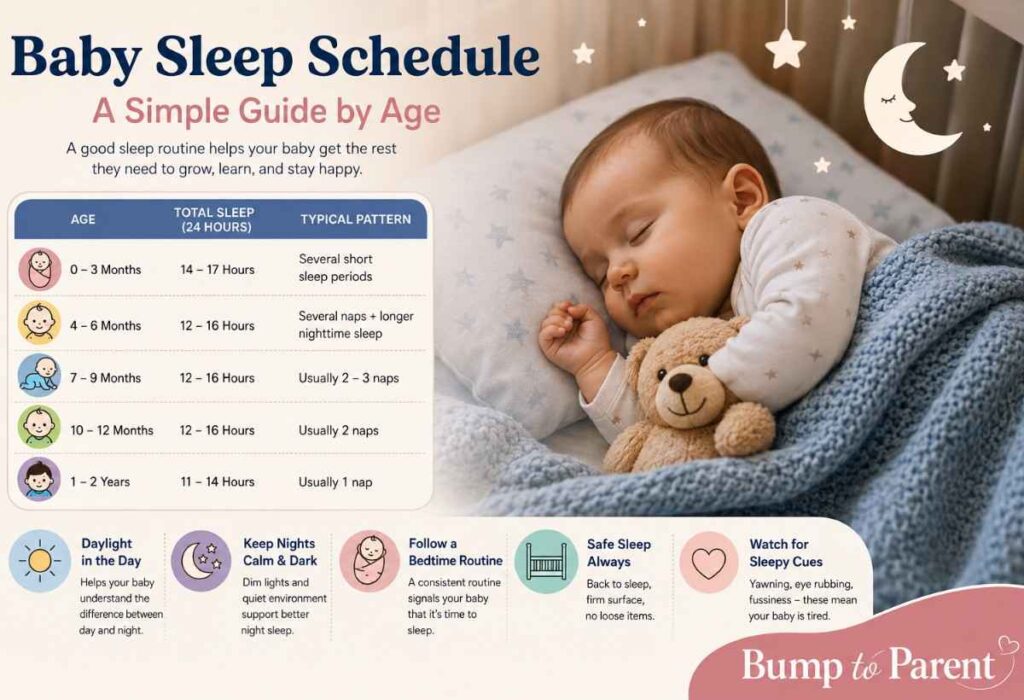
| Baby’s Age | Approximate Total Sleep in 24 Hours | Typical Sleep Pattern |
|---|---|---|
| 0–3 months | Around 14–17 hours may be typical | Several short sleep periods |
| 4–6 months | About 12–16 hours | Several naps plus longer nighttime sleep |
| 7–9 months | About 12–16 hours | Usually 2–3 naps |
| 10–12 months | About 12–16 hours | Usually 2 naps |
| 1–2 years | About 11–14 hours | Usually one nap after the transition |
The American Academy of Sleep Medicine recommends 12–16 hours of total sleep per 24 hours for infants aged 4–12 months, including naps.
For babies younger than 4 months, there is much greater normal variation, so a specific number should not be treated as a target that every newborn must meet. (AASM)
Baby Sleep Schedule by Age
0–3 Months: Newborn Sleep Schedule
Newborn sleep is usually irregular. Babies have small stomachs, need frequent feeding, and have not yet developed a mature circadian rhythm.
A typical newborn may:
- Sleep for short periods throughout the day and night
- Wake frequently for feeding
- Have several naps
- Stay awake for relatively short periods
- Have no consistent bedtime
- Confuse day and night during the first weeks
Instead of trying to establish a strict schedule, focus on recognizing your baby’s sleepy cues.
A simple newborn routine might look like:
Feed → Burp → Short awake time → Sleep → Repeat
During the day, expose your baby to normal household light and activity. At night, keep the environment quiet and dim when feeding or changing the baby.
Do not worry if your newborn’s schedule changes from one day to the next. At this stage, feeding and growth are more important than maintaining a precise sleep timetable.
3–4 Months: Developing a Routine
Around this period, many babies begin showing more predictable patterns. They may start sleeping for longer periods at night and having more organized naps during the day.
A flexible routine could look like:
| Approximate Time | Activity |
|---|---|
| 7:00 AM | Wake and feed |
| 8:30 AM | Nap |
| 10:00 AM | Feed and play |
| 11:30 AM | Nap |
| 1:00 PM | Feed and play |
| 2:30 PM | Nap |
| 4:00 PM | Feed and short play |
| 5:30 PM | Short nap if needed |
| 6:30–7:30 PM | Bedtime routine and sleep |
These times are examples rather than rules. Your baby may naturally sleep earlier or later.
4–6 Months: More Predictable Sleep
By around 4–6 months, many babies develop a clearer distinction between daytime and nighttime.
Some babies may begin sleeping longer stretches at night, although waking is still completely normal.
A sample schedule could include:
- Morning wake-up
- Three daytime naps
- Regular feeding periods
- A consistent bedtime routine
- Longer nighttime sleep with possible feeds
At this stage, watch your baby’s behavior rather than focusing only on the clock.
6–9 Months: Two to Three Naps
Many babies between 6 and 9 months settle into a pattern of two or three daytime naps.
A sample day might look like:
| Time | Activity |
|---|---|
| 7:00 AM | Wake and feed |
| 9:00 AM | Morning nap |
| 10:30 AM | Wake, feed and play |
| 1:00 PM | Afternoon nap |
| 2:30 PM | Wake and play |
| 4:30 PM | Short late nap if needed |
| 6:30 PM | Bedtime routine |
| 7:00 PM | Night sleep |
Some babies will no longer need the late afternoon nap. Others may still become overtired without it.
9–12 Months: Two-Nap Schedule
By 9–12 months, many babies are moving toward two daytime naps.
An example schedule:
| Time | Activity |
|---|---|
| 7:00 AM | Wake |
| 9:30 AM | Morning nap |
| 11:00 AM | Wake and activities |
| 2:00 PM | Afternoon nap |
| 3:30 PM | Wake |
| 6:30 PM | Bedtime routine |
| 7:00 PM | Night sleep |
Again, these are only examples. Your baby’s natural sleep needs should guide the schedule.
What Are Wake Windows?
A wake window is the approximate amount of time a baby can comfortably stay awake between sleep periods.
Wake windows tend to be shorter for newborns and gradually become longer as babies grow.
Rather than treating wake windows as exact rules, use them as a starting point. A baby who becomes cranky, rubs their eyes, stares into space, yawns, or becomes less interested in interaction may be ready for sleep.
If you wait too long, your baby may become overtired and have more difficulty settling.
Signs Your Baby Is Tired
Learning your baby’s individual sleepy cues can be more useful than following a clock. Common signs include:
- Yawning: Repeated yawning can indicate that your baby is becoming tired.
- Eye Rubbing: Babies may rub their eyes or face when they are ready for sleep.
- Reduced Interaction: A tired baby may stop engaging with toys or people.
- Staring: Some babies become quiet and stare into space when they are sleepy.
- Fussiness: Crying and irritability can occur when a baby becomes overtired.
- Slower Movements: Your baby may become less active as sleep approaches.
Try beginning the nap or bedtime routine when you notice early sleepy cues rather than waiting until your baby is extremely tired.
How to Create a Healthy Baby Sleep Routine?
1. Keep the Morning Consistent
A relatively consistent morning wake-up time can help establish a daily rhythm as your baby gets older.
You do not need to wake a newborn at exactly the same time every morning, but gradually creating a predictable morning routine can become helpful.
2. Use Natural Daylight
Daylight and normal daytime activity can help babies gradually learn the difference between day and night.
During the day, keep curtains open and allow normal household sounds. At night, keep lights low and interactions calm.
3. Create a Short Bedtime Routine
A predictable bedtime routine can signal that sleep is approaching.
It could include:
Bath → Pajamas → Feeding → Story or quiet interaction → Sleep
The routine does not need to be long. Even 15–30 minutes of calm, predictable activities can become a useful sleep cue.
4. Put Baby Down for Sleep in a Safe Environment
Safe sleep is more important than achieving a perfect schedule.
The American Academy of Pediatrics recommends placing infants on their backs for every sleep, using a firm, flat, non-inclined sleep surface, and keeping soft bedding and objects out of the sleep area.
5. Keep Nighttime Boring
When your baby wakes at night, keep the room dark or dim and avoid unnecessary stimulation.
Feed, change the diaper if needed, comfort your baby, and return to sleep when appropriate.
This can help your baby gradually understand that nighttime is for sleeping rather than playing.
Safe Sleep Rules Every Parent Should Know
A sleep schedule should never come at the expense of safe sleep.
The key recommendations include:
- Always place your baby on their back for sleep.
- Use a firm, flat, non-inclined sleep surface.
- Use a safety-approved crib, bassinet, or portable crib with a properly fitted mattress.
- Keep pillows, loose blankets, bumpers, stuffed toys, and other soft objects out of the sleep area.
- Keep your baby’s sleep surface separate from your own.
- Room-share rather than bed-share, particularly during early infancy.
- Avoid exposing the baby to smoke and nicotine.
- Avoid overheating.
- Move a sleeping baby from an inclined device such as a car seat to an appropriate firm sleep surface when practical.
The AAP recommends room-sharing without bed-sharing, ideally for at least the first six months.
The CDC similarly advises back sleeping, a firm sleep surface, no soft objects or loose bedding, and room-sharing rather than bed-sharing. (CDC Stacks)
What If My Baby Wakes Frequently at Night?
Frequent nighttime waking does not necessarily mean something is wrong.
Babies wake for many reasons, including:
- Hunger
- Growth and development
- Need for comfort
- Teething
- Illness
- Changes in routine
- Separation anxiety
- Developmental milestones
Newborns especially need frequent feeding, so expecting them to sleep through the night is unrealistic.
As babies grow, longer nighttime sleep may develop naturally, but there can still be periods when sleep temporarily becomes disrupted.
What Is a Sleep Regression?
A sleep regression is a period when a baby who previously slept relatively well begins waking more often or resisting naps.
Parents commonly notice sleep disruptions around developmental periods such as 4 months, 6 months, 8–10 months, and around the first birthday, although these patterns are not universal.
Sleep may change when babies learn new skills such as rolling, crawling, pulling themselves up, or becoming more socially aware.
The best approach is usually to maintain a familiar routine while recognizing that temporary changes are normal.
Common Baby Sleep Schedule Mistakes
1. Following the Clock Too Strictly
A schedule should provide structure, not pressure. Babies can become tired at different times from one day to another.
2. Keeping a Baby Awake to Make Them Sleep Better at Night
Keeping a baby awake for too long can lead to overtiredness and make settling more difficult.
3. Expecting Every Baby to Sleep Through the Night
Night waking is normal, especially in young infants.
4. Ignoring Sleepy Cues
If you wait until your baby is crying intensely from tiredness, settling may become harder.
5. Comparing Babies
Your friend’s baby, sibling’s baby, or another child online may have completely different sleep needs.
6. Using Unsafe Sleep Products
A product marketed as a sleep solution is not automatically safe for unsupervised sleep. Follow current safe-sleep recommendations instead of relying on marketing claims.
How to Transition to a More Predictable Schedule
If your baby’s sleep is currently chaotic, do not try to change everything overnight.
Start with three simple habits:
- Choose a consistent morning rhythm: Begin the day around a similar time when developmentally appropriate.
- Create predictable nap cues: Use the same short routine before naps.
- Establish a bedtime routine: Repeat the same calming sequence every evening.
Once these habits become familiar, your baby’s sleep pattern may gradually become more predictable.
When Should You Talk to a Pediatrician?
Talk with your baby’s pediatrician if you are concerned about your baby’s sleep, feeding, growth, breathing, or overall behavior.
Seek medical advice if your baby:
- Has unusual breathing during sleep
- Frequently appears to struggle to breathe
- Is extremely difficult to wake
- Has persistent feeding difficulties
- Is not gaining weight as expected
- Seems unusually lethargic
- Has persistent or severe sleep problems
- Has symptoms of illness alongside major changes in sleep
Parents of premature babies or babies with specific medical conditions may also need individualized sleep guidance.
FAQs
What is a good sleep schedule for a newborn?
Newborns usually do not follow a strict schedule. They sleep in short periods throughout the day and night and wake frequently for feeding. A flexible feed, awake, and sleep routine works best.
How many hours should a baby sleep?
Babies’ sleep needs vary by age. Infants aged 4–12 months generally need 12–16 hours of total sleep in 24 hours, including naps.
When should I start a baby sleep schedule?
You can begin establishing a simple routine from the early months, but newborns should not be expected to follow a strict clock-based schedule. More predictable sleep patterns often develop around 3–6 months.
What time should a baby go to bed?
There is no single ideal bedtime for every baby. Older babies often do well with a consistent early-evening bedtime, while newborns usually have irregular sleep patterns.
How many naps should a baby take?
The number of naps changes with age. Young babies may nap several times a day, while babies around 6–12 months commonly have two or three naps.
How long should a baby’s nap be?
Nap length varies widely. Some babies take short 30-minute naps, while others sleep for one to two hours. The important factor is getting enough total sleep over 24 hours.
How can I get my baby to sleep through the night?
Create a consistent bedtime routine, provide plenty of daytime sleep, watch for sleepy cues, keep nighttime interactions calm, and maintain a safe sleep environment. Not every baby will sleep through the night at the same age.
Should I wake my baby from a nap?
It depends on the baby’s age, feeding needs, growth, and overall sleep pattern. Young babies may need to wake for feeds according to their healthcare provider’s advice.
Is it normal for a baby’s sleep schedule to change?
Yes. Baby sleep can change during growth spurts, developmental milestones, illness, teething, travel, and changes in daily routines.
What is the 4-month sleep regression?
The 4-month sleep regression refers to a period when some babies begin waking more frequently or resisting sleep as their sleep cycles mature. It is a common developmental change, although not every baby experiences it.
Should a baby sleep in complete darkness?
A dark or dim environment can help signal nighttime, but newborns do not need complete darkness. During the day, natural daylight and normal household activity can help babies learn the difference between day and night.
What is the safest sleeping position for a baby?
Babies should be placed on their backs for every sleep, on a firm, flat sleep surface. Keep pillows, loose blankets, stuffed toys, and other soft objects out of the baby’s sleep area.
Is it normal for a baby to wake up at night?
Yes. Night waking is particularly common in newborns and young infants. Babies may wake because they are hungry, need comfort, or are experiencing normal developmental changes.
When do babies start sleeping through the night?
There is no universal age. Some babies begin sleeping longer stretches during the first year, while others continue waking at night. “Sleeping through the night” can also mean different things to different families.
Should I use a sleep-training method?
Sleep training is a personal decision and approaches vary. If you are considering it, discuss your baby’s age, development, feeding needs, and health with your pediatrician and continue following safe-sleep recommendations.
What is the 3-3-3 rule for baby sleep?
The 3-3-3 rule is not a standard medical guideline for infant sleep. Baby sleep needs vary by age.
How long until a baby is fully asleep?
Many babies settle within 10–20 minutes, although it varies.
What are common baby sleep problems?
Common problems include night waking, short naps, fighting sleep, and irregular sleep patterns.
What is unsafe sleep for infants?
Unsafe sleep includes stomach sleeping, soft bedding, pillows, stuffed toys, and unsafe sleep surfaces.
How do I know if my baby has a sleep disorder?
Persistent breathing problems, severe sleep difficulties, or unusual daytime sleepiness should be discussed with a pediatrician.
What causes lack of sleep in babies?
Hunger, illness, teething, discomfort, overtiredness, and developmental changes can affect sleep.
How do I know if a baby is fighting sleep?
Crying, fussiness, turning away, arching the back, or repeatedly waking can indicate resistance to sleep.
Is it normal for a 2-month-old to sleep 9 hours without feeding?
A 9-hour stretch without feeding may be too long for some 2-month-olds. Ask your pediatrician about your baby’s feeding needs.
What can I do if my baby isn’t sleeping enough?
Use a consistent routine, watch sleepy cues, provide naps, and maintain a safe sleep environment.
How long should a newborn sleep without feeding?
Newborns usually need frequent feeds and should not routinely go long periods without feeding unless advised by their healthcare provider.
How many hours should a 2-month-old sleep at night?
A 2-month-old may sleep several hours at night but commonly wakes for feeding.
How long should a 1-month-old sleep between feedings?
Young babies usually feed frequently, including at night, rather than following a strict schedule.
When do babies sleep 8 hours without feeding?
There is no fixed age; some babies sleep longer stretches during the first year while others continue waking.
Is 10 hours of sleep enough for a baby?
Usually not. Babies aged 4–12 months generally need 12–16 hours of total sleep per day, including naps.
Final Thoughts
A baby sleep schedule is best viewed as a flexible framework rather than a strict timetable. Newborns need time to develop mature sleep patterns, while older babies gradually become more predictable.
Instead of chasing a perfect schedule, focus on the basics: recognize sleepy cues, maintain a calming routine, provide appropriate opportunities for sleep, and create a safe sleep environment.
Most importantly, remember that sleep changes as babies grow. A routine that works today may need adjustment a few weeks later. That does not mean you are doing anything wrong. Your baby’s changing sleep pattern is often simply part of normal development.
Sources / References:
- American Academy of Sleep Medicine — Recommended Sleep Duration for Pediatric Populations
- American Academy of Pediatrics (AAP)
- NIH — Safe Sleep for Your Baby
- CDC — Safe Sleep Tips for Babies
- NICHD — Infant Sleep Information
- NHLBI — Sleep Recommendations by Age
- WHO Guidelines
- CDC — Infant Safe Sleep Guidance
About the Author:
Written by: Kirti Solanki, Health Content Researcher
Kirti Solanki creates reader-friendly health and wellness content based on established medical and scientific sources. Her work focuses on making health information practical, understandable, and evidence-informed for general readers.
Disclaimer:
This article is for general educational purposes only and does not replace advice from a pediatrician or other qualified healthcare professional. Always seek professional guidance for concerns about your baby’s sleep, feeding, growth, breathing, or health.
Also Read: