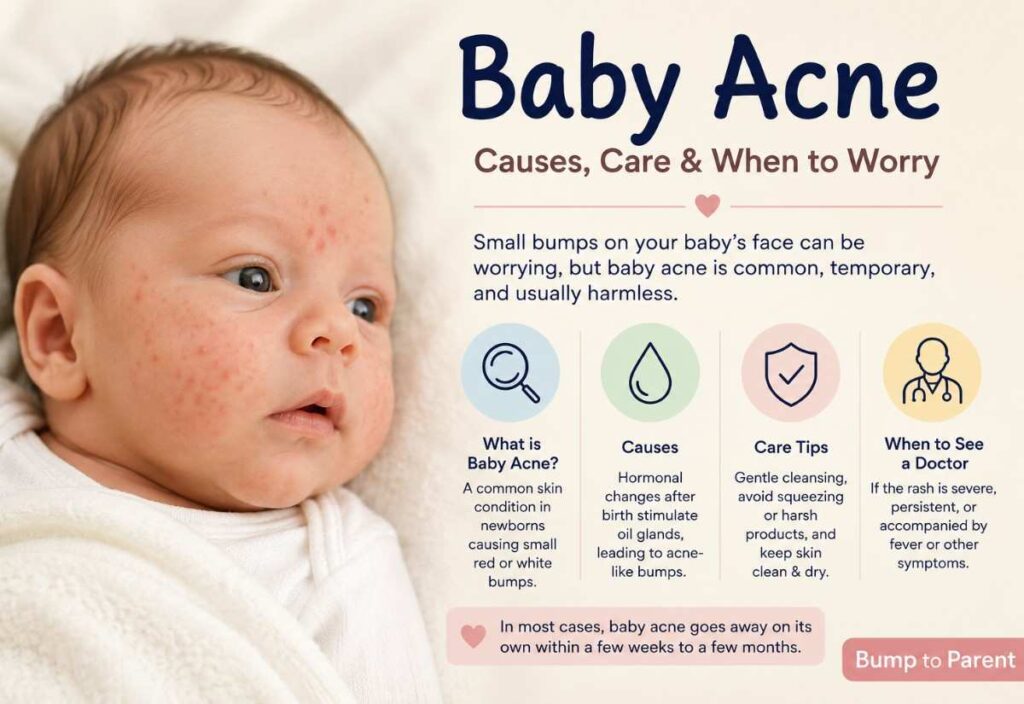

Seeing tiny red or white bumps on your newborn’s face can be alarming, especially during the first few weeks when almost every change in your baby’s skin feels important. The good news is that baby acne is common, temporary, and usually harmless.
Baby acne, also called neonatal acne or neonatal cephalic pustulosis, often appears during the first few weeks after birth. It commonly affects the cheeks, nose, forehead, chin, neck, chest, or back. In most cases, it improves naturally without prescription treatment or special acne products.
Although baby acne may look similar to teenage or adult acne, the causes and management are different. A newborn’s skin is delicate, so aggressive acne treatments, scrubbing, squeezing, or home remedies can do more harm than good.
This guide explains what baby acne looks like, why it happens, how long it lasts, how to care for your baby’s skin, and when it is worth contacting a pediatrician.
What Is Baby Acne?
Baby acne is a temporary skin condition that causes small red bumps, pimples, or pustules on a newborn’s skin. It is particularly common during the first several weeks of life.
The American Academy of Dermatology estimates that about 20% of newborns develop neonatal acne. It often appears around 2 weeks of age but can develop anytime during the first 6 weeks.
Baby acne is different from the acne commonly seen in teenagers. Newborn acne is generally associated with hormonal influences around birth and changes in the baby’s developing skin rather than the same combination of factors responsible for typical adolescent acne. In most newborns, the condition gradually disappears as the baby’s skin adjusts to life outside the womb.
What Does Baby Acne Look Like?
Baby acne can vary slightly from one baby to another, but common signs include:
- Small red or pink bumps on the skin.
- Tiny white or yellowish pustules.
- Slightly raised pimples around the cheeks and nose.
- Clusters of bumps on the forehead or chin.
- Occasional spots on the scalp, neck, upper chest, or back.
The bumps may become more noticeable when your baby cries, becomes warm, or is otherwise flushed.
Unlike some forms of childhood acne, neonatal acne generally does not involve blackheads.
Baby acne usually does not cause significant discomfort. If your baby appears unusually uncomfortable, develops extensive blistering, has a fever, or seems unwell, do not automatically assume the rash is acne.
Where Does Baby Acne Usually Appear?
Baby acne is most commonly noticed on the face, especially:
- Cheeks
- Nose
- Forehead
- Chin
It can also appear on the:
- Scalp
- Neck
- Upper chest
- Back
The distribution can vary, and not every baby will develop bumps in the same places.
When Does Baby Acne Start?
Neonatal acne often appears during the first 2 to 4 weeks after birth. Some babies have bumps at birth, while others develop them during the first several weeks.
The timing is useful because different types of infant skin conditions can occur at different ages.
The American Academy of Dermatology notes that acne beginning during the first 6 weeks is generally neonatal acne and usually clears without treatment. Acne that begins after 6 weeks may be classified as infantile acne and deserves assessment by a healthcare professional, particularly if it is significant.
What Causes Baby Acne?
The exact mechanism is not completely understood, but hormonal influences are thought to play an important role.
During pregnancy and around birth, babies are exposed to maternal and placental hormones. These hormonal influences can temporarily stimulate the baby’s sebaceous glands, which produce sebum, an oily substance that helps protect the skin.
As the baby’s hormonal environment changes after birth, the skin can temporarily produce more oil or develop clogged pores, resulting in acne-like bumps.
Importantly, baby acne is not caused by poor hygiene.
Parents should not feel guilty if their newborn develops pimples. Keeping the baby’s face excessively clean or repeatedly washing the skin will not necessarily prevent the condition.
Stages of Baby Acne
Baby acne does not have officially defined medical “stages” like some diseases. However, parents may notice a typical progression as the condition appears, becomes more noticeable, and gradually clears.
Stage 1: Early Appearance
Baby acne often begins during the first 2–4 weeks after birth. Small red, pink, or skin-colored bumps may first appear on the cheeks, forehead, nose, or chin.
Stage 2: More Noticeable Breakout
The bumps may become more visible and can develop into tiny white or yellowish pustules. The cheeks and nose are often the most affected areas.
Stage 3: Peak or Active Phase
During this phase, there may be clusters of red bumps or pustules. The acne can look worse when the baby is crying, overheated, or flushed. This does not necessarily mean the condition is becoming serious.
Stage 4: Gradual Improvement
As the baby’s hormones and skin continue to mature, the number of bumps usually begins to decrease. The redness and inflammation gradually become less noticeable.
Stage 5: Clearing
Most neonatal baby acne eventually disappears without scarring or specific acne treatment. This may take several weeks, and in some babies, it can take a few months.
Important: If a newborn develops a rash with fever, blisters, significant swelling, peeling skin, feeding problems, or unusual behavior, don’t assume it is baby acne. Contact a pediatrician promptly.
How Is Baby Acne Diagnosed?
Baby acne is usually diagnosed by a pediatrician or dermatologist through a physical examination. The doctor will look at the baby’s skin, including the appearance, location, and age when the bumps developed.
In most cases, no blood tests or special tests are needed. The doctor may also check whether the rash could be another newborn skin condition, such as milia, heat rash, eczema, or an infection.
How Is Baby Acne Treated?
Most newborn baby acne does not require medical treatment and clears on its own as the baby’s skin matures.
Recommended care may include:
- Gentle cleansing: Wash the baby’s face with lukewarm water and a mild cleanser.
- Avoid scrubbing: Gently pat the skin dry instead of rubbing.
- Don’t squeeze pimples: Picking can irritate the skin and increase the risk of infection.
- Avoid oily products: Heavy oils and greasy creams may make acne-like bumps worse.
- Avoid adult acne medicines: Do not use acne creams or treatments unless recommended by your baby’s doctor.
- Be patient: Most neonatal acne gradually disappears within several weeks to a few months.
Does Baby Acne Need Prescription Medicine?
Usually, no. If acne is severe, persistent, or appears later in infancy, a pediatrician or dermatologist may recommend treatment based on the baby’s age and the severity of the condition.
Parents should never start prescription or over-the-counter acne medication on a newborn without professional advice.
Can Breastfeeding Cause Baby Acne?
Parents sometimes wonder whether breastfeeding causes newborn acne.
There is no reason to stop breastfeeding simply because a baby develops acne. Hormonal changes around birth are considered an important factor, and baby acne is generally temporary.
If you are concerned that your baby’s skin is reacting to something related to feeding, discuss the pattern with your pediatrician rather than changing the baby’s feeding routine based solely on acne.
Is Baby Acne Contagious?
No. Baby acne is not contagious.
You cannot spread it by touching, cuddling, kissing, or holding your baby. It is a temporary skin condition rather than an infection that spreads from person to person.
Baby Acne vs. Milia: What’s the Difference?
Milia and baby acne are commonly confused because both can appear as small bumps on a newborn’s face.
Milia usually look like tiny white or pearly bumps, particularly around the nose, cheeks, chin, or forehead. They are caused by trapped keratin beneath the skin and generally disappear naturally within a few weeks. (Mayo Clinic)
Baby acne, in comparison, tends to look more like red pimples or small inflamed bumps and may include pustules.
Neither condition usually requires aggressive treatment.
Baby Acne vs. Heat Rash
Heat rash can also cause small red bumps on a baby’s skin.
Heat rash tends to appear when a baby becomes overheated or sweaty and may occur across areas where heat and moisture become trapped. It can appear quickly and may affect the upper body. (Mayo Clinic)
Baby acne usually appears as acne-like bumps, particularly on the face, during the first weeks of life.
Because newborn rashes can look similar, it is better not to diagnose a rash solely from a photograph or description if your baby seems sick or the rash is unusual.
Baby Acne vs. Eczema
Baby eczema usually causes dry, irritated, itchy, or scaly patches rather than classic acne-like pimples.
Eczema may appear on the cheeks and other areas of the body and can become rough or inflamed.
If your baby’s skin is persistently dry, cracked, intensely red, or appears uncomfortable, talk with your pediatrician about appropriate skincare.
How Long Does Baby Acne Last?
One of the most reassuring things about baby acne is that it is usually temporary.
Many cases improve within a few weeks, although some babies can have acne-like bumps for several weeks to a few months. Mayo Clinic notes that baby acne often clears within several weeks to months.
The exact timeline varies from baby to baby.
If the condition is gradually improving and your baby otherwise seems well, patience is usually more helpful than trying multiple skincare products.
Does Baby Acne Leave Scars?
Neonatal acne generally does not leave permanent scars and usually resolves as the baby’s skin matures.
However, squeezing or picking the bumps can irritate delicate skin and potentially increase the risk of inflammation or secondary infection.
The safest approach is to leave the pimples alone.
How to Care for Baby Acne?
The goal is not to aggressively treat newborn acne but to protect the skin while it naturally settles.
1. Wash the Face Gently
Clean your baby’s face with lukewarm water and gentle, age-appropriate cleansing products if recommended.
There is no need to scrub the skin. Mayo Clinic recommends gentle daily cleansing and careful drying.
2. Pat the Skin Dry
After washing, gently pat the skin dry with a clean, soft towel.
Avoid rubbing the affected areas because friction can increase irritation.
3. Avoid Squeezing the Pimples
Never pop, pinch, or squeeze baby acne.
Even though the bumps may resemble pimples you would normally squeeze on your own skin, newborn skin is much more sensitive.
4. Avoid Heavy Oils and Greasy Products
Some oily or greasy skincare products may worsen acne-like breakouts.
The American Academy of Dermatology recommends avoiding oily or greasy skincare products when a baby has acne.
5. Keep Food and Drool Off the Skin
Milk, saliva, spit-up, and food residue can irritate sensitive skin.
When your baby spits up or gets milk around the mouth and cheeks, gently clean the area rather than repeatedly scrubbing it.
6. Keep Fabrics Clean
Use clean, soft clothing, bibs, towels, and bedding that come into contact with your baby’s face.
This will not necessarily prevent baby acne, but it can help reduce irritation.
7. Keep the Skin Cool and Comfortable
Heat and sweating can make the bumps look more noticeable. Dress your baby appropriately for the temperature and avoid excessive overheating.
8. Give the Skin Time to Heal
In most cases, the best treatment is patience. Neonatal acne commonly resolves without medication as the baby’s skin matures.
What Not to Put on Baby Acne?
Newborn skin is extremely delicate, so avoid experimenting with adult acne treatments or internet remedies.
Do not use acne medicines, exfoliating acids, scrubs, essential oils, harsh soaps, or strong cleansers unless your baby’s healthcare professional specifically recommends them.
The American Academy of Dermatology specifically advises parents not to apply acne medication to a baby’s skin unless recommended by a dermatologist.
Avoid home remedies such as:
- Lemon juice
- Baking soda
- Toothpaste
- Apple cider vinegar
- Undiluted essential oils
- Harsh exfoliants
- Adult acne creams
- Strong antibacterial washes
A product being described as “natural” does not automatically make it safe for newborn skin.
Should You Use Baby Lotion on Baby Acne?
If your baby’s skin is acne-prone, avoid applying thick, greasy lotions or oils directly over the affected areas unless advised by a healthcare professional.
Some products may contribute to clogged pores or irritation.
If your baby has dry skin as well as acne, ask your pediatrician which moisturizer is appropriate rather than trying several products.
Should You Use Breast Milk on Baby Acne?
Breast milk is sometimes recommended online as a home remedy for baby acne. However, there is not enough evidence to recommend routinely applying breast milk to acne lesions as a treatment.
Instead, gentle cleansing and allowing the condition to resolve naturally is generally the safer approach.
If your baby’s skin is worsening, ask your pediatrician for advice.
Does Baby Acne Need Treatment?
Most neonatal acne does not require medical treatment.
Doctors can usually recognize baby acne by examining the skin, and testing is generally unnecessary.
In unusual or persistent cases, a healthcare professional may recommend treatment depending on the baby’s age, severity, and diagnosis.
Parents should never start prescription or over-the-counter acne medication without professional guidance.
When Should You Take Your Baby to the Doctor?
Contact your baby’s pediatrician or healthcare professional if:
- The rash is severe or rapidly spreading.
- The bumps become large, deep, or cyst-like.
- The skin develops significant swelling.
- The rash is accompanied by fever.
- Your baby appears unusually sleepy, irritable, or unwell.
- Your baby has difficulty feeding.
- The skin develops blisters or significant peeling.
- The rash does not improve as expected.
- Acne-like lesions continue or become significant after the newborn period.
- You are simply unsure what the rash is.
Cleveland Clinic recommends contacting a healthcare provider if baby acne does not clear after a few weeks or if other symptoms such as fever, blistering, peeling skin, fussiness, or feeding difficulties occur.
Can Baby Acne Be Prevented?
There is no reliable way to prevent neonatal acne.
Because hormonal changes are believed to contribute to its development, washing your baby’s face more frequently will not necessarily prevent it.
The best strategy is gentle skin care and avoiding unnecessary products.
Is Infantile Acne the Same as Baby Acne?
The terms are sometimes used interchangeably, but healthcare professionals distinguish between neonatal and infantile acne.
Neonatal acne generally develops during the first several weeks of life and commonly resolves naturally.
Infantile acne develops later, often around 3 to 6 months of age. The American Academy of Dermatology notes that infantile acne may last longer and, in more severe cases, can cause deeper lesions and scarring.
If significant acne begins after the first several weeks, it is worth discussing with your baby’s healthcare professional.
FAQs
Does baby acne mean my baby will have acne as a teenager?
Neonatal acne does not necessarily mean your child will develop severe acne later in life. The American Academy of Dermatology notes that neonatal acne does not increase the risk of severe acne later on.
Is baby acne normal?
Yes. Baby acne is common in newborns and usually does not indicate a serious health problem.
Can breast milk cause baby acne?
Breastfeeding itself does not usually cause baby acne. Hormonal changes are considered a more likely reason for newborn acne.
Can I pop my baby’s acne?
No. Avoid squeezing, popping, or picking the bumps because this can irritate delicate skin and increase the risk of infection or scarring.
Can I use acne cream on my baby?
Do not use adult acne creams or acne medications on a newborn unless your pediatrician specifically recommends them.
How should I treat baby acne at home?
Gently wash your baby’s face with lukewarm water and a mild cleanser, pat the skin dry, and avoid harsh products, scrubbing, and heavy oils.
Does baby acne hurt?
Baby acne usually does not cause significant discomfort. If your baby seems painful, unusually fussy, or unwell, contact a healthcare professional.
Is baby acne caused by poor hygiene?
No. Baby acne is not caused by dirty skin. Overwashing or scrubbing can actually irritate your baby’s sensitive skin.
Can kisses cause baby acne?
No. Kisses don’t cause baby acne, but saliva, makeup, or skincare products can irritate a baby’s skin.
Does baby acne mean milk allergy?
Usually not. Baby acne is mainly linked to hormonal changes, not milk allergy.
Can coconut oil help with baby acne?
There is no strong evidence that coconut oil treats baby acne, and it may worsen oily breakouts.
Are breastfed babies more prone to acne?
No. Baby acne can occur in both breastfed and formula-fed babies.
Why is my baby’s acne worse after feeding?
Feeding can make the baby’s face warmer or flushed, making acne appear redder. Milk and drool can also irritate the skin.
Final Thoughts
Baby acne can look concerning, but in most newborns it is simply a temporary part of early skin development. Small red or white bumps appearing during the first few weeks are often harmless and disappear as the baby’s skin adjusts to changing hormones and its new environment.
The most important approach is gentle skincare. Wash the baby’s skin carefully, avoid scrubbing and squeezing, and do not use adult acne treatments or unproven home remedies.
Most importantly, remember that not every newborn rash is baby acne. If the rash looks unusual, persists, becomes severe, or occurs alongside symptoms such as fever, feeding difficulty, blistering, or unusual behavior, contact your baby’s healthcare professional.
Sources / References:
- American Academy of Dermatology – Is That Acne on My Baby’s Face?
- Mayo Clinic – Baby Acne
- Cleveland Clinic – Baby Acne
- American Academy of Dermatology – What Are Those Bumps on My Child’s Skin?
About the Author:
Written by: Kirti Solanki (Health Content Researcher)
Kirti Solanki creates research-based health and wellness content using information from reputable medical and healthcare sources. Content is reviewed for clarity, accuracy, and practical usefulness for general readers.
Disclaimer:
This article is for general educational purposes only and is not a substitute for professional medical advice. Always consult your baby’s pediatrician or healthcare professional for diagnosis or treatment concerns.
Also Read: