
The postpartum period is a major transition. Your body is recovering from pregnancy and childbirth while you are also adjusting to feeding, sleeping in shorter stretches, caring for a newborn, and finding time for yourself. Exercise may be the last thing on your mind, but gentle movement can become an important part of recovery when you are medically ready.
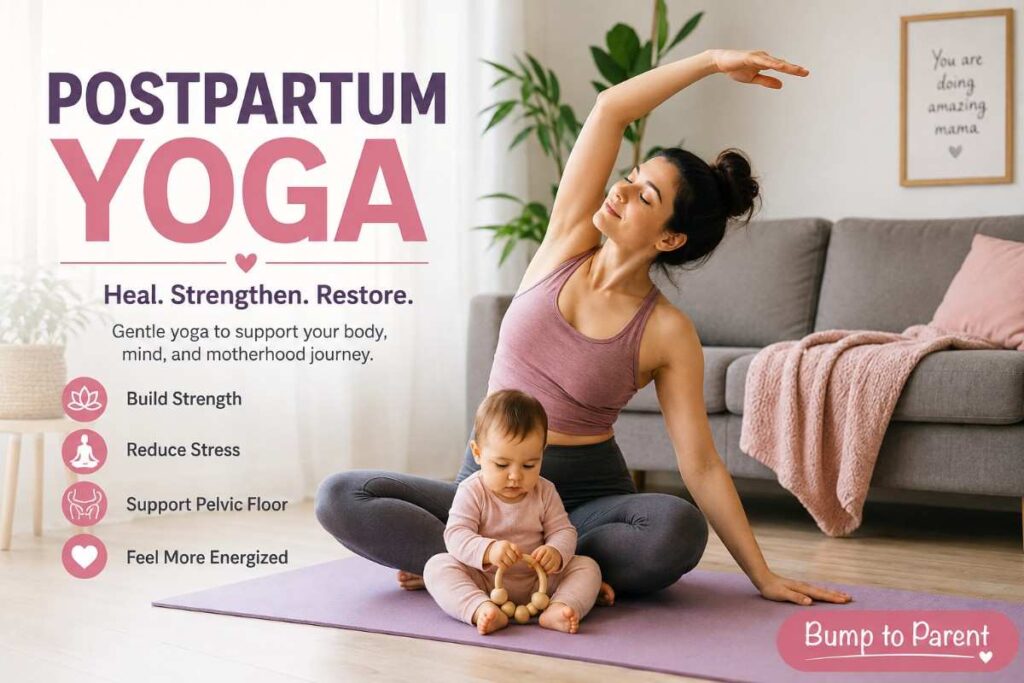
Postpartum yoga is one option that can combine gentle movement, breathing, stretching, relaxation, and gradual strengthening. Unlike an intense workout, postpartum yoga can be adapted to your energy level and stage of recovery.
However, postpartum exercise is not about quickly getting your “pre-pregnancy body” back. The goal is to rebuild strength, improve mobility, support your pelvic floor and core, reduce stiffness, and help you feel more comfortable in your changing body.
This guide explains how postpartum yoga can fit into recovery, which poses may be useful, when to begin, and what precautions new mothers should know.
What Is Postpartum Yoga?
Postpartum yoga is a modified form of yoga designed for women recovering after pregnancy and childbirth.
It can include:
- Gentle stretching
- Breathing exercises
- Pelvic-floor awareness
- Core-rebuilding movements
- Mobility exercises
- Relaxation techniques
- Gentle strengthening
- Posture-focused exercises
The exact practice should depend on how you delivered your baby, whether you experienced complications, your current symptoms, and your previous fitness level.
A woman who had an uncomplicated vaginal birth may be able to begin gentle movement relatively soon, while someone recovering from a cesarean birth, significant tearing, heavy bleeding, or another complication may need a more individualized plan.
ACOG states that after a healthy pregnancy and uncomplicated vaginal delivery, many women can begin exercising within days of giving birth when they feel ready. After a cesarean birth or complications, women should ask their obstetrician-gynecologist when exercise is appropriate. (ACOG)
10 Proven Benefits of Postpartum Yoga
1. Supports Gentle Recovery
Yoga allows you to reintroduce movement gradually instead of immediately returning to demanding workouts.
2. May Improve Flexibility
Pregnancy, feeding positions, carrying a baby, and spending long periods sitting can make the back, hips, shoulders, and neck feel stiff. Gentle stretching may help restore comfortable movement.
3. Helps Strengthen the Core Gradually
Pregnancy stretches and changes the abdominal wall. Appropriate postpartum exercises can gradually help rebuild abdominal and trunk strength.
4. Supports Pelvic-Floor Awareness
Postpartum yoga can incorporate gentle pelvic-floor awareness alongside breathing and movement. Pelvic-floor exercises such as Kegels are also commonly recommended after childbirth.
5. May Improve Posture
New mothers frequently spend considerable time feeding, holding, rocking, and carrying their babies. Gentle yoga can help address stiffness associated with these positions.
6. Encourages Relaxation
Slow movements and breathing can create a few quiet minutes during an otherwise demanding day.
7. May Help Manage Stress
Physical activity is associated with benefits for mental well-being, and ACOG notes that exercise can relieve stress during the postpartum period.
8. May Support Better Sleep
Although yoga cannot eliminate newborn-related sleep disruption, physical activity and relaxation practices may support overall sleep and well-being. ACOG lists better sleep among the potential benefits of postpartum exercise.
9. Supports General Fitness
As recovery progresses, yoga can contribute to flexibility, muscular endurance, balance, and overall physical activity.
10. Provides Time for Yourself
Even a short session can give a new mother an opportunity to focus on her breathing and body rather than only on the baby’s needs.
When Can You Start Postpartum Yoga?
There is no single starting date that works for every mother.
Your recovery depends on factors such as:
- Vaginal or cesarean birth
- Perineal tearing or stitches
- Bleeding
- Pain
- Abdominal recovery
- Pelvic-floor symptoms
- Pregnancy or delivery complications
- Previous fitness level
- Overall health
Women with a healthy pregnancy and uncomplicated vaginal delivery can generally resume exercise soon after birth, often within a few days if they feel ready. Women who had a cesarean birth or complications should consult their ob-gyn about when it is safe to begin.
The World Health Organization recommends that postpartum women without contraindications gradually return to physical activity, starting with small amounts and increasing frequency, duration, and intensity over time.
So instead of asking, “What week should every woman start yoga?” a better question is: “What level of movement is appropriate for my recovery right now?”
10 Best Postpartum Yoga Poses
These poses may be incorporated into a postpartum routine once your healthcare professional has cleared you for the relevant level of activity.
1. Easy Seated Pose
Sit comfortably with your legs crossed or in another supported position.
Keep your spine comfortable and take slow breaths.
Why it may help: It provides a simple starting position for breathing and relaxation.
2. Cat-Cow Stretch
Come onto your hands and knees and slowly alternate between a comfortable rounded-back position and a gentle chest-opening position.
Why it may help: It encourages spinal mobility and can ease stiffness.
Avoid excessive movement if your abdomen, incision, or pelvic area feels uncomfortable.
3. Child’s Pose
Kneel and gently lower your body toward the floor, using cushions or pillows for support if needed.
Why it may help: It can provide gentle relaxation and stretching for the back and hips.
A wider-knee variation may be more comfortable postpartum.
4. Supported Bridge
Lie on your back with your knees bent and feet supported. Gradually lift your pelvis only as high as comfortable.
Why it may help: It can gently engage the glutes and muscles around the hips.
Do not force the movement or continue if you experience pain or pressure.
5. Pelvic Tilts
While lying comfortably with knees bent, gently tilt your pelvis to engage your abdominal and pelvic muscles without straining.
Why it may help: It can introduce gentle core awareness.
6. Side-Lying Leg Lifts
Lie on your side and slowly raise the upper leg.
Why it may help: It gently works the muscles around the hips and pelvis.
7. Seated Side Stretch
Sit comfortably and reach one arm overhead while gently leaning to the opposite side.
Why it may help: It can stretch the sides of the torso and improve mobility.
8. Gentle Neck and Shoulder Rolls
Slowly move your shoulders and neck through comfortable ranges of motion.
Why it may help: It can help relieve stiffness from feeding and carrying your baby.
9. Diaphragmatic Breathing
Place one hand on your abdomen and take slow, comfortable breaths, allowing the belly and ribs to expand naturally.
Why it may help: It encourages relaxation and helps you reconnect with your breathing and abdominal area.
10. Legs-Up-the-Wall Variation
Rest your legs against a wall while lying comfortably, if this position is appropriate for you.
Why it may help: It can provide a relaxing end to a gentle session.
If getting down to or up from the floor is uncomfortable, choose a seated or supported alternative.
Postpartum Yoga for Core Recovery
Core recovery deserves special attention after pregnancy.
The abdominal muscles and connective tissues undergo significant changes during pregnancy. Some women also experience diastasis recti, a separation or widening between the abdominal muscles.
This does not mean that all abdominal exercises are unsafe. However, exercises should be progressed appropriately.
Rather than immediately performing intense crunches or advanced yoga poses, start with controlled movements that allow you to maintain comfortable breathing and abdominal control.
A postpartum physical therapist can be particularly helpful if you notice:
- A persistent abdominal bulge or doming
- Significant abdominal weakness
- Pelvic heaviness
- Urinary or fecal leakage
- Pain during exercise
- Difficulty controlling your pelvic floor
Postpartum Yoga and the Pelvic Floor
The pelvic floor supports the bladder, bowel, and reproductive organs. Pregnancy and childbirth can place considerable demands on these muscles.
Some women experience pelvic-floor weakness after childbirth, while others may have muscles that are overly tense. Therefore, simply doing more pelvic-floor contractions is not necessarily the right approach for everyone.
A qualified pelvic-floor physical therapist can assess whether you need strengthening, relaxation, coordination, or a combination of approaches.
If you experience urinary leakage, pelvic pressure, pain, or discomfort during exercise, consider discussing these symptoms with your healthcare provider rather than pushing through them.
How Long Should a Postpartum Yoga Session Be?
You do not need a one-hour yoga class to benefit from movement.
A beginner might start with:
5–10 minutes: breathing, gentle mobility, and stretching
10–20 minutes: gentle yoga and basic strengthening
20–30 minutes: a more complete postpartum routine when recovery allows
Physical activity can be divided into smaller sessions, including 10-minute periods throughout the day.
This is particularly useful for new mothers because finding a continuous block of free time can be difficult.
Even a short session counts.
How Often Should You Do Postpartum Yoga?
Start according to your recovery rather than following a strict fitness schedule.
For example:
| Recovery Stage | Possible Approach |
|---|---|
| Very early recovery | Breathing, rest, gentle mobility as advised |
| Early exercise phase | 5–10 minutes of gentle movement |
| Building consistency | 10–20 minutes several times per week |
| Later recovery | 20–30+ minutes with gradual strengthening |
| Established fitness | Combine yoga with walking and other appropriate exercise |
The WHO recommends postpartum women without contraindications gradually building toward at least 150 minutes of physical activity per week, while incorporating muscle-strengthening activities and gentle stretching.
This is a general health target, not a requirement to achieve immediately after delivery.
Postpartum Yoga After C-Section
A cesarean birth requires additional consideration because it involves abdominal surgery.
Do not assume that because an exercise feels gentle it is automatically appropriate immediately after surgery.
Your healthcare provider can tell you when to begin and which movements to avoid initially.
When you eventually begin yoga, focus on:
- Comfortable breathing
- Gentle mobility
- Gradual walking
- Supported positions
- Avoiding pressure on the incision
- Slow progression
- Monitoring for pain or unusual symptoms
Avoid rushing into abdominal exercises, deep twists, intense backbends, or demanding poses simply because you feel motivated.
Recovery comes first.
Postpartum Yoga After Vaginal Delivery
Women who have had an uncomplicated vaginal delivery may be able to return to gentle activity relatively quickly.
However, vaginal birth can still involve:
- Perineal soreness
- Stitches
- Pelvic-floor changes
- Bleeding
- Swelling
- Fatigue
Your comfort matters.
If sitting, kneeling, squatting, or certain stretches cause discomfort, modify or skip them.
Postpartum Yoga While Breastfeeding
Yoga and breastfeeding can generally coexist, but practical considerations matter.
Drink enough fluids, particularly if you are breastfeeding and exercising.
You may also find it more comfortable to feed your baby or express milk before a longer workout if breast fullness makes movement uncomfortable.
Wear supportive clothing that does not cause excessive pressure or discomfort.
Most importantly, do not let exercise interfere with adequate nutrition, hydration, rest, and recovery.
What to Avoid During Early Postpartum Yoga?
During early recovery, avoid turning yoga into an intense fitness challenge.
Be cautious with:
- Deep abdominal exercises
- Aggressive twists
- Advanced inversions
- High-impact movements
- Excessive stretching
- Long breath-holds
- Heavy resistance
- Exercises that cause pain
- Exercises that create significant abdominal doming
- Movements that increase pelvic pressure
As recovery progresses, some of these activities may eventually become appropriate. The important factor is gradual progression.
Warning Signs: When to Stop Exercising
Stop your workout and contact a healthcare professional if you experience concerning symptoms such as:
- Significant or increasing pain
- Heavy or unusual bleeding
- Dizziness or fainting
- Chest pain
- Trouble breathing
- Severe headache
- New swelling or significant leg pain
- Worsening incision problems
- New pelvic pressure or severe discomfort
Do not try to “push through” symptoms because you believe they are part of postpartum recovery.
Simple 15-Minute Postpartum Yoga Routine
Once you have been cleared for exercise appropriate to your recovery, you can build a simple routine.
Minute 1–3: Breathing
Sit or lie comfortably and take slow, relaxed breaths.
Minute 3–5: Shoulder Mobility
Perform gentle shoulder rolls and arm movements.
Minute 5–7: Cat-Cow
Move slowly between comfortable spinal positions.
Minute 7–9: Pelvic Tilts
Perform gentle pelvic movements while maintaining relaxed breathing.
Minute 9–11: Side-Lying Leg Lifts
Perform controlled repetitions on each side.
Minute 11–13: Supported Bridge
Perform a few comfortable repetitions if appropriate for your recovery.
Minute 13–15: Relaxation
Finish with comfortable breathing and gentle stretching.
This routine is not a substitute for individualized postpartum rehabilitation. Think of it as a framework that can be adapted to your recovery.
Tips for Practicing Postpartum Yoga Safely
- Start Small: Five minutes of comfortable movement is better than forcing yourself through a long workout.
- Listen to Your Body: Pain, pressure, dizziness, or unusual bleeding should not be ignored.
- Progress Gradually: Increase duration and intensity slowly rather than jumping into advanced yoga.
- Stay Hydrated: Keep water nearby, especially when breastfeeding.
- Choose Comfortable Clothing: Avoid clothing that puts unnecessary pressure on your abdomen or breasts.
- Use Props: Pillows, cushions, blocks, and blankets can make postpartum yoga significantly more comfortable.
- Focus on Breathing: Avoid holding your breath during strengthening exercises.
- Prioritize Recovery: Sleep, nutrition, hydration, medical follow-up, and emotional well-being are just as important as exercise.
- Consider Professional Guidance: A postpartum or pelvic-floor physical therapist can help customize exercise if you have persistent symptoms.
Can Postpartum Yoga Help With Weight Loss?
Yoga can contribute to an active lifestyle, but it should not be viewed as a quick weight-loss solution.
After childbirth, your body needs adequate energy and nutrients to recover. If you are breastfeeding, your nutritional needs are also important.
Postpartum exercise can help women lose pregnancy-related weight while providing broader benefits such as improved energy, stress management, sleep, and muscle strength.
A healthier goal is to gradually rebuild fitness and strength rather than focusing exclusively on the number on the scale.
Postpartum Yoga and Mental Well-Being
The postpartum period can be emotionally demanding.
Hormonal changes, sleep deprivation, physical recovery, feeding challenges, and the responsibility of caring for a newborn can affect mood.
Physical activity may support mental well-being, but yoga should never be presented as a treatment for postpartum depression.
If you feel persistently sad, hopeless, extremely anxious, disconnected from your baby, or unable to cope, speak with a healthcare professional. Mental health deserves the same attention as physical recovery.
WHO emphasizes that postpartum care should address women’s physical, mental, and social well-being and support a positive postnatal experience. (World Health Organization)
FAQ’s
Is postpartum yoga safe after a C-section?
Postpartum yoga can eventually be part of recovery after a C-section, but the timing should be individualized. Avoid movements that cause incision pain or excessive abdominal pressure until you have been medically cleared.
Can postpartum yoga help with belly fat?
Yoga can support overall physical activity and muscle strength, but it cannot specifically burn belly fat. Gradual exercise, balanced nutrition, and recovery are more important than rapid weight loss after childbirth.
Can yoga help with diastasis recti?
Some gentle exercises may support core recovery, but not every yoga pose is suitable for diastasis recti. A postpartum or pelvic-floor physical therapist can recommend appropriate exercises.
Does postpartum yoga strengthen the pelvic floor?
Certain yoga and breathing exercises can improve pelvic-floor awareness and coordination. Women with leakage, pelvic pressure, or pain may benefit from professional pelvic-floor assessment.
Can I do postpartum yoga while breastfeeding?
Yes, breastfeeding mothers can generally include appropriate exercise in their routine. Stay hydrated, eat adequately, and choose comfortable clothing and supportive positions.
Can postpartum yoga help reduce stress?
Gentle yoga, breathing exercises, and relaxation may help manage everyday stress and support emotional well-being. Persistent sadness, anxiety, or other concerning symptoms should be discussed with a healthcare professional.
Can I do postpartum yoga every day?
Gentle stretching and breathing may be suitable frequently, but your body also needs recovery time. Adjust your routine based on your symptoms, energy, and healthcare provider’s advice.
What yoga poses should I avoid after childbirth?
Avoid exercises that cause pain, heavy pelvic pressure, abdominal doming, dizziness, or discomfort. Advanced inversions, intense twists, deep backbends, and strenuous core exercises may need to wait until later recovery.
Can postpartum yoga help with back pain?
Gentle yoga may help improve mobility and strengthen muscles that support posture. However, persistent or severe back pain should be evaluated by a healthcare professional.
Does postpartum yoga help with weight loss?
It can contribute to an active lifestyle and help improve strength and fitness, but postpartum weight loss should be gradual. Recovery, nutrition, sleep, and overall health should remain priorities.
What should I wear for postpartum yoga?
Choose soft, comfortable clothing that allows unrestricted movement. A supportive, comfortable bra can also make exercise easier, particularly while breastfeeding.
When should I stop postpartum yoga?
Stop exercising if you experience significant pain, heavy bleeding, dizziness, chest pain, difficulty breathing, severe headache, new leg pain or swelling, or worsening problems around a C-section incision.
How many minutes of postpartum yoga should I do?
Start with a duration you can tolerate comfortably. Even 5–10 minutes can be a useful beginning, and activity can be gradually increased as recovery progresses.
Can yoga help postpartum stress?
Gentle movement, breathing, and relaxation may help manage stress. However, persistent anxiety, depression, or other concerning mental-health symptoms should be discussed with a qualified healthcare professional.
Final Thoughts
Postpartum yoga is less about performing perfect poses and more about reconnecting with your body after one of the biggest physical changes of your life.
Start gently. Give yourself permission to modify poses, take breaks, and skip movements that do not feel right. Your recovery does not need to look like anyone else’s.
The broader evidence supports regular physical activity for postpartum women without contraindications, but WHO and ACOG both emphasize gradual progression and appropriate medical guidance when complications or cesarean birth are involved. (ACOG)
Most importantly, exercise should support your recovery rather than become another source of pressure. Some days, a 10-minute yoga session may be realistic. On other days, rest may be exactly what your body needs.
Sources / References:
- American College of Obstetricians and Gynecologists (ACOG) — Exercise After Pregnancy(ACOG)
- World Health Organization — WHO Recommendations on Maternal and Newborn Care(World Health Organization)
- WHO Guidelines on Physical Activity and Sedentary Behaviour(World Health Organization)
- WHO Physical Activity Recommendations(World Health Organization)
About the Author:
Written by: Kirti Solanki (Health Content Researcher)
Kirti Solanki creates reader-friendly health and wellness content based on research from reputable medical and public-health sources.
Disclaimer:
This article is for general educational purposes and does not replace medical advice. Consult your obstetrician, gynecologist, or qualified healthcare professional before starting postpartum exercise, especially after a cesarean birth or pregnancy/childbirth complications.
Also Read: