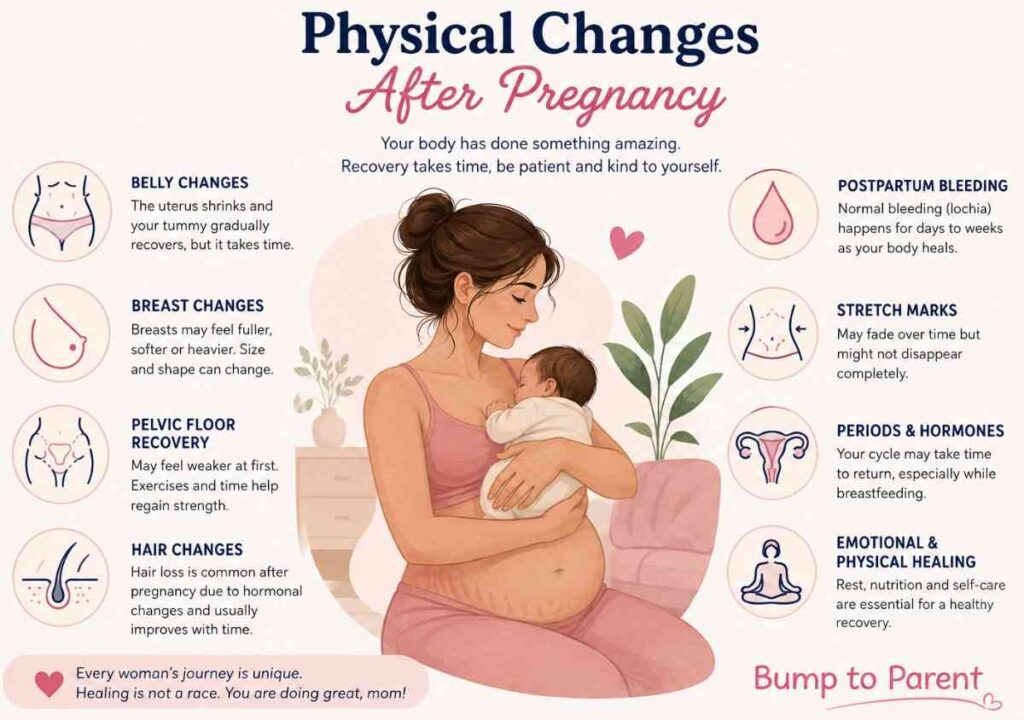

Pregnancy is an incredible experience, but it also asks a lot from the body. The uterus expands, abdominal muscles stretch, breasts prepare for feeding, blood volume changes, hormones shift, and the pelvic floor carries extra pressure for months. After birth, the body does not immediately return to its pre-pregnancy state.
For some women, changes disappear within weeks or months. For others, certain changes such as stretch marks, breast shape, abdominal changes, or pelvic-floor symptoms may last much longer. There is no single “normal” postpartum body, and recovery can look very different from one person to another.
The first few weeks are especially important for healing. The World Health Organization emphasizes that the postnatal period is a critical time for maternal recovery and recommends appropriate postnatal care and monitoring. (World Health Organization)
What Are Physical Changes After Pregnancy?
Physical changes after pregnancy are the changes that occur in a woman’s body during the weeks, months, and sometimes years following childbirth.
These changes may affect the:
- Abdomen and waist
- Breasts
- Vagina and pelvic floor
- Uterus
- Skin and hair
- Weight and body composition
- Menstrual cycle
- Bladder and bowel function
- Feet and joints
- Energy levels
- Sexual health
Some changes are temporary parts of healing, while others may become a long-term part of the body.
20 Common Physical Changes After Pregnancy
1. Your Belly May Still Look Pregnant
One of the first things many new mothers notice is that their stomach does not immediately become flat after delivery. The abdominal muscles and skin have stretched during pregnancy, and the uterus needs time to shrink back toward its pre-pregnancy size.
A softer or larger abdomen during the early postpartum period is completely different from “not losing weight fast enough.” The body needs time to recover.
2. Abdominal Muscle Separation Can Occur
Pregnancy can cause the two large abdominal muscles to separate along the midline, a condition commonly called diastasis recti.
It may appear as a gap or bulge around the belly button, particularly when getting up from a lying position. Specific exercises and, when necessary, physical therapy can help address persistent symptoms.
3. Your Uterus Gradually Shrinks
During pregnancy, the uterus becomes dramatically larger. After childbirth, it begins contracting and gradually returning toward its pre-pregnancy size.
You may notice cramping during this process, particularly while breastfeeding because breastfeeding stimulates hormonal activity that promotes uterine contraction.
4. Postpartum Vaginal Bleeding Is Normal
Bleeding after delivery, known as lochia, is part of the body’s process of clearing blood and tissue from the uterus.
It usually changes in amount and appearance over time. However, sudden or extremely heavy bleeding, particularly when accompanied by weakness or faintness, requires urgent medical attention.
5. Breast Size and Shape Can Change
Breasts often become larger, fuller, tender, or heavier after childbirth. Colostrum is produced initially, followed by mature milk when lactation is established.
Over time, breast size and shape may change again. These changes can occur whether or not a woman breastfeeds because pregnancy itself changes breast tissue and breast size.
6. Breast Tenderness and Fullness May Occur
When milk production increases, breasts can feel tight, heavy, warm, or uncomfortable.
A supportive bra and appropriate breastfeeding support can make the early days more comfortable. Persistent severe pain, redness, fever, or other concerning symptoms should be discussed with a healthcare professional.
7. Stretch Marks May Become More Noticeable
Stretch marks can develop on the abdomen, breasts, hips, thighs, or other areas where the skin stretches during pregnancy.
After birth, they generally become lighter over time, although they may not disappear completely. Their appearance varies greatly between individuals.
8. Your Skin May Look Different
Hormonal changes after pregnancy can affect pigmentation and skin appearance. Some women notice darker areas around the nipples, abdomen, or other parts of the body.
For many people, pigmentation gradually fades after pregnancy, although some changes may remain.
9. Postpartum Hair Loss Is Common
Hormonal changes can affect the normal hair-growth cycle. Some women experience noticeable hair shedding several months after giving birth.
It can feel alarming when hair seems to come out in large amounts, but postpartum shedding is commonly related to hormonal changes and often improves with time.
10. Pelvic Floor Muscles May Feel Weaker
Pregnancy and childbirth place significant pressure on the pelvic floor muscles.
Some women experience heaviness, discomfort, or difficulty controlling urine after childbirth. Pelvic floor exercises can be helpful, and persistent symptoms deserve professional assessment rather than being dismissed as something every mother simply has to live with.
11. Urinary Leakage May Occur
Sneezing, coughing, laughing, exercising, or lifting may cause urine leakage after pregnancy.
This is relatively common after childbirth, but it is not something you have to accept permanently. Pelvic floor exercises and evaluation by a healthcare professional or pelvic health physiotherapist may help.
12. Constipation Can Happen After Birth
Constipation may occur because of hormonal changes, reduced activity, changes in diet, dehydration, medications, or fear of bowel movements after stitches or tearing.
Adequate fluids, fiber-rich foods, gentle movement, and medical advice when needed can support recovery.
13. Hemorrhoids May Develop or Continue
Hemorrhoids, commonly called piles, can occur during pregnancy and after childbirth because of pressure on the veins around the rectum.
They often improve within days or weeks, but persistent pain, bleeding, or severe symptoms should be evaluated.
14. Vaginal Soreness May Last for a While
After a vaginal birth, soreness can occur because of stretching, tearing, or an episiotomy.
Healing time depends on the extent of injury. Larger tears may take longer to heal, so ongoing pain should not simply be ignored.
15. Vaginal Dryness Can Occur
Hormonal changes after childbirth, particularly during breastfeeding, can contribute to vaginal dryness.
This can make sexual activity uncomfortable. Hormone levels and symptoms may change as breastfeeding decreases or ends. If discomfort continues, a healthcare professional can discuss appropriate options.
16. Your Menstrual Cycle May Change
Periods may not return immediately after childbirth. Breastfeeding can delay the return of menstruation for some women. When periods return, the timing, flow, and symptoms may not initially feel exactly the same as before pregnancy.
Importantly, ovulation can occur before the first postpartum period, so pregnancy can be possible before menstruation returns.
17. Your Feet May Change
Some women notice that their feet remain slightly different in size or shape after pregnancy.
Pregnancy-related changes in body weight, ligaments, and foot structure may contribute to changes in how shoes fit.
18. Back and Joint Discomfort May Continue
Pregnancy changes posture, body weight distribution, and the way muscles are used. Caring for a newborn can add repetitive lifting, bending, feeding, and carrying.
As a result, back or other musculoskeletal discomfort can continue after childbirth. Gradual strengthening and attention to posture may help, while persistent or severe pain deserves medical evaluation.
19. Body Weight and Shape May Change
Postpartum weight loss is not always immediate or predictable. Some of the weight gained during pregnancy is lost quickly after delivery, while other changes happen gradually.
Sleep deprivation, breastfeeding, appetite, activity, hormones, genetics, and lifestyle can all influence postpartum body composition.
Rather than focusing only on returning to a pre-pregnancy weight, recovery should also include adequate nutrition, strength, mobility, rest, and overall well-being.
20. Your Body May Not Return Exactly to Its Pre-Pregnancy Shape
This is perhaps the most important physical change to understand. Your body may recover considerably, but it may not look exactly as it did before pregnancy. A softer abdomen, different breast shape, stretch marks, changes in hip or foot size, or other differences can remain.
That does not mean something went wrong. Pregnancy and childbirth can produce genuine long-term physical changes.
Physical Changes After Pregnancy: Quick Timeline
| Time After Birth | Common Physical Changes |
|---|---|
| First few days | Bleeding, uterine contractions, breast tenderness, vaginal or C-section discomfort, fatigue |
| 1–2 weeks | Bleeding gradually changes, soreness begins improving, uterus continues shrinking |
| 3–6 weeks | Pelvic and abdominal recovery continues, energy may slowly improve |
| 6–12 weeks | Strength and mobility may improve, menstrual and hormonal changes may continue |
| 3–6 months | Hair shedding may occur, body composition continues changing, pelvic-floor symptoms may improve |
| 6–12 months | Longer-term changes become easier to assess; some symptoms may still require treatment |
| Beyond 1 year | Some physical changes may remain, while others continue improving with appropriate care |
This timeline is only a general guide. Recovery can be shorter or longer depending on the pregnancy, type of delivery, complications, breastfeeding, sleep, nutrition, physical activity, and individual health.
Permanent Body Changes After Pregnancy
Pregnancy can change the body in ways that improve with time and in ways that may remain long term. Not every woman experiences permanent changes, and having them does not mean that anything went wrong during pregnancy or childbirth. Common Body Changes That May Last After Pregnancy:
- Breast Shape and Size Changes — Breasts may remain different in size, shape, firmness, or position compared with before pregnancy.
- Stretch Marks — Stretch marks often fade and become less noticeable, but they may remain permanently as lighter or slightly textured lines.
- Abdominal Shape Changes — The abdomen may remain softer or have a different contour because of stretched skin, muscles, and changes in body composition.
- Diastasis Recti — Separation of the abdominal muscles can persist in some women after pregnancy, particularly when it is not addressed with appropriate rehabilitation.
- Pelvic Floor Changes — Pregnancy and childbirth can contribute to long-term pelvic-floor weakness, urinary leakage, pelvic pressure, or other symptoms in some women.
- Vaginal Changes — Vaginal tissue and the pelvic floor may feel different after childbirth. Some women notice changes in sensation or comfort during sex.
- Changes in Hip or Pelvic Shape — Pregnancy-related changes in ligaments and pelvic structures can sometimes contribute to a lasting difference in body shape.
- Foot Size Changes — Some women notice that their feet remain slightly longer or wider after pregnancy, which can affect shoe size.
- Skin Pigmentation Changes — Darkening around the nipples, abdomen, or other areas may fade after pregnancy but can sometimes remain partially.
- C-Section Scar — A cesarean delivery leaves a surgical scar that generally remains, although it usually becomes flatter and lighter with time.
- Perineal Scarring — Women who experience an episiotomy or significant perineal tear may have lasting scar tissue or changes in sensation.
- Changes in Body Weight and Fat Distribution — Some women experience a long-term change in weight or where their body stores fat after pregnancy.
Which Changes Usually Improve With Time?
Many temporary changes gradually improve, including:
- Postpartum bleeding
- Uterine enlargement
- Breast fullness related to milk production
- Pregnancy-related swelling
- Postpartum hair shedding
- Some skin pigmentation
- Abdominal muscle weakness
- Certain pelvic-floor symptoms
- Pregnancy-related weight gain
If symptoms remain persistent, painful, or interfere with daily activities, professional assessment can help.
Vaginal Birth vs. C-Section: Are the Physical Changes Different?
Yes, although there is significant overlap.
After a vaginal birth, you may experience vaginal soreness, perineal tears, pelvic-floor symptoms, or temporary urinary leakage.
After a cesarean birth, recovery includes healing from abdominal surgery. The incision may remain sensitive or numb for some time, and activities such as lifting and strenuous exercise may need to be limited during early recovery according to medical advice.
Importantly, pregnancy itself can contribute to abdominal, pelvic-floor, breast, hormonal, and other changes regardless of how the baby is delivered.
How Long Does It Take for the Body to Recover After Pregnancy?
There is no universal recovery period.
The first six weeks are an especially important phase of postpartum recovery, but physical recovery does not necessarily end at six weeks. ACOG describes postpartum care as extending through the broader postpartum period, while WHO emphasizes ongoing support and monitoring during the early postnatal period.
Some changes improve within days or weeks. Others take several months. Certain changes may remain long term.
Instead of asking, “When will my body be normal again?” a more useful question is, “How is my recovery progressing, and do I need support?”
How to Support Your Body After Pregnancy?
1. Eat a Nutrient-Rich Diet
Include vegetables, fruits, whole grains, protein-rich foods, healthy fats, and adequate fluids. If you are breastfeeding, your nutritional needs may be different, so personalized advice can be useful.
2. Start Movement Gradually
Walking and gentle movement may be appropriate for many women when medically cleared. More demanding exercise should be introduced gradually rather than immediately.
3. Focus on Pelvic Floor Recovery
Pelvic floor exercises can help improve muscle function and urinary control. If you have persistent leakage, pelvic pressure, pain, or difficulty with bowel or bladder control, consider seeing a qualified healthcare professional or pelvic health physiotherapist.
4. Give Your Abdominal Muscles Time
Avoid rushing into intense abdominal workouts, particularly if you have abdominal separation, pain, or other postpartum symptoms.
A professional assessment can help determine which exercises are appropriate.
5. Prioritize Rest Whenever Possible
Newborn care can make adequate sleep difficult, but rest remains an important part of recovery. Accepting practical help with meals, household tasks, and baby care can give your body more time to heal.
6. Keep Your Postpartum Appointments
Postnatal appointments provide an opportunity to discuss physical recovery, contraception, breastfeeding, emotional health, pain, bleeding, pelvic-floor symptoms, and other concerns.
When Should You Contact a Doctor?
Not every postpartum symptom is simply a normal part of recovery.
Seek urgent medical care for symptoms such as:
- Very heavy vaginal bleeding or large blood clots
- Chest pain or difficulty breathing
- Sudden swelling, pain, or redness in one leg
- Severe or persistent headache, particularly with vision changes
- High fever
- Severe abdominal pain
- Signs of infection around a wound or incision
- Fainting or severe weakness
- Seizures
- Severe or worsening pain
These symptoms can sometimes indicate serious postpartum complications and should not be ignored.
Can You Get Your Pre-Pregnancy Body Back?
You may regain much of your previous strength, fitness, and body composition, but there is no guarantee that your body will look exactly as it did before pregnancy.
Pregnancy changes tissues, muscles, skin, breasts, hormones, and body structure. Some changes may gradually disappear, while others may remain.
The goal should not be to punish your body into becoming smaller as quickly as possible. A healthier postpartum goal is to recover strength, manage symptoms, eat adequately, move safely, and give the body enough time to heal.
Final Thoughts
Physical changes after pregnancy are a normal part of the transition into motherhood, but that does not mean every symptom should be ignored. Your body has undergone months of significant physical changes and then experienced childbirth, so recovery deserves patience and proper care.
A larger abdomen, stretch marks, breast changes, hair shedding, pelvic-floor symptoms, altered periods, or changes in body shape can all occur after pregnancy. Some improve naturally, while others may benefit from targeted treatment.
Most importantly, there is no deadline for looking “normal” again. Postpartum recovery is not a race. If something hurts, feels unusual, interferes with daily life, or is getting worse instead of better, talk to a healthcare professional.
FAQ’s
Does the belly go back to normal after pregnancy?
The uterus gradually shrinks and the abdominal area usually becomes smaller, but the belly may remain softer or look different than before pregnancy.
Why does my stomach still look pregnant after giving birth?
The uterus needs time to shrink, while stretched abdominal muscles, skin, and changes in body composition can also make the abdomen look larger for a while.
Do breasts stay bigger after pregnancy?
Breast size can change during and after pregnancy. Some women notice their breasts become smaller, larger, softer, or different in shape over time.
Do stretch marks disappear after pregnancy?
Stretch marks usually become lighter and less noticeable over time, but they may not disappear completely.
When do periods return after pregnancy?
The timing varies. Breastfeeding can delay the return of periods, while women who are not breastfeeding may experience menstruation sooner.
Can pregnancy change your body shape permanently?
Yes. Changes in breast shape, abdominal appearance, stretch marks, pelvic-floor function, or foot size can sometimes remain after pregnancy.
Is urinary leakage normal after childbirth?
Urine leakage can occur after pregnancy and childbirth because the pelvic floor may be weakened or stretched. Persistent leakage can often be treated with pelvic-floor exercises or professional care.
What happens to the uterus after childbirth?
The uterus contracts and gradually becomes smaller after delivery. This process is called uterine involution.
Why do I have postpartum bleeding?
Postpartum bleeding, called lochia, occurs as the uterus sheds blood and tissue after childbirth. It gradually decreases and changes in appearance as healing progresses.
Can pregnancy cause abdominal muscle separation?
Yes. Pregnancy can cause diastasis recti, where the abdominal muscles separate along the middle of the abdomen. Targeted exercises and physical therapy may help.
Can feet become bigger after pregnancy?
Some women notice a lasting change in foot size or shape after pregnancy, partly because of changes in ligaments and foot structure.
Why do I feel tired after giving birth?
Childbirth recovery, hormonal changes, disrupted sleep, breastfeeding, and caring for a newborn can all contribute to postpartum fatigue.
Can vaginal dryness happen after pregnancy?
Yes. Hormonal changes, particularly during breastfeeding, can contribute to vaginal dryness and discomfort during sex.
How long does postpartum swelling last?
Mild swelling can occur after pregnancy and generally improves gradually. Sudden or severe swelling, particularly if it affects one leg, should be medically evaluated.
Will my body ever look the same after pregnancy?
It may return close to your previous shape, but it is also completely possible for some changes to remain. Every postpartum body recovers differently.
When should I worry about physical changes after pregnancy?
Contact a healthcare professional if symptoms are severe, worsening, persistent, or interfering with daily life. Seek urgent care for heavy bleeding, chest pain, breathing difficulty, severe headache with vision changes, fainting, or other serious symptoms.
What is the most important thing to remember about postpartum recovery?
Postpartum recovery takes time. There is no fixed deadline for your body to look or feel exactly as it did before pregnancy.
How long does it take for your body to go back to normal after birth?
Most early changes improve within 6–12 weeks, but complete recovery can take several months or longer.
Do all pregnancy symptoms go away after birth?
Most improve after delivery, but symptoms such as fatigue, breast changes, swelling, and hormonal changes may continue for weeks or months.
How can I feel normal after having a baby?
Rest, eat well, stay hydrated, move gradually, and seek medical support for persistent symptoms.
What should I expect after having a baby?
Expect bleeding, cramping, breast changes, fatigue, hormonal changes, abdominal changes, and gradual physical recovery.
Does it take 2 years to recover from childbirth?
Not usually. Many women recover within months, although some changes may continue improving for a year or longer.
Sources / References:
- American College of Obstetricians and Gynecologists (ACOG) – After Pregnancy
- ACOG – Postpartum Recovery
- World Health Organization – Postnatal Care
- WHO – Recommendations on Maternal and Newborn Care for a Positive Postnatal Experience
- NHS – Your Body After the Birth
- Mayo Clinic Press – How Will My Body Change After Pregnancy?
About the Author:
Written by: Kirti Solanki, Health Content Researcher
Kirti Solanki creates reader-friendly health content based on research from reputable medical and public-health sources, with a focus on making complex health topics easier to understand.
Disclaimer:
This article is for general educational purposes only and is not a substitute for professional medical advice, diagnosis, or treatment. If you experience concerning symptoms after pregnancy, consult a qualified healthcare professional promptly.
Also Read: