
Burping a baby can feel surprisingly difficult at first. Babies have tiny stomachs and are still learning how to coordinate sucking, swallowing, and breathing, so they may swallow some air while feeding. That trapped air can sometimes make a baby uncomfortable, fussy, or more likely to spit up.
The good news is that burping does not need to be complicated. With gentle handling, proper head and neck support, and a little patience, most parents can quickly become comfortable with it.
It is also important to remember that not every newborn needs to burp after every feed. Some babies swallow very little air, particularly during breastfeeding, and may be perfectly comfortable without producing a burp.
This guide explains how to burp a baby safely, when to burp your baby, the best burping positions, what to do if your baby will not burp, and when spit-up or vomiting may need medical attention.
What Does Burping a Newborn Mean?
Burping, sometimes called “winding,” means helping a baby release swallowed air from the stomach.
During breastfeeding or bottle-feeding, babies can swallow small amounts of air along with milk. Some babies handle this air naturally, while others may become uncomfortable until they release it.
Burping can be particularly useful when a baby appears uncomfortable during or after feeding. However, burping is not a requirement after every feeding.
Why Do Babies Need to Burp?
Newborns may swallow air while:
- Breastfeeding
- Bottle-feeding
- Feeding very quickly
- Crying while feeding
- Gulping milk
- Taking milk from a bottle
The swallowed air can contribute to a feeling of fullness or discomfort. Stopping briefly to burp may also slow down fast feeding and reduce the amount of air swallowed.
Bottle-fed babies may swallow more air than breastfed babies, although breastfed babies can also need help burping.
How to Burp a Baby? Step by Step Guide
Burping should always be gentle. You do not need to pat hard or repeatedly for a long time.
Step 1: Prepare a Burp Cloth
Place a clean burp cloth, muslin cloth, or small towel over your shoulder or nearby.
A baby may bring up a small amount of milk while burping, which is common.
Step 2: Hold Your Baby Upright
Bring your newborn into an upright position and make sure their head and neck are well supported.
Keep your baby’s body relatively straight rather than allowing the stomach and back to curl tightly.
Step 3: Gently Rub or Pat the Back
Using your free hand, gently rub or pat your baby’s back.
There is no need to use force. Slow, gentle movements are usually sufficient.
Step 4: Give Your Baby a Little Time
Try burping for a couple of minutes. If your baby does not burp but appears comfortable, you generally do not need to keep trying indefinitely.
Step 5: Continue or Finish the Feed
If you paused during a feeding and your baby still seems hungry and comfortable, you can continue feeding.
If the feeding is finished, you can keep your baby upright for a while while supervising them, particularly if they tend to spit up.
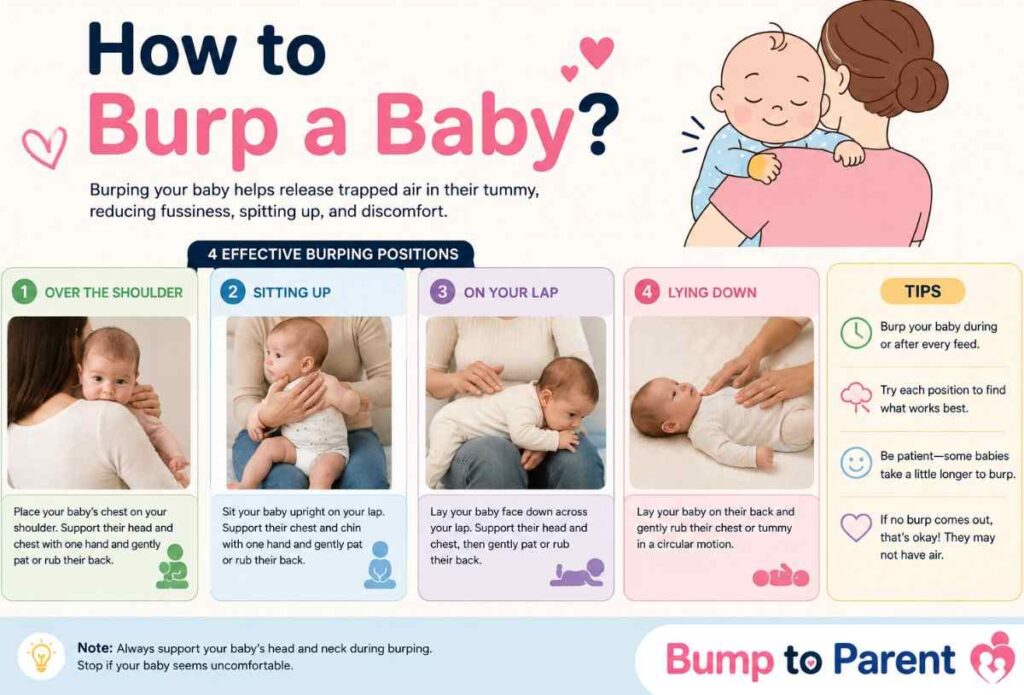
3 Best Positions for Burping a Baby
There is no single position that works for every baby. You can try different positions and see which one your newborn tolerates best.
1. Over-the-Shoulder Position
This is one of the most familiar burping positions.
How to do it:
- Hold your baby upright against your chest.
- Rest your baby’s chin gently over your shoulder.
- Support the baby’s head and neck.
- Keep the baby’s body secure.
- Gently pat or rub the back.
Some parents find that slowly walking around while holding the baby helps.
2. Sitting on Your Lap
This position can be useful if your baby does not like being over your shoulder.
How to do it:
- Sit comfortably.
- Place your baby upright on your lap, facing away from you.
- Support the baby’s chest.
- Support the chin and jaw with your hand.
- Do not put pressure on the throat.
- Lean the baby slightly forward.
- Gently rub or pat the back.
The baby’s head and neck should remain supported throughout the process.
3. Across-the-Lap Position
Another option is to place your baby across your lap.
How to do it:
- Position your baby face-down across your lap.
- Keep the baby’s head supported and higher than the chest.
- Support the chin without pressing on the throat.
- Gently rub or pat the baby’s back.
This position should always be performed carefully and with your baby continuously supported.
When Should You Burp a Baby?
There is no universal schedule for burping.
Some babies benefit from a burping break during a feed, while others only need to be burped afterward. Watching your baby’s feeding cues is often more useful than following a strict schedule.
During Breastfeeding
You can try burping:
- When your baby naturally pauses
- When switching breasts
- If your baby becomes fussy
- If your baby seems uncomfortable
- At the end of the feeding
Some breastfed babies swallow very little air and may not need to burp.
During Bottle-Feeding
You can try burping:
- During a natural feeding break
- If your baby becomes uncomfortable
- When your baby finishes feeding
For bottle-fed babies, the American Academy of Pediatrics suggests burping after every 2–3 ounces (60–90 mL), although individual babies may need different approaches.
How Long Should You Burp a Baby?
You generally do not need to spend a long time trying to make your baby burp.
Try for about 2–3 minutes. If your baby is comfortable and does not burp, you can stop.
A couple of minutes of gentle rubbing or patting is usually enough. If your baby does not burp but is calm and comfortable, you can stop.
Remember: A baby does not have to burp every time.
Trying too hard can make both you and your baby unnecessarily uncomfortable.
What If Your Baby Will Not Burp?
This is one of the most common concerns for new parents.
If you have tried a couple of gentle burping positions and your baby does not burp, don’t panic.
If your newborn:
- Is relaxed
- Is feeding normally
- Has normal breathing
- Is not showing obvious discomfort
there may simply be no air that needs to come out.
Some babies naturally release swallowed air in other ways, and some do not need help burping at every feed.
If your baby appears uncomfortable, you can try changing positions and gently massaging the tummy while the baby is lying safely on their back. Gentle bicycle-like leg movements may also help with trapped gas.
Signs Your Baby May Have Trapped Gas
A baby with trapped gas may show signs such as:
- Fussiness during or after feeding
- Crying
- Drawing the legs toward the tummy
- Arching the back
- Clenching the fists
- Appearing uncomfortable while feeding
These signs can have other causes as well, so they should not automatically be attributed to gas.
If your baby is frequently uncomfortable during feeds, discuss the symptoms with your pediatrician.
Burping and Spitting Up: Is It Normal?
Small amounts of spit-up are common in young babies.
A newborn’s stomach is small, and milk and swallowed air can fill it quickly. When the baby burps, some milk may come back up with the air.
Small, effortless spit-up is generally different from forceful vomiting.
Keeping your baby upright and supervised for a period after feeding may help reduce spit-up in some babies. However, upright positioning after feeding should never replace safe sleep practices.
What Is the Difference Between Spit-Up and Vomiting?
Normal Spit-Up
Spit-up generally:
- Flows easily from the mouth
- Involves a relatively small amount
- May happen with a burp
- Usually does not distress the baby
Vomiting
Vomiting is more forceful and may involve strong abdominal contractions.
If a newborn repeatedly has forceful or projectile vomiting, particularly after feeds, contact a pediatrician promptly.
How to Reduce the Amount of Air Your Baby Swallows?
Burping is only one part of comfortable feeding. You can also pay attention to how your baby feeds.
1. Feed Before Your Baby Becomes Extremely Hungry
A baby who is crying intensely may gulp milk and air more quickly.
Feeding in response to early hunger cues may help keep feeding calmer.
2. Give Your Baby Natural Feeding Breaks
If your baby naturally pauses, use the opportunity to see whether they need to burp.
You do not necessarily need to interrupt a comfortable feeding just to force a burp.
3. Check Bottle Feeding Position
During bottle-feeding, keep your baby in a safe feeding position rather than feeding them while lying flat.
For bottle-fed babies, keeping the bottle relatively horizontal can help control the flow of milk.
4. Avoid Forcing the Bottle
Follow your baby’s feeding cues rather than insisting that they finish the bottle.
Forcing a baby to finish can contribute to overfeeding and discomfort.
Mistakes to Avoid When Burping a Newborn
1. Patting Too Hard
A newborn does not need strong back-patting. Use gentle pats or rubbing motions.
2. Forgetting Head and Neck Support
Newborns cannot reliably support their own heads. Always provide appropriate head and neck support.
3. Pressing on the Throat
When using the sitting-on-the-lap position, support the baby’s chin and jaw without putting pressure on the throat.
4. Trying for Too Long
If your baby has not burped after a few minutes and is comfortable, there is usually no reason to keep trying.
5. Assuming Every Cry Means Gas
Crying can have many causes, including hunger, tiredness, temperature, a wet diaper, overstimulation, or illness.
6. Putting the Baby in an Unsafe Sleeping Position
Never place a baby on their stomach or on an inclined surface for sleep simply because they spit up.
Safe Sleep After Burping
This is particularly important for new parents.
Even if your baby spits up frequently, the safest sleep position is on the back, on a firm, flat sleep surface.
Placing babies on their backs for every sleep, including naps and nighttime sleep. The sleep surface should be firm and flat rather than inclined.
Do not use pillows, wedges, positioners, or inclined sleep products to try to prevent spit-up.
A baby can be held upright while awake and supervised after feeding, but when it is time to sleep, follow safe-sleep recommendations.
Do Breastfed Babies Need to Burp?
Sometimes, but not always.
Some breastfed newborns swallow very little air and may not need to burp. Others may swallow more air because of feeding position, latch, milk flow, or individual feeding habits.
If your breastfed baby seems comfortable after feeding, there is generally no need to force a burp.
If your baby frequently coughs, gulps, pulls away, becomes distressed during feeds, or appears uncomfortable, speak with your pediatrician or a qualified breastfeeding professional.
Do Bottle-Fed Babies Need to Burp?
Bottle-fed babies may swallow more air and can benefit from burping during or after feeds.
Watch your baby’s cues rather than focusing only on a specific number of burps. You can pause during feeding when your baby naturally slows down or appears uncomfortable.
Burping bottle-fed babies after every 2–3 ounces (60–90 mL), while recognizing that individual babies differ.
Can You Burp a Sleeping Newborn?
If your baby falls asleep while feeding, you can gently hold them upright and try to burp them without unnecessarily waking them.
However, you should not keep a sleeping baby in an unsafe position simply because you are waiting for a burp.
When your baby is ready for sleep, place them on their back on a firm, flat sleep surface.
How to Know Your Baby Is Comfortable After Feeding?
A comfortable newborn may:
- Relax their hands and body
- Stop fussing
- Appear calm
- Feed normally
- Have normal breathing
- Settle after feeding
A baby does not necessarily need to produce an audible burp to be comfortable.
When Should You Call a Doctor?
Burping itself is usually a simple part of newborn care, but some feeding symptoms deserve medical attention.
Contact your baby’s healthcare professional if your newborn:
- Frequently refuses feeds
- Has persistent feeding difficulties
- Is repeatedly very distressed during or after feeds
- Has poor weight gain
- Frequently vomits
- Has repeated forceful or projectile vomiting
- Has blood in vomit or spit-up
- Has breathing difficulties
- Appears unusually sleepy or difficult to wake
- Shows signs of dehydration
The American Academy of Pediatrics specifically advises prompt medical evaluation for forceful vomiting after every feeding or blood in vomit.
If your newborn has trouble breathing, turns blue, becomes unresponsive, or appears seriously ill, seek emergency medical care immediately.
Quick Newborn Burping Guide
| Situation | What You Can Do |
|---|---|
| Baby seems comfortable after feeding | You can try a gentle burp, but it may not be necessary |
| Baby becomes fussy during feeding | Pause and try burping |
| Breastfed baby | Try during a natural pause or when switching breasts |
| Bottle-fed baby | Try during breaks and after feeding |
| Baby does not burp | Stop after a few minutes if baby is comfortable |
| Baby spits up a small amount | Usually common; keep a burp cloth nearby |
| Baby has forceful vomiting | Contact your pediatrician promptly |
| Baby is going to sleep | Place baby on their back on a firm, flat surface |
Final Thoughts
Learning how to burp a baby is mostly about gentle handling, good support, and paying attention to your baby’s cues. There is no need to pat forcefully or spend a long time trying to produce a burp.
Try the over-the-shoulder, sitting-on-the-lap, or across-the-lap position and see which one works best for your baby. If your newborn does not burp but is comfortable, that is usually not a problem.
Most importantly, remember that burping is about comfort, not a test you have to pass after every feeding. If your baby regularly struggles with feeding, has persistent discomfort, or develops concerning vomiting or other symptoms, talk with your pediatrician.
FAQ’s
Do newborns need to burp after every feeding?
No. Some babies, especially breastfed babies, may not need to burp after every feed.
What is the best position to burp a baby?
Holding your baby upright against your shoulder is a common and effective position, but sitting on your lap is another option.
Should I burp my baby during or after feeding?
You can try during natural breaks in feeding or after the feed, depending on your baby’s cues.
Is it normal for a newborn to spit up while burping?
Yes. Small amounts of spit-up are common in newborns, particularly around feeding and burping.
Why does my baby cry when I try to burp them?
Your baby may be tired, uncomfortable, hungry, or dislike the position. Try another gentle position and watch their cues.
When should I worry about my baby’s vomiting?
Contact a pediatrician if your newborn has repeated or forceful vomiting, blood in the vomit, feeding difficulties, poor weight gain, breathing problems, or unusual sleepiness.
What if a newborn doesn’t burp and falls asleep?
If your baby is calm and comfortable, you usually do not need to wake them just to burp.
Is it okay to lay baby down without burping?
Yes. If your baby seems comfortable, you can put them down safely on their back on a firm, flat sleep surface.
Do hiccups mean baby needs to be burped?
Not necessarily. Hiccups are common in newborns and do not always mean that your baby has trapped gas.
Is one burp enough after feeding?
Yes. If your baby burps once and seems comfortable, there is usually no need to keep trying.
What is the difference between burping and hiccups?
A burp releases swallowed air from the stomach, while hiccups are involuntary contractions of the diaphragm.
Can a baby choke in sleep if not burped?
Not burping does not mean a baby will choke during sleep. Always place your baby on their back on a firm, flat sleep surface.
What is the “Magic” burp technique?
There is no medically proven “magic” burp technique. Gentle upright positioning, head and neck support, and light back rubbing or patting are generally sufficient.
Is it okay to sit a newborn to burp?
Yes, you can sit your newborn upright on your lap while supporting their head, neck, chin, and chest properly.
How do I know if my newborn is full of gas?
Fussiness, crying, drawing the legs toward the tummy, or arching the back can sometimes indicate gas, although these signs can have other causes.
What is the fastest way to burp a newborn?
Hold your baby upright with proper head and neck support and gently rub or pat their back. Some babies burp within minutes, while others may not burp at all.
Does a burp mean baby is full?
No. A burp only means your baby has released swallowed air. It does not indicate that the baby has finished feeding or is full.
Is it okay to put baby to sleep without burping?
Yes. If your newborn is comfortable after feeding, you do not have to force a burp before sleep. Always follow safe-sleep guidelines and place the baby on their back.
Sources / References:
About the Author:
Written by: Kirti Solanki (Health Content Researcher)
Kirti Solanki creates research-based health and wellness content designed to make reliable health information easier for general readers to understand.
Disclaimer:
This article is for general educational purposes and does not replace professional medical advice. For concerns about your newborn’s feeding, vomiting, breathing, growth, or overall health, consult a qualified pediatric healthcare professional.
Also Read: